
AI Marketing Tools vs Human Marketers: Who Wins (and Why the Answer Is Both)
The debate over AI marketing tools vs human marketers peaked around 2023, and it is now mostly settled. AI marketing tools won on speed, scale, and data analysis; human marketers kept the ground that requires judgment, empathy, and accountability.
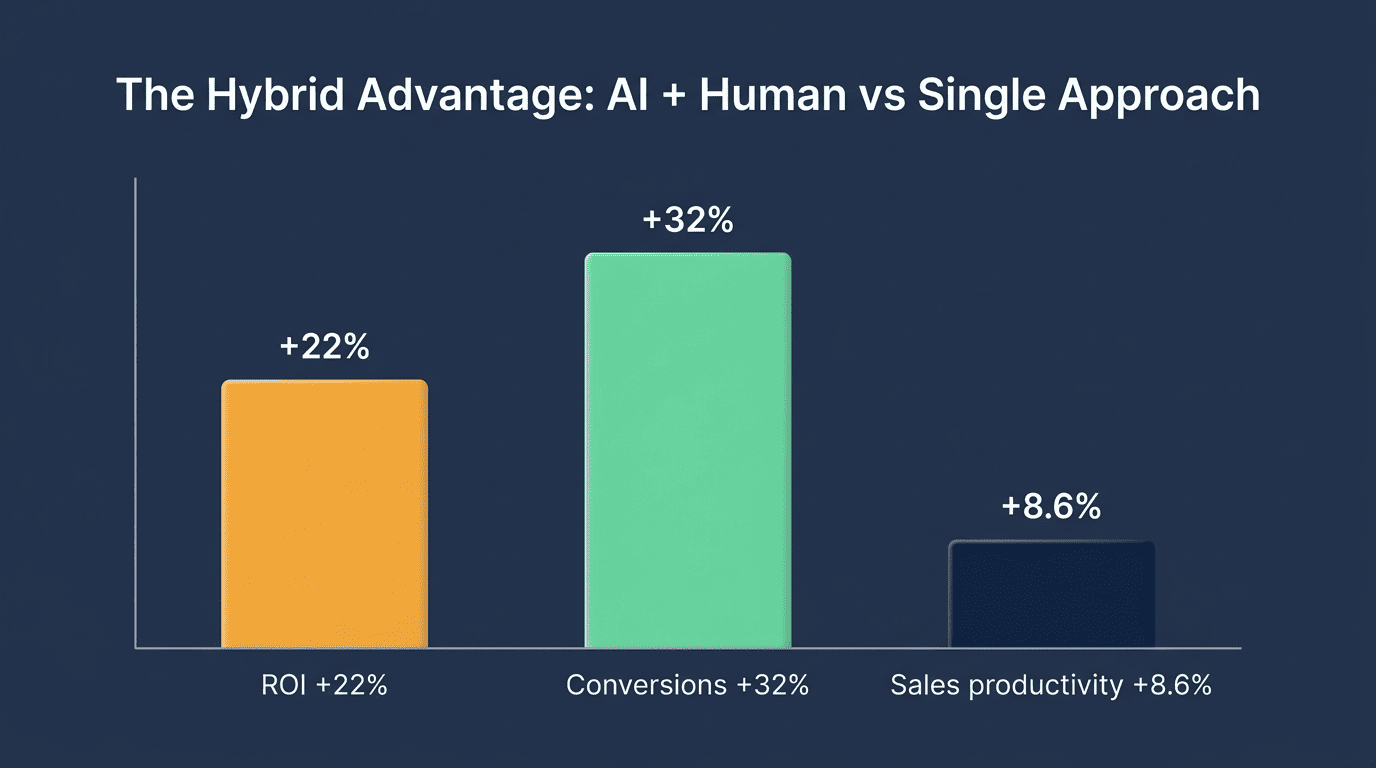
Neither side won outright. Brands that structure their teams around a clear AI + human split report meaningfully stronger performance than campaigns run entirely by AI or entirely by people — some industry analyses put the gap as high as 22% more ROI and 32% more conversions, though exact multipliers vary by study. Duke University’s CMO Survey, which tracks AI’s measurable impact on marketing performance twice a year, found a more conservative but still real number: an 8.6% increase in sales productivity attributable to AI adoption in early 2025. That gap is the reason “AI vs humans” is the wrong framing — the real question is where to draw the line between the two.

This article breaks down exactly what each side does better, what happens when marketers try to skip the divide entirely, and how a layered division of labor turns the rivalry into a working system.
What AI Marketing Tools Do Best
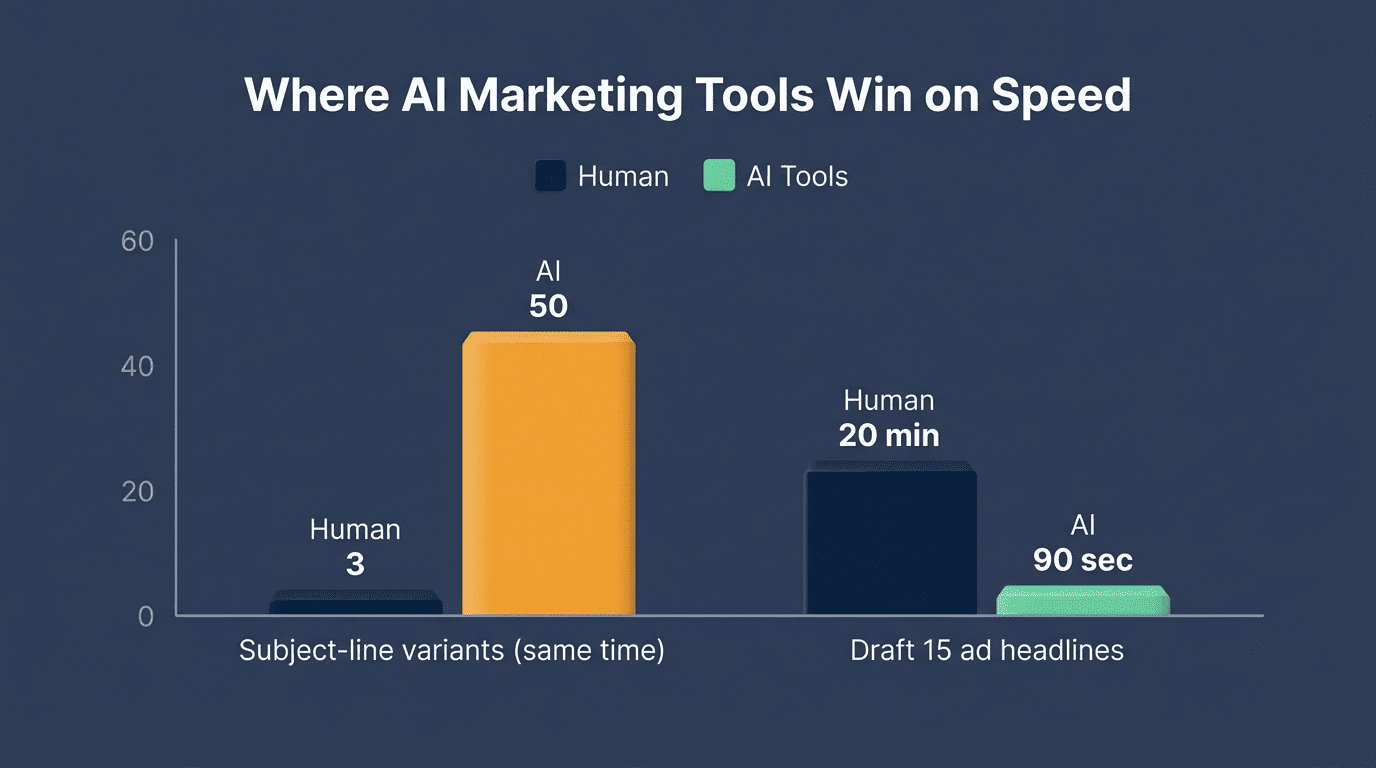
AI-powered marketing tools are built for volume and consistency, not for original thinking. Give an AI model a brief and it will produce fifty subject-line variants while a human writer is still drafting the third one. That gap compounds across every repetitive task in a marketing calendar — headline testing, audience segmentation, bid adjustments — and it’s why generative AI for marketing has spread fastest in the parts of the funnel that reward speed over nuance.
Speed and scale
A task that used to take a copywriter twenty minutes — drafting fifteen headline options for an A/B test — now takes an AI marketing tool about ninety seconds. That difference shows up at the publishing level too: brands that lean on AI marketing software for content production ship four to five times more content than teams working without it. Speed alone doesn’t guarantee quality, but it removes the bottleneck that used to cap how much a small team could test in a month.
Data analysis and pattern recognition
Marketing automation platforms process volumes of behavioral data no human analyst could review manually, and they surface patterns a person would miss simply because of scale. Teams that adopt predictive analytics for targeting and timing consistently report meaningfully higher ROI than teams that don’t, with some industry benchmarks putting the gap at roughly 2-3x. A few systems marketers rely on for this today:
- Klaviyo’s predictive CLV models, which score every contact’s expected lifetime value from purchase and engagement history.
- GA4’s predictive audiences, which flag visitors likely to convert or churn before either happens.
- Meta’s pixel-based signal processing, which feeds real-time conversion data back into ad delivery.
Bid optimization and automation
Meta Advantage+ and Google Performance Max run on machine-learning bidding systems that adjust in real time across thousands of auction signals per second — something no human trader could replicate manually. On accounts spending more than $20,000 a month with clean conversion tracking, automated bidding built into these platforms typically outperforms manual bid management — though the advantage isn’t universal: independent incrementality testing has found cases where automation underperforms a well-run manual setup once signal data gets messy or creative variety is thin. That’s a big part of why AI marketing tools now power a large share of paid-media spend on both platforms.
Personalization at scale
A large majority of marketers — well over 80% in recent industry surveys — say AI has measurably improved their personalization efforts, largely because AI-powered marketing tools can tailor messaging to segments of one rather than broad demographic buckets. McKinsey’s research on AI-driven personalization puts the typical revenue lift at 10-15%, with company-specific results ranging as high as 25% depending on sector and execution.
| AI marketing task | Typical human baseline | AI-tool result |
|---|---|---|
| Email subject line variants | 3 in 20 minutes | 50 in under a minute |
| Ad headline testing | 15 headlines / 20 min | 15 headlines / ~90 sec |
| Bid optimization ($20K+/mo accounts) | Manual adjustments, hours/week | Continuous, real-time |
| Personalized segments | Broad demographic groups | Individual-level targeting |
What Human Marketers Still Do Better
Coming up with the first 10% of an idea. AI is a strong iterator — it can take a rough creative brief and produce dozens of variations fast. What it struggles with is the original premise: the campaign angle nobody has tried, the brand story that only makes sense because of a company’s specific history. That first spark still comes from human marketers, and every AI-generated variant downstream depends on it being right.
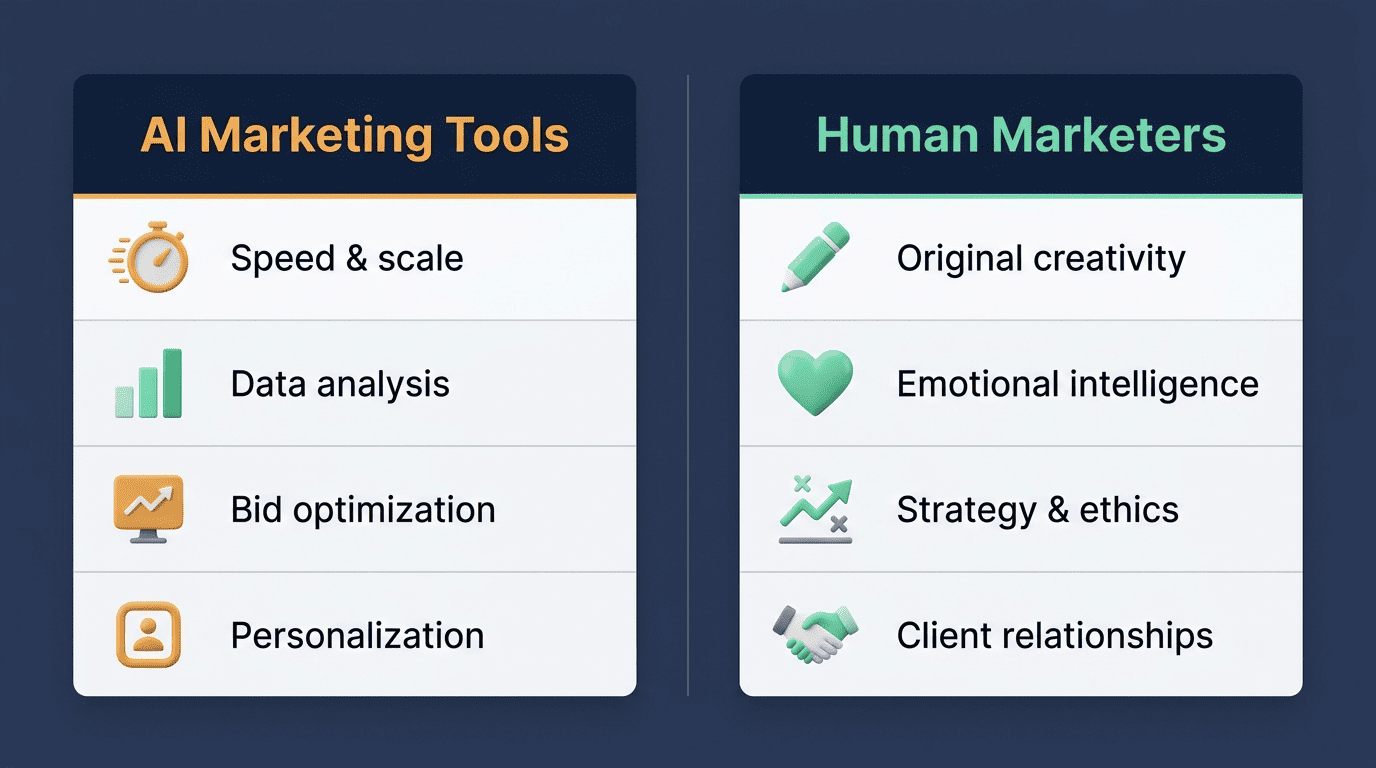
Reading emotion, not just detecting it. AI sentiment tools can flag that a piece of copy sounds negative or a customer review sounds frustrated, but they don’t feel the sarcasm, the cultural context, or the timing risk in a joke that lands differently across markets. Human marketing teams catch the tone problems that a model scores as technically fine but that a real audience would read as tone-deaf.
Owning strategy, ethics, and brand control. Somewhere between 40% and 60% of AI-generated marketing content needs meaningful human editing before it ships — for accuracy, brand voice, or legal exposure. That editing isn’t optional overhead; a single legal or ethical misstep in published content can cost a brand more than a full year of AI-driven productivity gains, in both direct penalties and reputational damage.
Being accountable when something goes wrong. Someone has to own the outcome of a campaign, sign off on a client relationship, and take responsibility when a launch underperforms. AI tools don’t carry accountability, and the client-facing trust that keeps retainers renewed is still built by people, not software.
Generative AI can give marketers the power to generate massive sets of content that consistently speak in a brand voice and engages customers.Forrester
Will AI Replace Human Marketers?
The framing of “AI replacing marketers” misses what’s actually happening inside marketing teams. Forrester’s own research is explicit: generative AI is meant to augment marketers’ work — automating repetitive tasks and expanding creative capacity — not replace the people doing it. The more accurate version of the risk, as several 2026 industry surveys put it, isn’t that AI takes marketing jobs — it’s that marketers who use AI well replace marketers who don’t.
The real shift: augmentation, not replacement
Adoption data backs this up. Roughly 88% of marketers now use AI tools daily, up from about half two years earlier. That’s not a sign of headcount reduction — it’s a sign that AI has become a standard part of the workflow, the way spreadsheets or CRM software did in earlier decades. Teams aren’t being replaced by AI marketing agents; they’re being expected to operate one.
The skills gap is the bottleneck
58% of marketers cite the skills gap, not the technology itself, as their biggest AI challenge. That matters because the tools are broadly available — what separates high performers is whether the team actually knows how to prompt, edit, and QA AI output. Marketing organizations that invest specifically in AI training report meaningfully higher project success rates than those that hand out tool access without structured onboarding — some industry surveys put the gap at over 40%. The gap usually shows up in three specific skills:
- Prompt structuring — writing briefs specific enough that AI output needs light, not heavy, editing.
- Output QA — catching factual, brand-voice, or compliance errors before content ships.
- Tool selection — knowing which platform fits a given task instead of defaulting to one generalist tool for everything.
The Hybrid Model: Why AI + Human Wins
A layered division of labor
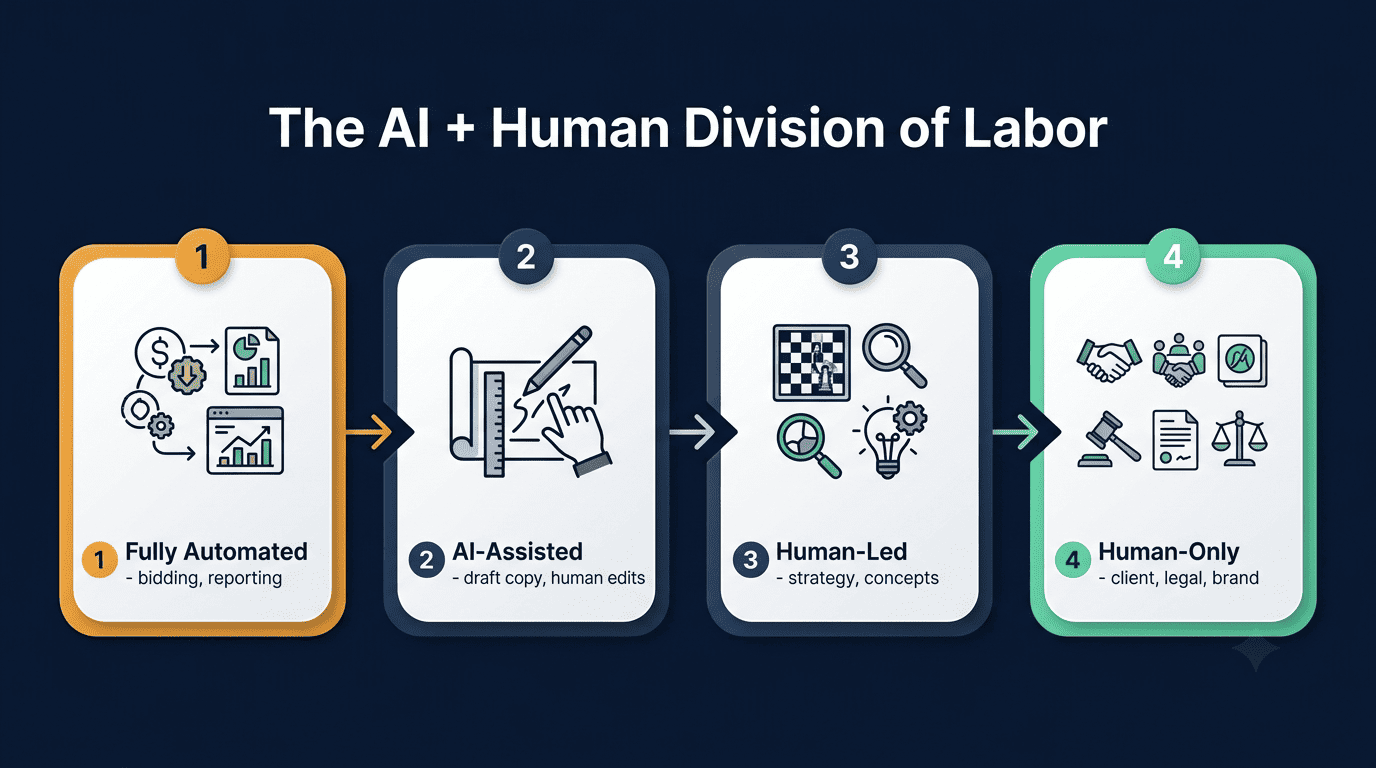
The clearest way to think about AI marketing tools vs human marketers isn’t a competition — it’s a stack with four layers:
- Fully automated — bidding, reporting, and audience segmentation run without daily human input.
- AI-assisted — first-draft copy, headline variants, and creative testing generated by AI, then edited by a human.
- Human-led — campaign strategy and creative concepts are set by people, with AI used to execute and test.
- Human-only — client relationships, legal and compliance review, and final brand sign-off never touch AI directly.
Assigning every task to one of these four layers, rather than deciding case by case, is what keeps a hybrid AI + human approach consistent as a team scales.
What the numbers say
The data on hybrid performance points the same direction across multiple sources, though the size of the gap varies by study. Some industry analyses put the gap at roughly 22% more ROI and 32% more conversions for teams that split work between AI and humans versus campaigns run purely by AI or purely by human teams. Separately, marketers who apply AI strategically — rather than piecemeal — report productivity gains cited around 44% and ROI improvements of 20-30% in vendor and industry surveys. Duke University’s CMO Survey, which polled 281 senior marketing executives in early 2025, found a more conservative but still meaningful figure: an 8.6% increase in sales productivity attributable to AI adoption, up from 5.1% a year earlier. Channel-level results diverge, too — one 2026 industry analysis found that for organic SEO, AI-assisted human teams still outperform, while for paid ads, a genuine AI + human hybrid wins outright.
AI Tools vs In-House vs Agency: The Cost Picture
Choosing your stack
Budget is often the deciding factor in how a company structures its AI marketing tools vs human marketers split, and the cost spread between models is wide.
| Model | Typical monthly cost |
|---|---|
| AI tools only | $500 – $2,000 |
| In-house team + AI tools | $8,000 – $20,000 |
| Agency + AI tools | $3,500 – $10,000 |
| Hybrid (lean team + AI + contractors) | $2,000 – $5,000 |
The AI-only tier is the cheapest, but it isn’t a substitute for expertise — it still requires someone who understands paid media well enough to set the right targeting parameters and catch when automated bidding drifts off-strategy. For context on how far AI has compressed the cost of insight: a brand running a mid-five-figure monthly Meta ads budget today gets audience intelligence that would have required a substantially larger research and media-buying budget just a few years ago, when comparable competitive and audience data came from licensed syndicated research rather than built-in ad-platform tooling. Smaller teams weighing this tradeoff can compare tool options in more detail in our guide to AI marketing tools for small business, and teams focused on organic output should see our breakdown of AI tools for content marketing.
Real-World Examples of AI + Human Marketing
Some of the best-known campaigns of the last few years are hybrid by design, not by accident.
- Netflix’s recommendation engine runs on AI models trained on viewing behavior, but the content licensing and original-title decisions behind what’s available to recommend are made by human executives.
- Coca-Cola’s “Share a Coke” used AI-driven data analysis to identify the most popular names to print, while the bottle design and campaign creative were built by human designers.
- Heinz’s AI Ketchup campaign generated 1.15 billion impressions and a 38% engagement lift after AI-generated concept art was refined and directed by the brand’s creative team.
- Coca-Cola’s “Create Real Magic” let users generate AI artwork with brand assets and drew more than 120,000 creations in its first month — a scale of participation a purely human campaign couldn’t have handled.
- Sephora’s Virtual Artist uses AI-powered augmented reality for try-on recommendations, layered on top of a beauty advisory program still staffed and trained by people.
What’s Next: GEO and Machine Customers
Marketing to machines
Generative Engine Optimization (GEO) is the emerging discipline of structuring content so AI systems — not just search engines — can extract and cite it accurately. It matters because search behavior is already shifting: an estimated 68% of US Google searches now end without a click, up from roughly 60% just two years earlier, and organic search volume has dropped in categories most affected by ChatGPT and AI Overview adoption. Harvard Business Review has described the next phase of this shift as the rise of “machine customers” — AI agents that research, compare, and even purchase on a person’s behalf. If that trend continues, marketing teams will need to adapt on a few fronts at once:
- EEAT signals — clear authorship, sourcing, and expertise markers that both search engines and AI models weigh when deciding what to cite.
- Structured, machine-readable content — data and claims formatted so an AI model can extract them accurately, not just a human reader.
- Direct-answer framing — leading sections with the answer itself, since a chatbot summary may be the only place a brand’s information ever appears to the end user.
Frequently Asked Questions
Will AI replace human marketers?
No. Forrester’s research frames generative AI as a tool to augment marketers, not replace them. The real risk isn’t AI taking marketing jobs — it’s marketers who use AI well replacing those who don’t.
What can AI marketing tools do better than humans?
Speed, scale, data analysis, bid optimization, and personalization. AI can generate 50 subject-line variants while a person writes three, and automated bidding typically wins on accounts spending over $20,000 a month.
What can human marketers do that AI can’t?
Original creative concepts, emotional intelligence, strategy under incomplete data, ethical and legal judgment, brand control, and client relationships.
Is a hybrid AI + human marketing approach really better?
Yes. Hybrid teams consistently outperform campaigns run purely by AI or purely by human marketers — some industry analyses put the gap as high as 22% more ROI and 32% more conversions, while Duke’s CMO Survey independently found an 8.6% lift in sales productivity from AI adoption.
How much of marketing is done by AI in 2026?
Around 88% of marketers now use AI tools daily, up from about half two years earlier — though humans still lead strategy, creative concepts, and client relationships.
How much do AI marketing tools cost?
AI-only stacks run about $500-$2,000 a month, agency-plus-AI runs $3,500-$10,000, and a full in-house team with AI tools runs $8,000-$20,000 a month.