
AI Tools for Content Marketing: The 2026 Stack That Actually Ships Content
Content teams no longer choose between speed and quality — the right AI tools for marketing now handle drafting, SEO, images, and video inside one workflow. More than 60% of marketers already use AI in their daily work, and a Forrester Total Economic Impact study of Jasper customers found up to 342% ROI over three years (payback in under six months), alongside a 60–80% cut in production time.

This guide breaks the market down by the job each tool actually does — writing, SEO, visuals, video, ad copy, and workflow glue — with current pricing and the case studies behind the numbers, so you can build a stack instead of collecting subscriptions.
What AI Content Marketing Tools Actually Do
AI content marketing tools are a category of generative AI software: applications built on large language models that draft, optimize, or automate marketing content instead of a human doing every step manually. According to Microsoft’s 2024 Work Trend Index, three out of four knowledge workers already use AI on the job, and 93% of self-described power users say it helps them focus on their most important work.
From single-task helpers to full content engines
AI tools evolved from narrow helpers — a grammar checker here, an idea generator there — into platforms that cover the whole production cycle: brief, draft, SEO pass, visual, and distribution. The engine underneath is almost always a general-purpose LLM such as ChatGPT or Claude, with purpose-built products like Jasper layered on top for brand-specific workflows.
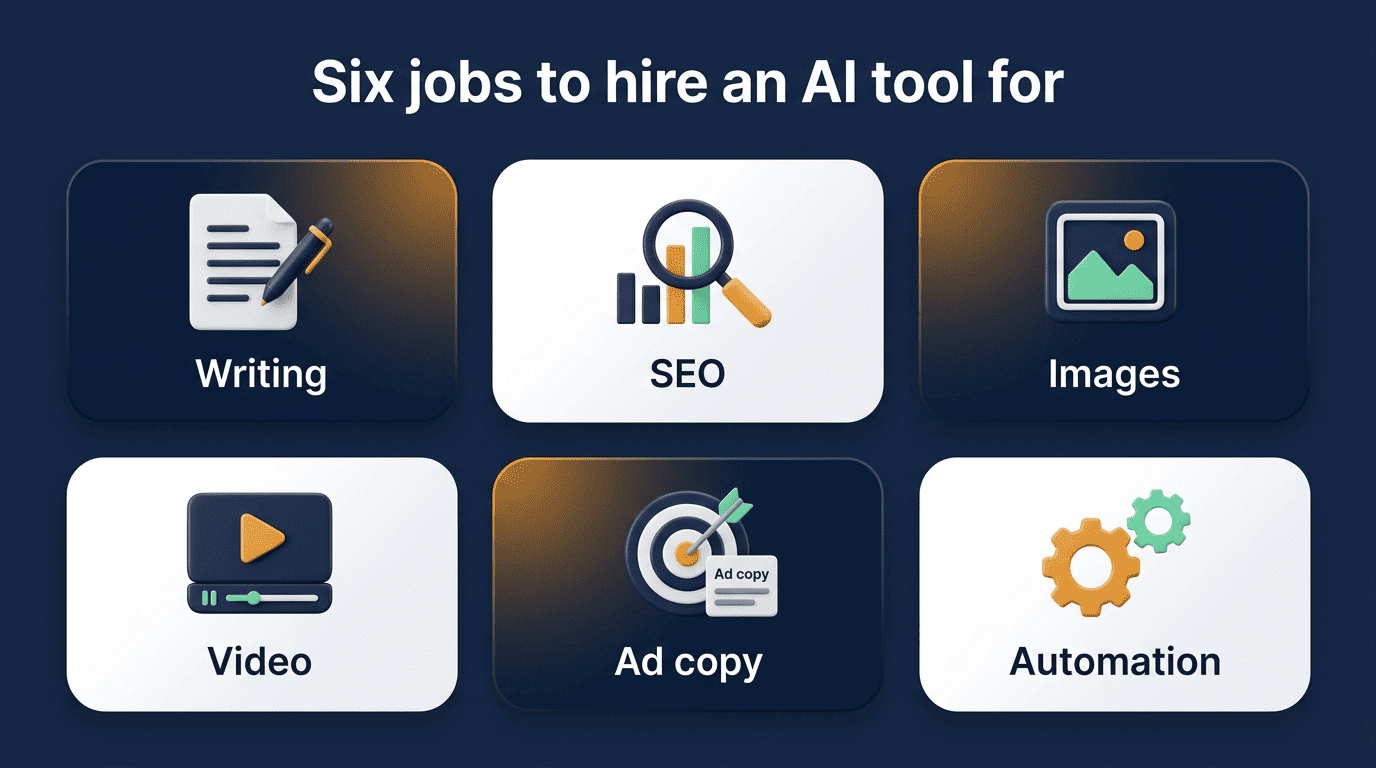
The six jobs to hire an AI tool for
Most content marketing stacks in 2026 map to six distinct jobs, and buying one tool per job beats buying one tool that claims to do all six:
- Long-form writing and drafting
- SEO content optimization
- Image generation
- Video and AI avatars
- Ad copy and predictive scoring
- Editing, grammar, and workflow automation
The sections below cover the strongest option in each category, with pricing and evidence.
Best AI Tools for Writing and Long-Form Content
Long-form drafting is where AI adoption is deepest — every competitor in this space leads with a writing tool, and pricing spans from free to enterprise. The table below compares the main options before the detail.
| Tool | Starting price | Strongest use case |
|---|---|---|
| Jasper | $59–69/mo per seat | On-brand long-form at volume |
| Copy.ai | Free – $49/mo | Sales + marketing GTM copy |
| Writer | Custom/enterprise | Brand governance at scale |
| ChatGPT | $8 (Go) – $20 (Plus)/mo | General-purpose drafting |
| Claude | ~$200/year (Pro) | Long-context, nuanced writing |
| Koala AI | $9/mo | Budget SEO blog drafts |
Jasper — on-brand long-form at scale
Jasper is built for teams that need volume without losing a consistent brand voice. It runs $59–69 per seat per month (annual vs. monthly billing) and holds a 4.7/5 rating on G2 across more than 1,270 reviews. Adidas used Jasper to test 150 shoe models and generated up to 7,500 product descriptions and press releases in 24 hours; Anthropologie and Wayfair are cited among the retailers running SEO and content programs on the same platform.
Copy.ai and Writer — GTM copy and enterprise governance
Copy.ai targets go-to-market teams, not just content departments. It bridges sales and marketing copywriting, runs from a free tier (2,000 words/month, no credit card) up to around $49/month on its Pro tier, and counts more than 17 million registered users. Writer sits at the other end of the market: an enterprise platform built around its own Palmyra models and SOC 2 compliance, aimed at organizations that need hard guardrails on brand language.
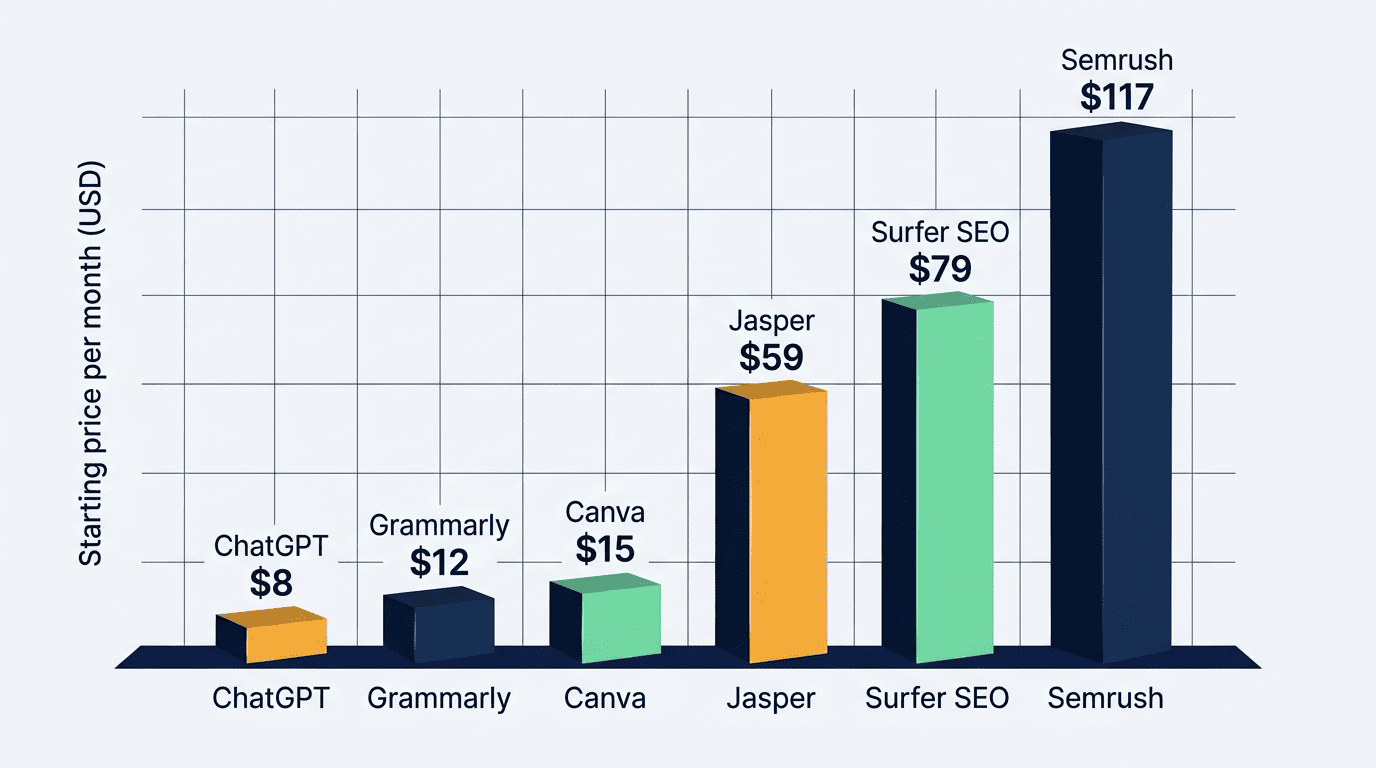
ChatGPT and Claude remain the default drafting layer underneath both. ChatGPT ($8 Go / $20 Plus per month) and Claude (roughly $200/year on the Pro plan) are the general-purpose LLMs marketers reach for when they need a custom prompt rather than a pre-built workflow — often feeding drafts into Jasper or Copy.ai for brand-voice polishing afterward.
Best AI SEO Content Tools
SEO-specific AI tools skip the generic “write me a blog post” prompt and instead pull live SERP data before drafting a single sentence.
Surfer SEO, Frase and Clearscope — briefs that rank
Surfer SEO ($79/month) builds data-driven content briefs and scores drafts against a live content score as you write. Frase, rated 4.8 stars on G2 from 300+ reviews, scans the ranking SERP and assembles an outline in about 30 seconds. Clearscope focuses on terminology coverage — matching the vocabulary top-ranking pages use, which supports the E-E-A-T signals Google evaluates. Semrush markets its ContentShake tool as roughly 12x faster than manual writing — illustrating how far draft-speed has moved even inside SEO-focused tools.
GEO: optimizing for AI answers, not just Google
AI Overviews and answer engines like ChatGPT and Perplexity have added a new layer on top of classic SEO: Generative Engine Optimization, or GEO — writing and structuring content so it gets cited inside AI-generated answers, not just ranked on a results page. Google’s own Search Central documentation on helpful, people-first content is explicit that content written primarily to game an algorithm, AI or otherwise, is the thing to avoid — GEO works best as an extension of that principle, not a replacement for it.
In practice, GEO overlaps heavily with the SEO fundamentals teams already run:
- Clear, direct answers near the top of a section, not buried under throat-clearing
- Original data, quotes, or case studies an AI model can’t easily paraphrase from a competitor
- Structured formatting (tables, lists, headers) that both crawlers and answer engines can parse
- Consistent terminology that matches how the target query is actually phrased
Best AI Tools for Images and Video
Visual production used to require a design team or a video editor on staff; AI tools have pushed a meaningful share of that work back to the marketer.
Image generation for social and blog visuals
Midjourney, DALL-E 3, and Adobe Firefly — which Adobe markets as commercially safe for enterprise use because it’s trained on licensed and public-domain content — cover most blog and social image needs without a dedicated designer. Canva AI adds the template layer on top: Canva Pro runs $15/month (about $10/month billed annually) for access to more than 1.6 million templates, which is why it shows up in nearly every stack of AI marketing tools regardless of company size.
| Tool | Starting price | Best for |
|---|---|---|
| Canva AI | $10–15/mo | Templated social and blog graphics |
| Synthesia | $29/mo | Talking-head video from a script |
| Runway | $12/seat (625 credits) | Generative video and editing |
| Descript | $16/seat | Transcript-based editing + voice cloning |
Video and avatars without a studio
Video production used to be the category that most needed a specialized hire, and it’s the one AI has changed the most. Synthesia turns a script into a talking-head video using its library of more than 230 AI avatars (higher-tier plans unlock the full set), with plans starting at $29/month and no camera or studio required. Runway ($12 per seat for 625 credits) handles generative video and editing tasks that used to need a motion designer, and Descript ($16 per seat) treats video editing like editing a document — cut a sentence in the transcript and the clip cuts too — and can clone a presenter’s voice for corrections without a reshoot.
We are at the beginning of one of the most consequential platform shifts that will change the entire tech stack as agents proliferate and become the dominant workload.Satya Nadella, CEO, Microsoft
That framing, made at the outset of the current AI product cycle, is exactly what played out across content production: a task that took a studio and a crew now takes a script and a subscription.
Best AI Tools for Ad Copy and Optimization
Ad copy is the one category where AI tools compete on measurable prediction accuracy, not just generation speed.
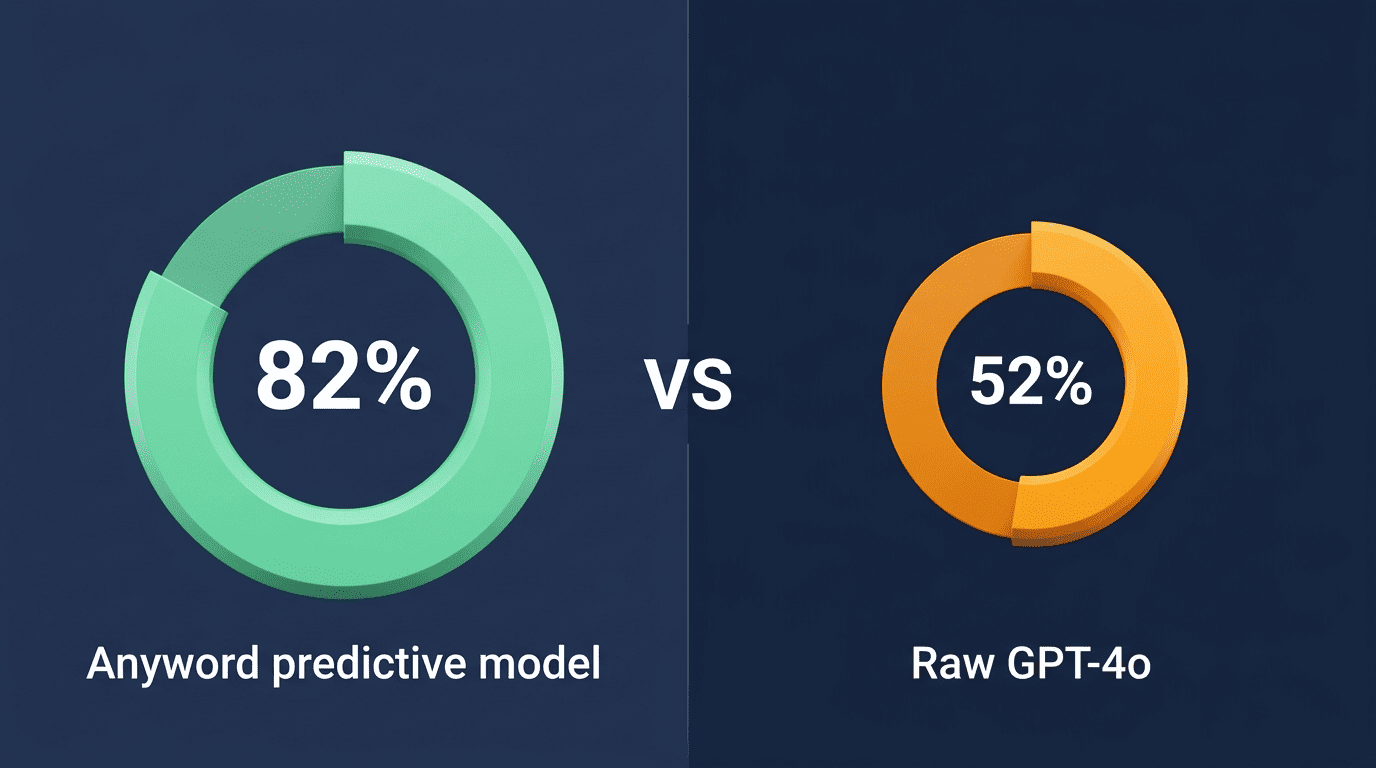
Predictive copy that scores before you spend
Anyword scores ad copy before it ever runs. Its predictive performance model claims 82% accuracy forecasting how copy will convert, compared to 52% for raw output from GPT-4o on the same task — a meaningful gap for teams spending real media budget on the variant they pick. Persado and Phrasee take a similar predictive approach but focus on enterprise-scale campaigns, generating and testing language variants tuned specifically for conversion rather than general readability.
AI Editing, Grammar and Workflow Automation
Even a strong draft needs a quality gate and a way to move between tools without manual copy-paste — this is where the stack’s plumbing lives.
Grammarly — the final quality gate
Grammarly ($12/month, more than 40 million users) is the last check before publishing: grammar, tone consistency, and clarity across whatever tool produced the draft, whether that’s Jasper, ChatGPT, or a human writer.
Zapier and HubSpot — glue the stack together
Zapier connects more than 9,000 marketing and business apps and holds SOC 2 Type II certification, which is what lets a brief move automatically from Frase into Jasper and then into a CMS without a person dragging files between tabs. HubSpot’s Breeze AI takes a different approach, building generation directly into the CRM and CMS so content and customer data stay in the same system instead of requiring a connector at all.
Common automations marketing teams wire up with Zapier include:
- Pushing a finished Jasper or Copy.ai draft straight into a CMS as a scheduled post
- Routing a Frase or Surfer SEO brief to the right writer automatically
- Logging every AI-generated asset into a shared content calendar
- Alerting an editor in Slack when a draft is ready for the human review pass
How to Choose the Right AI Content Stack
Picking tools by category, not by hype, is the difference between a stack that ships content and a graveyard of unused subscriptions.

Match the tool to the job, not the hype
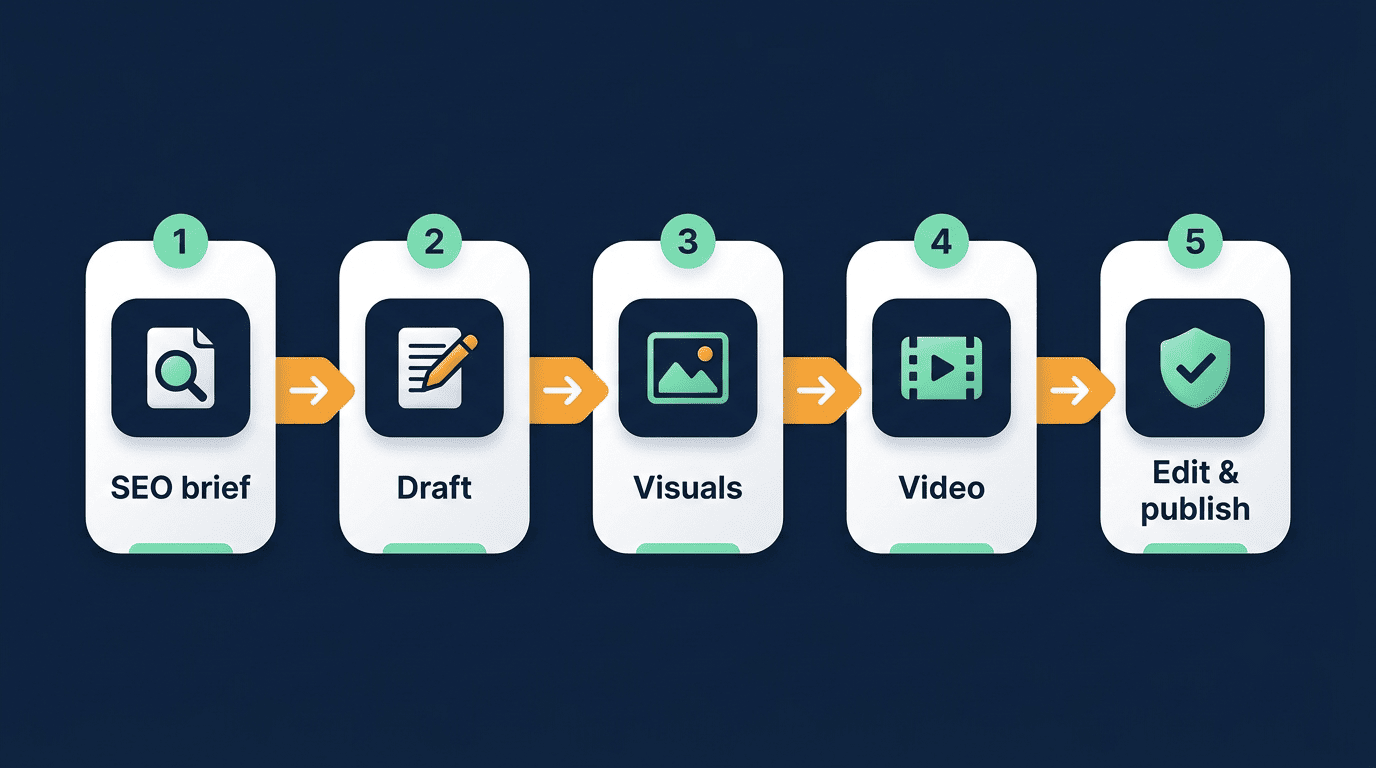
The fastest way to waste a content budget is signing up for 30 tools that each claim to do everything. A cleaner approach: pick one tool per job — writing, SEO, images, video, ad copy, automation — sized to actual volume and budget. Weigh four criteria for each pick:
- Does it integrate with the CMS and tools already in use?
- Can it hold a consistent brand voice across writers?
- What’s the real cost per seat at the team’s headcount?
- Does the vendor carry SOC 2 or equivalent data-security certification?
Cushman & Wakefield’s marketing team reported saving more than 10,000 hours a year after consolidating around an AI content stack, and the Forrester study of Jasper customers found up to 342% ROI over three years against a 60–80% cut in production time. A practical way to get there is to build the stack in order, one job at a time:
- Audit current output — how much content, in which formats, ships each month
- Pick one SEO tool (Surfer SEO or Frase) to standardize briefs before any drafting starts
- Pick one writing tool (Jasper, Copy.ai, or ChatGPT) matched to volume and brand-voice needs
- Add a visual tool (Canva, Synthesia) only for the formats actually in the content calendar
- Wire the handoffs together with Zapier or a native CMS integration
- Put Grammarly or an equivalent editing pass before anything publishes
- Review output monthly against the ROI and time-savings baseline set in step one
Keep a human in the loop
AI speeds up production; it doesn’t replace judgment. Fact-checking, E-E-A-T review, brand strategy, and original insight still need a human pass before publishing. Google’s guidance rewards people-first content, so unedited AI output — however fast it was to generate — carries both a quality risk and a ranking risk if it ships without review. The strongest stacks pair the best AI marketing tools for drafting speed with an editor who has final say.
Related AI marketing guides
Building a full stack? Explore AI SEO tools for marketing and AI social media marketing tools to round out your marketing workflow.
Frequently Asked Questions
What are the best AI tools for content marketing?
It depends on the job: Jasper, Copy.ai, and ChatGPT lead for writing; Surfer SEO and Frase for SEO optimization; Canva and Midjourney for images; Synthesia and Descript for video; Anyword for ad copy; and Zapier for tying the stack together.
How is AI used in content marketing?
AI drafts long-form content, builds SEO briefs from live SERP data, generates images and video, scores ad copy before it runs, checks grammar and tone, and automates handoffs between tools — typically cutting production time by 60-80%.
Can AI replace content marketers?
No. AI speeds up drafting and production, but strategy, original insight, fact-checking, and E-E-A-T review still require a human editor. The strongest results come from a human-in-the-loop workflow, not full automation.
What is the best free AI content marketing tool?
ChatGPT’s free tier and Copy.ai’s free plan are the most capable no-cost starting points for drafting. Canva AI and Grammarly also offer free tiers for visuals and editing.
How much do AI content marketing tools cost?
Pricing ranges widely: ChatGPT Go is $8/month, Grammarly and Canva are around $12/month, Jasper runs $59-69/month, Surfer SEO is $79/month, and Semrush’s AI tools start at $117+/month. Most offer a free or trial tier.
How do I use AI to create marketing content?
A typical pipeline: build a brief in an SEO tool like Surfer or Frase, draft in a writer like Jasper or ChatGPT, generate visuals in Canva, produce video in Synthesia, run everything through Grammarly, then have a human fact-check and publish.