
AI Tools for Marketing Analytics: The Best Platforms to Turn Data Into Decisions in 2026
AI tools for marketing analytics connect your channels, surface the metrics that matter, and let you ask plain-language questions instead of digging through spreadsheets. They are the analytics layer of any stack of best AI marketing tools — the part that tells you what actually worked, according to Google’s own Analytics Help documentation on predictive metrics.
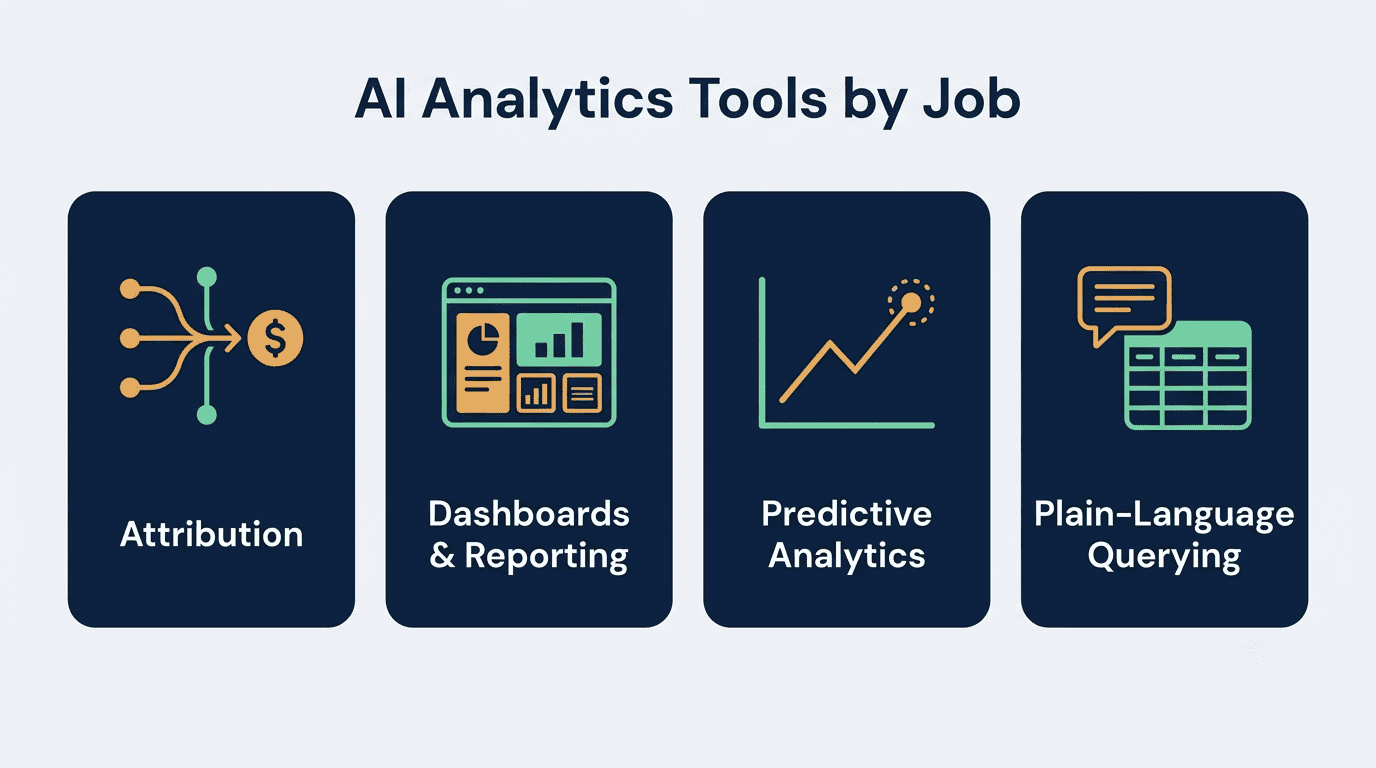
Most platforms in this category cover one of four jobs: attribution, dashboards and reporting, behavioral and predictive analytics, or natural-language querying. AI now saves marketing teams an estimated 13 hours a week on reporting, yet only 13% of marketers say they fully trust the output — so the choice is less about picking “the best” tool and more about matching the right one to your task and budget.

How AI Is Used in Marketing Analytics
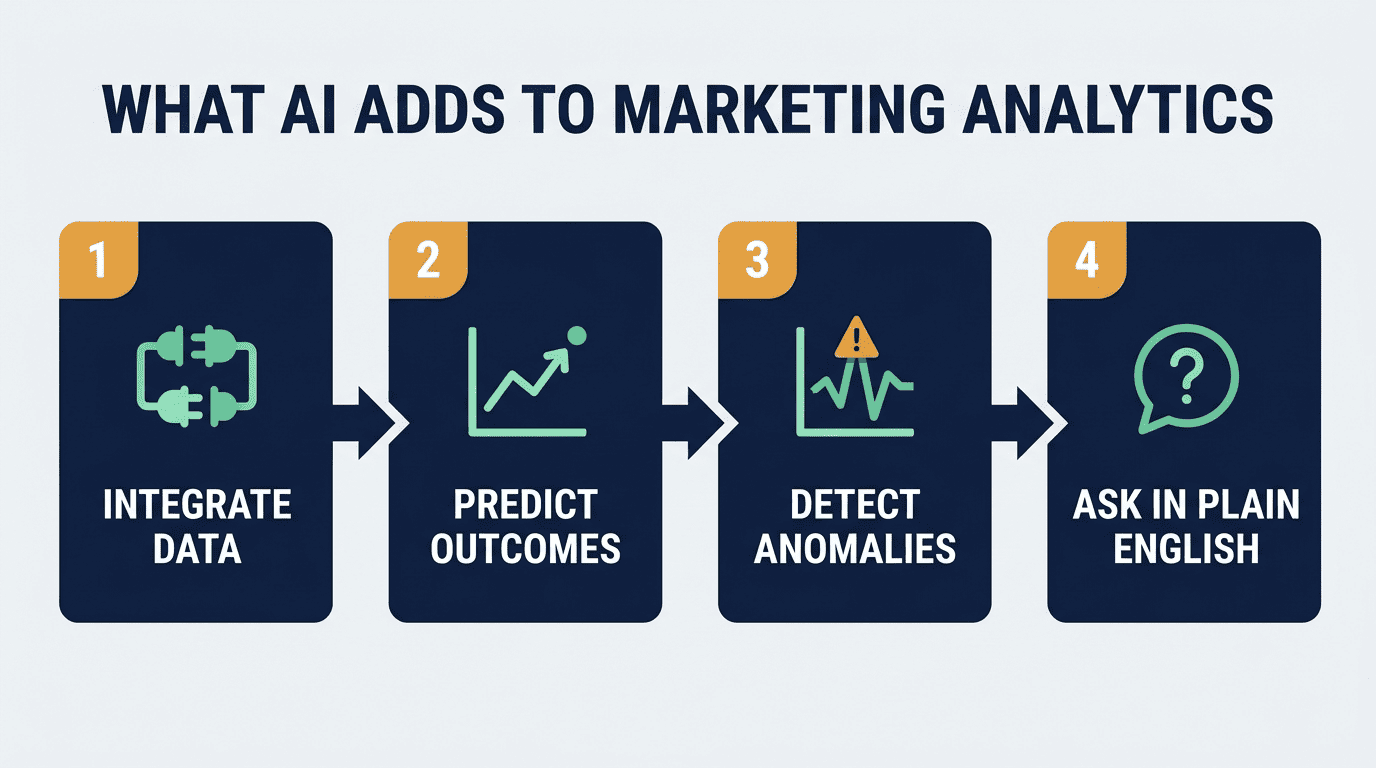
Marketing analytics used to mean pulling a dashboard, exporting a spreadsheet, and writing a SQL query to find out why a number moved. AI analytics tools compress that loop: they integrate data automatically, forecast what happens next, flag anomalies before a human notices, and answer questions typed in plain English.
From dashboards to answers
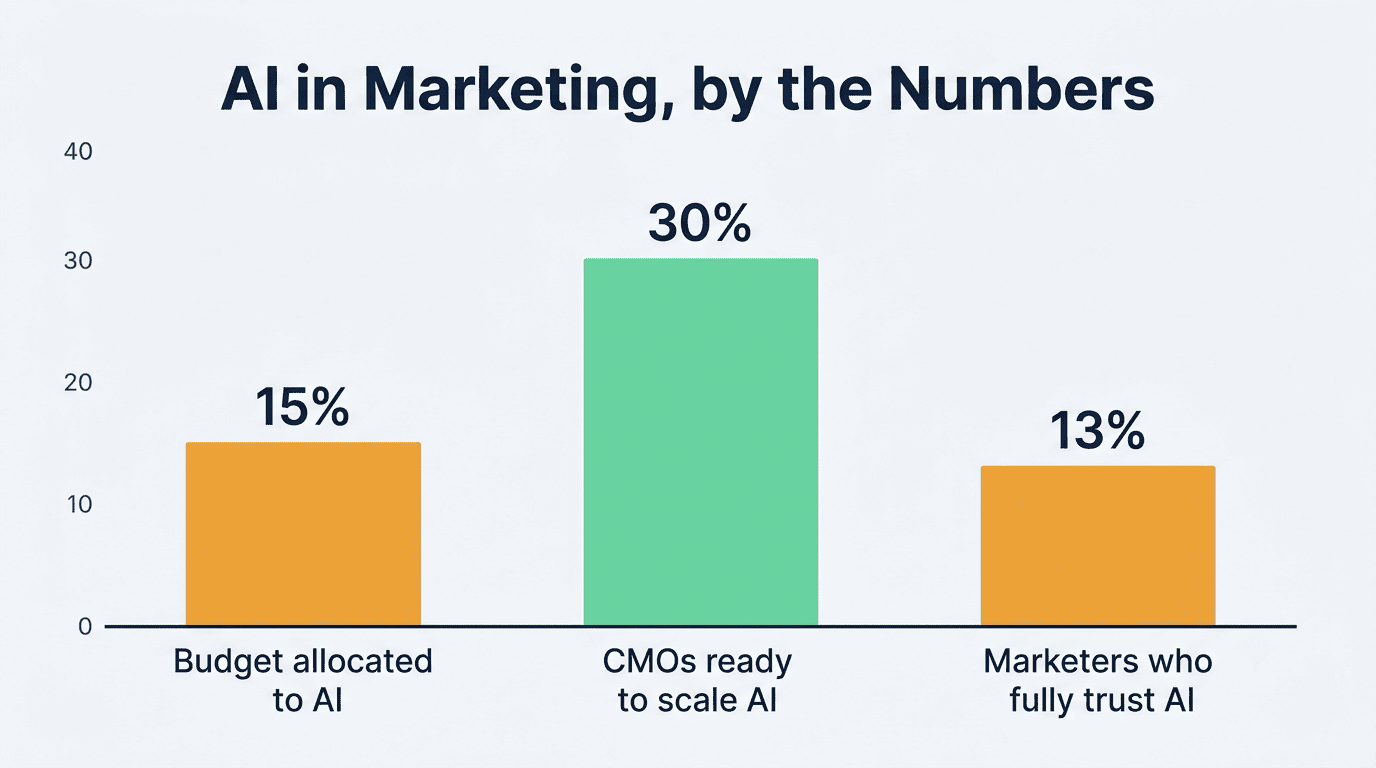
Traditional analytics is descriptive and manual — someone builds a dashboard, then someone else interprets it. AI-driven analytics is predictive and conversational: the system surfaces what changed and why, and a marketer can ask a follow-up question instead of building a new report. AI gives marketers back an estimated 13 hours a week, according to ActiveCampaign’s 2025 marketer research, yet separate industry surveys find just 13% of marketers fully trust AI-generated insights without a human review step. The honest framing is that AI does not replace judgment — it removes the manual digging that used to come before judgment.
The four things AI adds to analytics
Four capabilities separate an AI analytics tool from a plain dashboard:
- Automatic data integration across ad platforms, CRM, and site analytics, without manual exports.
- Predictive forecasting, such as churn or purchase probability scored per user.
- Real-time anomaly and root-cause detection, flagging a metric shift before a human spots it in a chart.
- Natural-language querying, letting a marketer type a question and get a chart or number back.
That shift matters because marketing budgets have stopped growing at the same pace demands for proof have. Gartner’s 2025 CMO Spend Survey found marketing budgets flatlined at 7.7% of overall company revenue, and its 2026 follow-up found CMOs now allocate 15.3% of that budget to AI — even though only 30% say they are ready to scale their AI capabilities. Flat budgets plus rising AI investment push teams toward tools that can answer “why” as fast as they can show “what.”
Best AI Tools for Marketing Attribution
Attribution is the hardest analytics job to automate well, because it requires stitching together ad platform data, CRM records, and on-site behavior into a single revenue story.
Cometly connects ad platforms, CRM, and site data to show which campaigns actually drive revenue. It uses server-side tracking combined with multi-touch attribution, so a click on one platform can be matched to a closed deal recorded in another system days later. Cometly’s published Core plan starts around $500 per month (usage-based on pageviews), with a custom-quoted Enterprise tier for larger teams.
Northbeam focuses on incrementality for ecommerce and DTC brands. Rather than just crediting the last click, it estimates how much revenue a channel would lose if it were turned off — a more useful question for a brand deciding where to cut spend. Its published Starter tier starts near $1,500 per month for brands under about $1.5 million a month in media spend, with a custom-quoted Professional tier for larger accounts (around $250,000-plus a month in ad spend).
HubSpot Marketing Analytics ties marketing activity to closed revenue for B2B companies with longer sales cycles. Because HubSpot already houses the CRM for many B2B teams, attribution here means connecting a six-month sales cycle back to the first touchpoint, not just the last ad click. HubSpot Marketing Hub Professional runs roughly $800–$890 per month.
| Tool | Best for | Attribution type | Starting price |
|---|---|---|---|
| Cometly | Paid media/B2B SaaS teams | Server-side multi-touch | From ~$500/mo |
| Northbeam | Ecommerce/DTC brands | Incrementality | From ~$1,500/mo |
| HubSpot Marketing Analytics | B2B, long sales cycles | Revenue attribution | ~$800–$890/mo |
Best AI Tools for Dashboards and Multi-Channel Reporting
Once data lives in five or ten different platforms, the job shifts from analysis to unification — pulling everything into one place before anyone can ask a useful question.
Whatagraph and Databox handle multi-channel reporting for agencies that need to hand a client a single dashboard instead of five logins. Whatagraph connects more than 60 data sources, with its Max plan starting around $699 per month (billed annually) and a custom-quoted Prime tier above that for higher connector volumes. Funnel.io and Improvado sit a level up, built for enterprise data unification, while Supermetrics stays lightweight, piping raw data into spreadsheets or a BI tool rather than replacing the dashboard itself:
- Whatagraph — 60+ connectors, agency-focused multi-channel dashboards, from ~$699/mo.
- Databox — a free plan for individual accounts (not agencies); agency reporting starts around $79/mo.
- Funnel.io — 500+ connectors, enterprise data unification, starting around $200/mo (the tier with 500+ connectors runs about $600/mo).
- Improvado — 1,000+ sources, aimed at larger marketing organizations with dedicated data teams.
- Supermetrics — 100+ connectors, lightweight pipe into sheets or BI tools, from around $39/mo.
Best AI Tools for Behavioral and Predictive Analytics
Behavioral analytics tools track what individual users do inside a product or on a site, then use that history to predict what they will do next.
Predictive metrics that come free
Google Analytics 4 is free with no published event cap for standard use (10 million events per month is the threshold where BigQuery’s free export and standard-report sampling limits start to apply) and includes machine-learning predictive audiences plus metrics like purchase probability and churn probability. Churn probability is scored on a rolling 7-day prediction window; purchase probability uses a 28-day lookback with a 7-day forward-looking prediction window. Mixpanel’s free tier covers up to 1 million events per month before its Growth plan kicks in at a metered rate, and Amplitude’s free Starter plan covers up to 2 million events with unlimited seats; Amplitude’s AI-driven Causal Insights feature, which automatically investigates why a metric moved instead of leaving a marketer to guess, becomes fully available on its paid Growth and Enterprise tiers.
Where enterprise behavioral analytics earns its price
Adobe Analytics, powered by Adobe Sensei, adds anomaly detection and contribution analysis built for large organizations, typically running around $100,000 per year. GA4 360, Google’s enterprise tier, starts near $50,000 per year and adds higher data limits and service-level guarantees on top of the free product. Heap differentiates itself with automatic event capture — it records every user interaction without requiring engineers to instrument tracking code first, which matters most for product-led companies iterating quickly on their site or app.
CMOs are being asked to deliver growth, efficiency and transformation without meaningful budget expansion. Those who succeed will make deliberate, data-driven trade-offs and treat AI as a force multiplier.Ewan McIntyre, Gartner
Best AI Tools for Natural-Language Data Querying
Natural-language querying is the newest of the four categories, and it changes who can actually use analytics day to day — not just the analyst who wrote the SQL.
Three approaches currently cover this job, each suited to a different starting point:
- Tableau (Tableau Agent, part of Tableau Einstein) — type a question like “which channel drove the most signups last month” and get a chart back without writing a query; Tableau Agent replaced the older Ask Data feature, which Tableau retired in 2024. Tableau Creator starts at $75 per user per month.
- Improvado AI Agent — a conversational, text-to-SQL interface layered on top of already-unified marketing data, aimed at teams that use Improvado for integration.
- MCP-connected chat assistants — the Model Context Protocol (MCP), an open standard maintained by Anthropic, connects governed marketing data sources directly to Claude and ChatGPT, so a marketer can ask a question inside the chat tool they already use rather than opening a separate BI platform.
How to Choose an AI Marketing Analytics Tool
Picking a tool works better as a short, ordered process than as a feature comparison, because the right answer depends on constraints most teams already know before they start shopping.
- List your data sources and check which ones each tool connects to natively.
- Pick the primary job the tool needs to do: attribution, reporting, behavioral/predictive analysis, or natural-language querying.
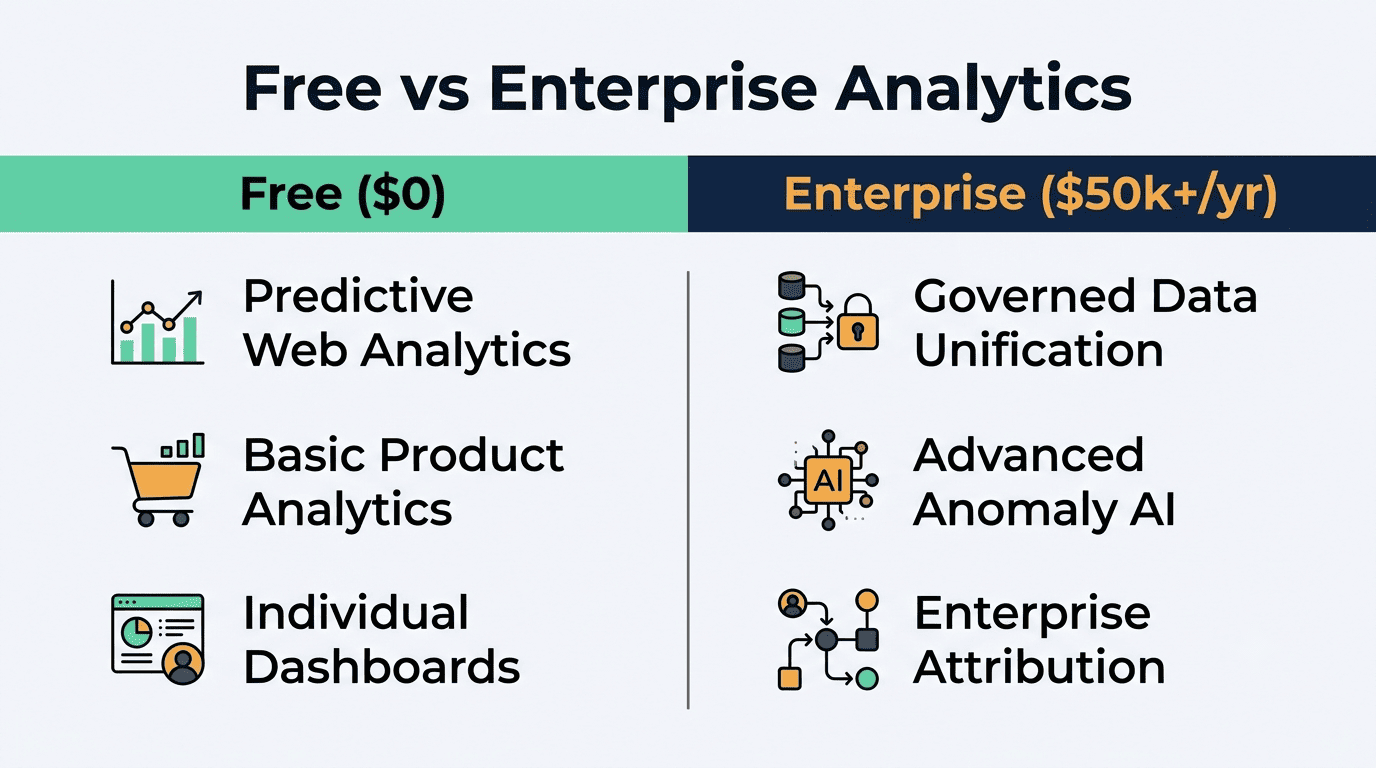
- Set a budget range — free tools like GA4 and Mixpanel’s limited free tier at one end, enterprise platforms at $50,000-plus per year at the other.
- Match the tool to team skill: analyst-heavy platforms like Tableau and Adobe reward a dedicated analyst, while marketer-friendly tools like Whatagraph and HubSpot are built for self-service.
- Keep a human in the loop before acting on any output — with only 13% of marketers fully trusting AI-generated insights, verification still matters. A navigator like our AI marketing software directory helps map the tool to the job and the budget before you commit.
Free vs Enterprise: What You Actually Pay
Budget is often the real filter, and the range across this category is wide enough that “AI marketing analytics” means something very different at $0 and at $100,000 a year.
| Tier | Tools | Typical price |
|---|---|---|
| Free | GA4, Mixpanel (to 1M events/mo), Amplitude Starter (to 2M events/mo), Databox (individual accounts) | $0 |
| Mid-market | Mixpanel Growth (metered), Supermetrics, Funnel.io Starter, Databox agency plans | $39–$600/mo |
| Enterprise | Whatagraph, Northbeam Professional, GA4 360, Adobe Analytics | $700/mo–$100,000/yr |
Most teams start on a free tier and layer in a paid attribution or data-unification tool as ad spend and data volume grow, rather than buying an enterprise platform on day one. A few signals usually mean it is time to move up a tier:
- Monthly event volume is approaching the free-tier cap (10M for GA4, 1M for Mixpanel, 2M for Amplitude).
- Ad spend has crossed roughly $10,000 a month and attribution errors are getting expensive.
- Reports are still being assembled by hand across more than three data sources.
- Stakeholders are asking questions the free tool cannot answer without an analyst’s help.
These AI marketing tools are built to scale with the data you generate, not the other way around.
Related AI marketing guides
Building a full stack? Explore AI advertising tools for marketing and AI SEO tools for marketing to round out your marketing workflow.
Frequently Asked Questions
What is the best AI tool for marketing analytics?
It depends on the job: GA4 for free predictive web analytics, Cometly for attribution, Amplitude or Mixpanel for behavioral analytics, and Whatagraph or Funnel.io for multi-channel reporting.
How is AI used in marketing analytics?
For automatic data integration across channels, predictive forecasting such as churn and purchase probability, real-time anomaly and root-cause detection, and natural-language querying of marketing data.
Can AI analyze marketing data?
Yes — AI tools connect your channels, surface patterns and anomalies automatically, forecast outcomes, and answer plain-language questions, though a human should still verify results before acting on them.
What is AI marketing analytics?
Using machine learning and natural-language AI on marketing data to predict outcomes, detect anomalies, attribute revenue, and generate insights without manual SQL queries or static dashboards.
Is GA4 an AI analytics tool?
Yes — Google Analytics 4 uses machine learning for predictive audiences and metrics like purchase and churn probability, and it is free up to 10 million events per month.
How much do AI marketing analytics tools cost?
From free (GA4, Mixpanel to 1M events/month, and Amplitude free tiers) to mid-market ($39-$600/month for Supermetrics and Funnel.io, with Mixpanel Growth metered by usage) up to enterprise (Whatagraph from about $700/month, GA4 360 around $50,000/year, and Adobe Analytics around $100,000/year).