
AI SEO Tools for Marketing: The Best Picks by Task and Budget (2026)
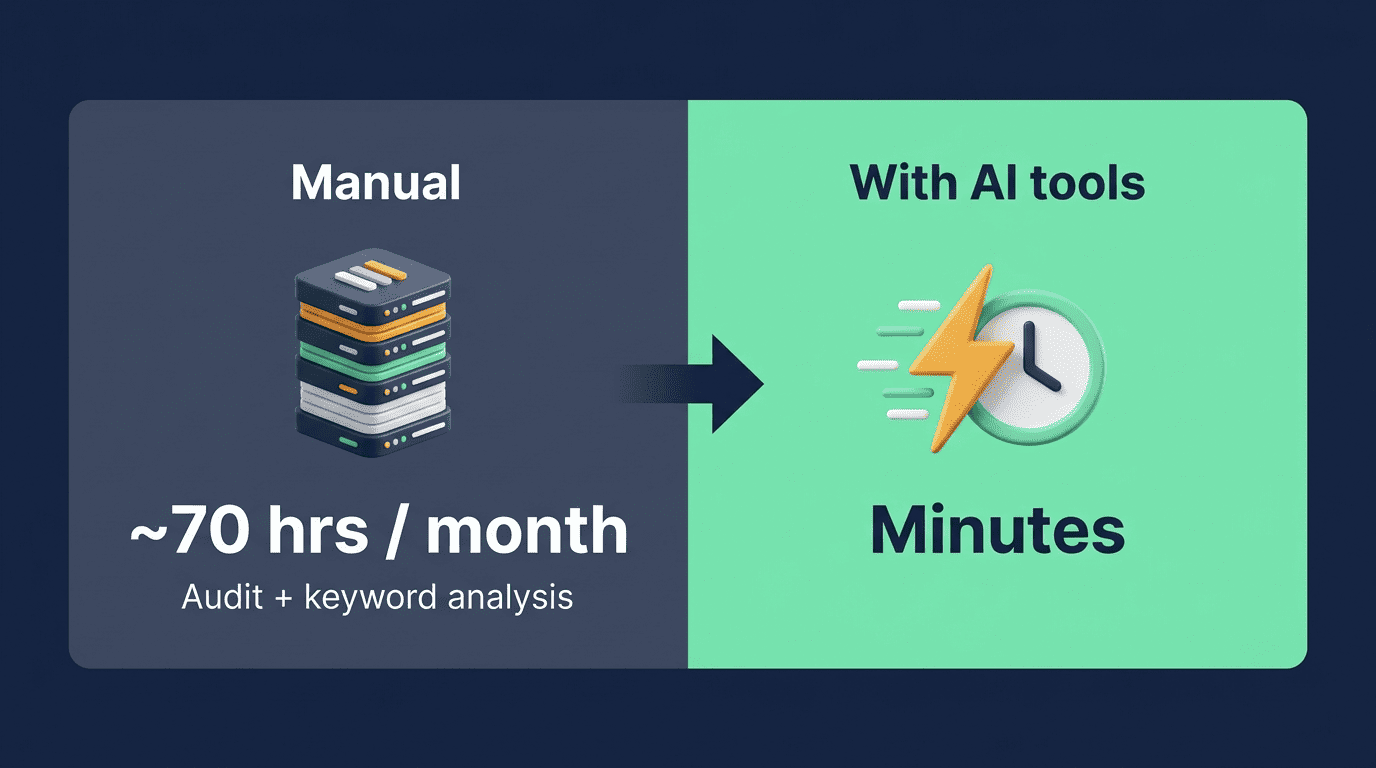
SEO work that once took days — keyword research, content briefs, technical audits — now runs in minutes with the right AI tools for marketing. That shift is already mainstream: 78% of organizations report using AI somewhere in their marketing stack, and a manual SEO audit that used to eat roughly 40 hours a month now compresses into a few AI-assisted passes.

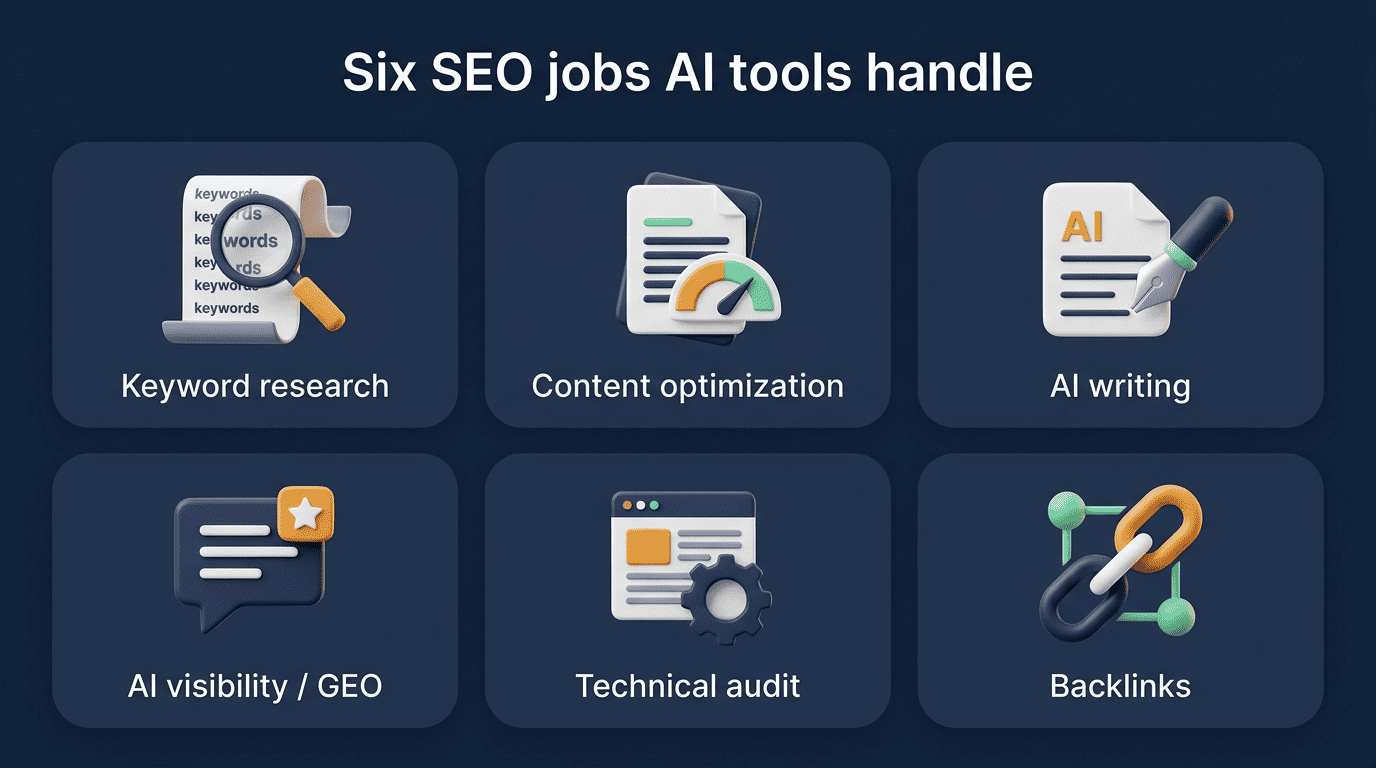
This guide breaks the market into six jobs — keyword research, content optimization, AI writing, technical audits, backlinks, and the newest layer, AI visibility and GEO — with real prices and what each tool is actually good for.
What AI SEO Tools Actually Do
From manual grind to AI automation
AI SEO tools automate work that used to take marketers hours by hand: keyword research, content briefs, crawling hundreds of pages for technical errors, and tracking rankings across markets. Manual keyword analysis alone typically runs about 30 hours a month per team, on top of the ~40 hours spent on audits. Google ships more than 500 algorithm updates a year, which is far more than any team can track manually — one reason agentic SEO platforms that monitor changes automatically have become standard rather than optional. Google is explicit that automation itself isn’t the problem; using it to game rankings is. As Google Search Central’s spam policies put it:
Using automation—including AI—to generate content with the primary purpose of manipulating ranking in search results is a violation of our spam policies.Google Search Central
That’s the line every AI SEO software vendor now designs around: automate the research and the grunt work, keep a human on strategy and review.
Six SEO jobs AI tools handle
Most AI-powered SEO tools fall into one of six buckets, and a marketing team rarely needs all six from the same vendor:
- Keyword research and clustering
- Content optimization (scoring drafts against top-ranking pages)
- AI content writing and briefs
- AI visibility / GEO — tracking brand mentions in AI answers
- Technical SEO and site audits
- Backlink analysis
The rest of this guide covers the strongest option in each category, plus pricing.
Best AI Tools for Keyword Research and Clustering
Keyword research is where most AI SEO platforms start, because clustering thousands of queries by intent is exactly the kind of pattern-matching AI does well.
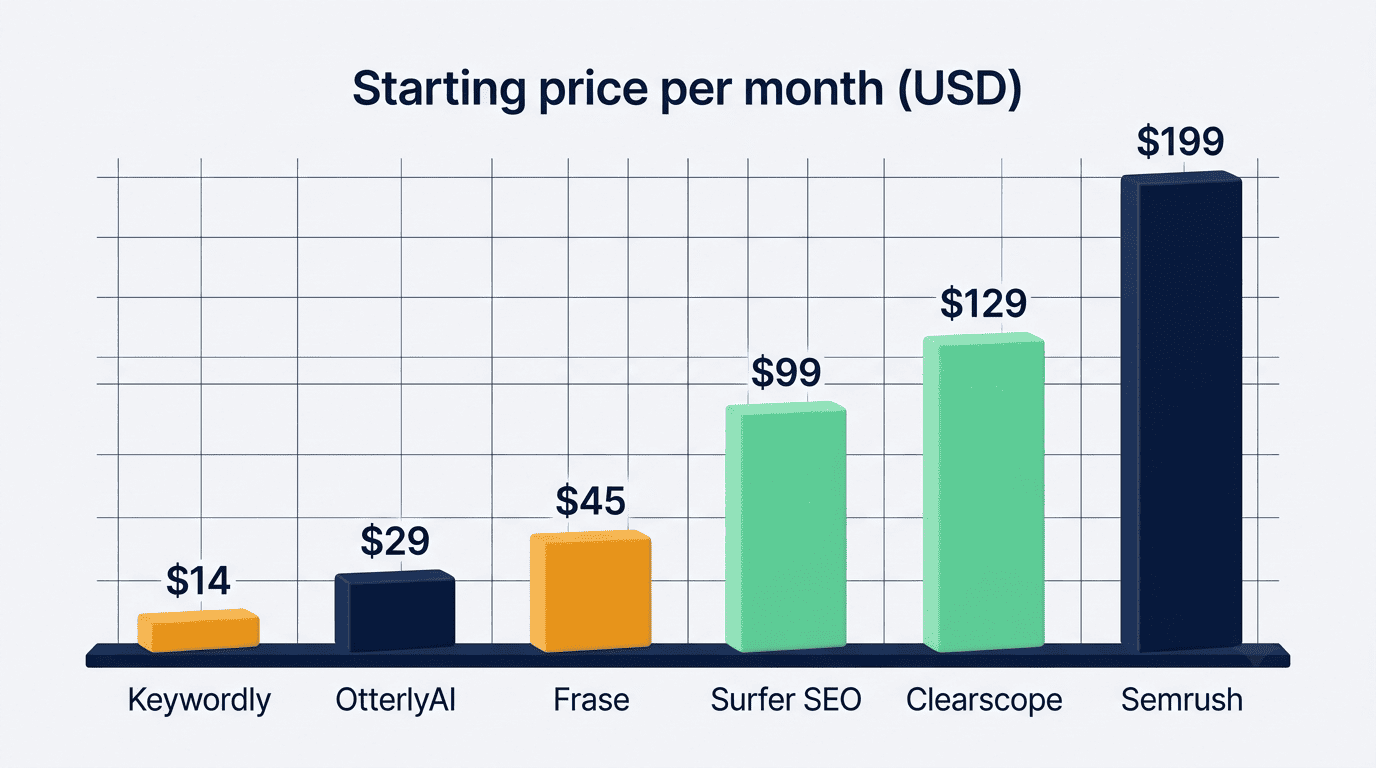
Semrush covers the broadest surface. Used by more than 10 million marketing professionals, Semrush bundles keyword research into its AI Visibility plan (from $99/month) or the full Semrush One suite ($199/month), which also covers rank tracking and site audits in one dashboard.
Keyword Insights specializes in clustering. Instead of a general toolkit, Keyword Insights (from $58/month for 10,000 credits) focuses on grouping keywords by search intent and building content strategy maps from the clusters.
AlsoAsked mines the People Also Ask graphs. Priced between $15 and $59 a month, it pulls PAA question trees to surface subtopics competitors and Google itself are already surfacing.
SE Ranking keeps the cost down. It pairs rank tracking with keyword-difficulty metrics at a lower price point than Semrush, which makes it a common pick for smaller in-house teams.
| Tool | Starting price | Best for |
|---|---|---|
| Semrush (AI Visibility / One) | $99–$199/mo | All-in-one research + tracking |
| Keyword Insights | $58/mo (10,000 credits) | Clustering & content strategy |
| AlsoAsked | $15–$59/mo | People Also Ask mining |
| SE Ranking | Budget-tier | Rank tracking + keyword metrics |
Best AI Content Optimization Tools
Surfer SEO, Clearscope and Frase — briefs that rank
Content optimization tools score a draft against the pages already ranking for a target query, then recommend terms, headings, and length. Surfer SEO ($99–$219/month) runs a real-time content score as you write and claims its optimized pages get up to 25% more AI citations in generative search results. Clearscope (from $129/month) leans on terminology coverage, which lines up with how Google evaluates E-E-A-T signals in a page. Frase ($45/month) is built for speed — it scans the SERP and drafts an outline in a couple of minutes rather than requiring a full manual audit.
Budget alternatives worth a look
Not every team needs Surfer- or Clearscope-level pricing. Rankability’s Growth plan ($199/month, or $166/month billed annually) adds built-in coaching on top of its optimization scoring. NeuronWriter is the standout budget pick at $19/month on annual billing and supports more than 170 languages, which matters for any team publishing outside English. Scalenut ($59/month) rounds out the field with a combined brief-and-draft workflow. Across this category, most best AI marketing tools shortlists converge on the same core loop — score the draft, flag missing terms, suggest structure — so the real differentiator ends up being price and language coverage rather than the underlying method.
| Tool | Starting price | Standout feature |
|---|---|---|
| Surfer SEO | $99–$219/mo | Real-time score, AI-citation lift |
| Clearscope | $129/mo | Terminology coverage for E-E-A-T |
| Frase | $45/mo | Fast SERP scan + outline |
| Rankability | $166–$199/mo | Optimization + coaching |
| NeuronWriter | $19/mo | 170+ languages |
| Scalenut | $59/mo | Brief + draft in one flow |
Best AI SEO Content Writing Tools
Writing tools sit one step past optimization — they draft the copy itself, ideally against a brief a tool like Surfer or Frase already produced. Writesonic is the budget leader at $16/month and holds a 4.7 out of 5 rating across more than 2,029 G2 reviews, which is a large enough sample to trust for a mid-market tool. AirOps ($199/month, with a 14-day trial) is built differently: it’s a workflow platform that chains together research, drafting, and publishing, with native integrations into Semrush, ChatGPT, and Perplexity, so it fits agencies running the same content pipeline across many clients. Koala AI takes the free-tier route, giving new users a 5,000-word free trial before any paid plan kicks in — enough to test whether AI drafting fits a team’s editing process before committing budget.
AI Visibility and GEO: The New SEO Layer
Tracking your brand in ChatGPT, Perplexity and AI Overviews
A newer category has emerged alongside classic SEO: AI visibility tools, built around Generative Engine Optimization (GEO) — optimizing for citation inside AI answers rather than just blue-link rankings. Semrush’s AI Visibility product tracks brand mentions across a database of more than 261 million AI search prompts spanning 32 countries, which is the largest dataset of its kind currently on the market. OtterlyAI ($29/month) and SE Ranking’s AI Overview Tracker offer the same core idea — monitoring when and how a brand shows up in ChatGPT, Perplexity, and Google’s AI Overviews — at a fraction of Semrush’s price.
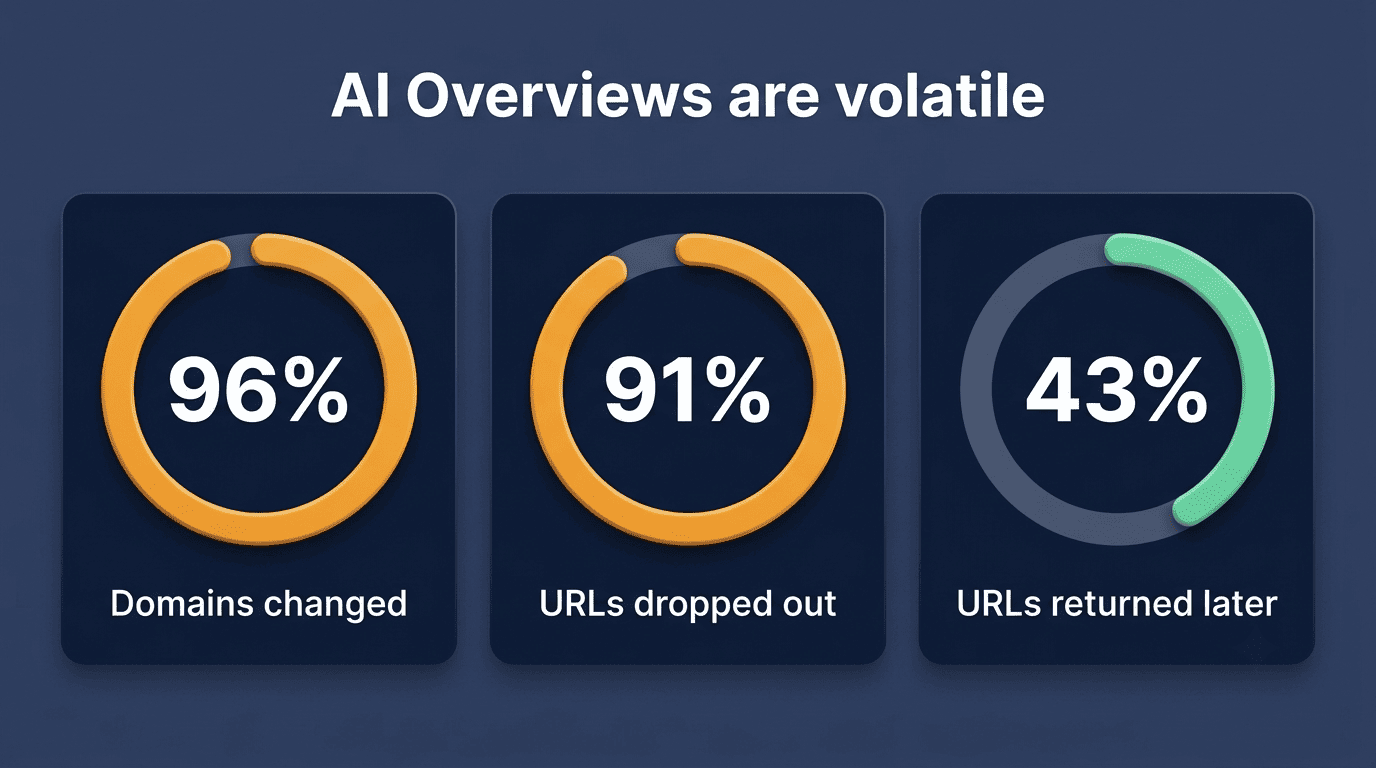
The data behind this category is volatile by nature. A Semrush study of AI Overview results found that 96% of domains shown changed between crawls and 91% of URLs dropped out entirely, though 43% of those dropped URLs returned later. That volatility sounds alarming, but it doesn’t mean classic SEO stopped mattering — Perplexity’s citations overlap with Google’s top 10 results in more than 91% of cases, meaning the same ranking fundamentals still drive most AI-answer visibility. Reddit, notably, shows up in 40.1% of AI-generated citations, underscoring how much weight AI systems now give to community discussion over branded content. These are the kinds of signals AI visibility tools are built to monitor:
- Which brand or competitor names appear in a given AI answer
- How often a domain gets cited across ChatGPT, Perplexity, and AI Overviews
- Which source pages the AI model pulled the citation from
- How visibility shifts week over week as models retrain or re-crawl
GEO is an extension of SEO, not a replacement
Semrush projects that AI-powered search will overtake traditional search by early 2028. That’s a five-alarm number for anyone still treating GEO as a side project, but the mechanics underneath it haven’t actually changed: Google’s own guidance on AI features in Search still points back to the same fundamentals — helpful, people-first content and clear topical authority. GEO isn’t a new discipline that replaces SEO; it’s the same discipline measured against a new set of surfaces.
Best AI Tools for Technical SEO and Audits
Technical SEO is where AI tools have the clearest, most measurable payoff: catching an error before it costs traffic instead of after.
Screaming Frog remains the crawling standard. It’s free for sites under 500 URLs and $279/year beyond that, and most technical SEO workflows — from other vendors’ tools included — still assume a Screaming Frog crawl as the baseline data source.
Ahrefs owns backlink analysis. Plans run from $129/month (Lite) up to $1,499/month for Enterprise, and its link index refreshes every 15 to 30 minutes, which matters for anyone tracking a fast-moving link campaign or a competitor’s outreach.
Siteimprove and Search Atlas add agentic monitoring on top. Rather than a one-time crawl, these tools watch a site continuously — the kind of setup that can catch a routine JavaScript update silently breaking a batch of pages and cutting organic traffic within hours, instead of weeks later during a manual review.
That kind of continuous monitoring typically flags:
- Broken internal links and orphaned pages after a deploy
- Sudden indexability drops (noindex tags, robots.txt changes)
- Core Web Vitals regressions tied to a specific release
- Duplicate or thin content introduced by a CMS template change
How to Choose the Right AI SEO Tools
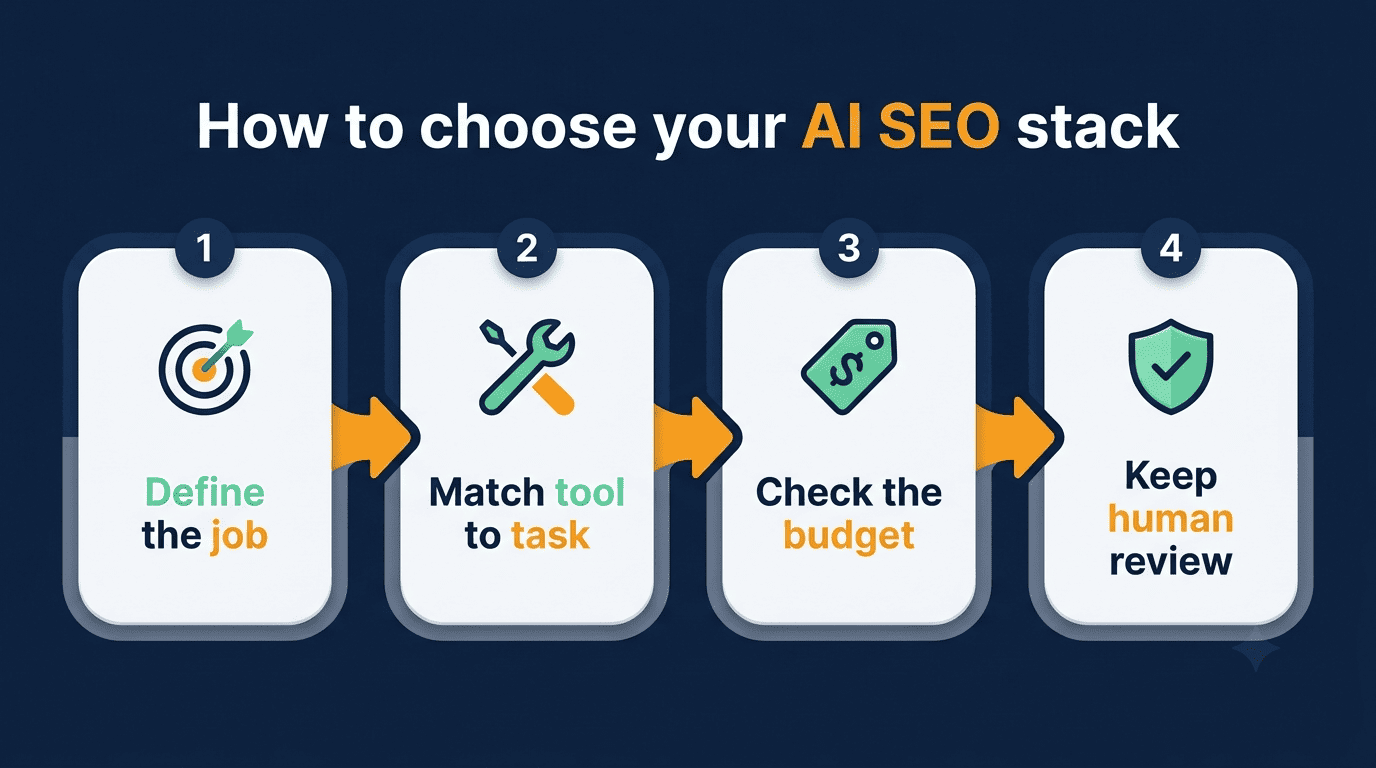
Match the tool to the job and budget
The biggest mistake teams make is buying an “all-in-one” suite without mapping it to actual jobs — most end up using roughly 10% of the features they’re paying for. A faster path: match the tool to the task first, then the budget.
- Define the primary job — keyword research, optimization, writing, GEO tracking, or technical audits.
- For keyword research, start with Semrush or Keyword Insights depending on team size.
- For content optimization, compare Surfer SEO against Clearscope on price per seat.
- For AI visibility, budget-conscious teams should start with OtterlyAI before Semrush AI Visibility.
- For technical audits, run Screaming Frog free up to 500 URLs before paying for anything.
- Cross-check the shortlist against total budget — pricing across this category spans $14/month to $1,499/month, from Keywordly at the low end to Ahrefs Enterprise at the top.
Do AI SEO tools actually work — and what to avoid
They work as an accelerator, not an autopilot. Ahrefs has stated publicly that AI-generated content on its own doesn’t hurt rankings — the risk isn’t the AI, it’s unedited output shipped without fact-checking or a human review pass, which erodes E-E-A-T over time. Strategy, fact-checking, and final edits still belong to a person, no matter how good the underlying model gets. A few warning signs are worth screening for before signing a contract:
- Marketing that promises a full “autopilot” with no human review step
- No visible way to export or audit the underlying data
- Pricing pages that hide usage limits or credit costs until checkout
- No free trial or sandbox to test output quality first
For teams building out a full AI-driven marketing workflow rather than a single SEO tool, it’s worth comparing the wider landscape of AI marketing tools before locking into any one vendor’s ecosystem.
Related AI marketing guides
Building a full stack? Explore AI content marketing tools and AI marketing analytics tools to round out your marketing workflow.
Frequently Asked Questions
What are the best AI SEO tools?
It depends on the job: Semrush and Keyword Insights for keyword research, Surfer SEO, Clearscope, and Frase for content optimization, Writesonic for AI writing, Semrush AI Visibility and OtterlyAI for AI-visibility/GEO tracking, and Screaming Frog with Ahrefs for technical audits and backlinks.
How is AI used in SEO?
AI handles keyword research and clustering, generates content briefs and drafts, crawls hundreds of pages for technical errors, and tracks brand mentions in AI-generated answers — work that took tens of hours a month manually now runs in minutes.
Do AI SEO tools actually work?
Yes, as an accelerator: they compress a roughly 40-hour manual audit into minutes. They aren’t an autopilot, though — strategy, fact-checking, and E-E-A-T still need human review. Ahrefs has confirmed that AI-generated content by itself doesn’t hurt rankings.
What is the best free AI SEO tool?
Screaming Frog is free for crawls under 500 URLs, Koala AI offers a 5,000-word free trial, and Google Search Console remains a free baseline that most paid tools build on top of.
How much do AI SEO tools cost?
Prices range from $14/month (Keywordly) and $29/month (OtterlyAI, Ubersuggest) up to $99–$199/month (Semrush) and $129/month (Clearscope), topping out around $1,499/month for Ahrefs Enterprise. Most vendors offer a free trial.
What is GEO in SEO?
GEO (Generative Engine Optimization) is the practice of optimizing content to be cited inside AI-generated answers from ChatGPT, Perplexity, and Google AI Overviews. It extends classic SEO rather than replacing it, since it still relies on people-first content and topical authority.
Can AI do SEO automatically?
AI can automate the research, drafting, and monitoring pieces of SEO, but it can’t run the process unsupervised. Google’s spam policies explicitly treat automation used to manipulate rankings as a violation, and unedited AI content risks both quality and E-E-A-T without human review.