
AI Advertising Tools for Marketing: The Best Platforms to Run Smarter Ads in 2026
AI advertising tools now do the heavy lifting on paid campaigns — writing copy, generating creative, and shifting budget in real time. If you are building a stack of best AI marketing tools, the advertising layer is where AI pays back fastest.
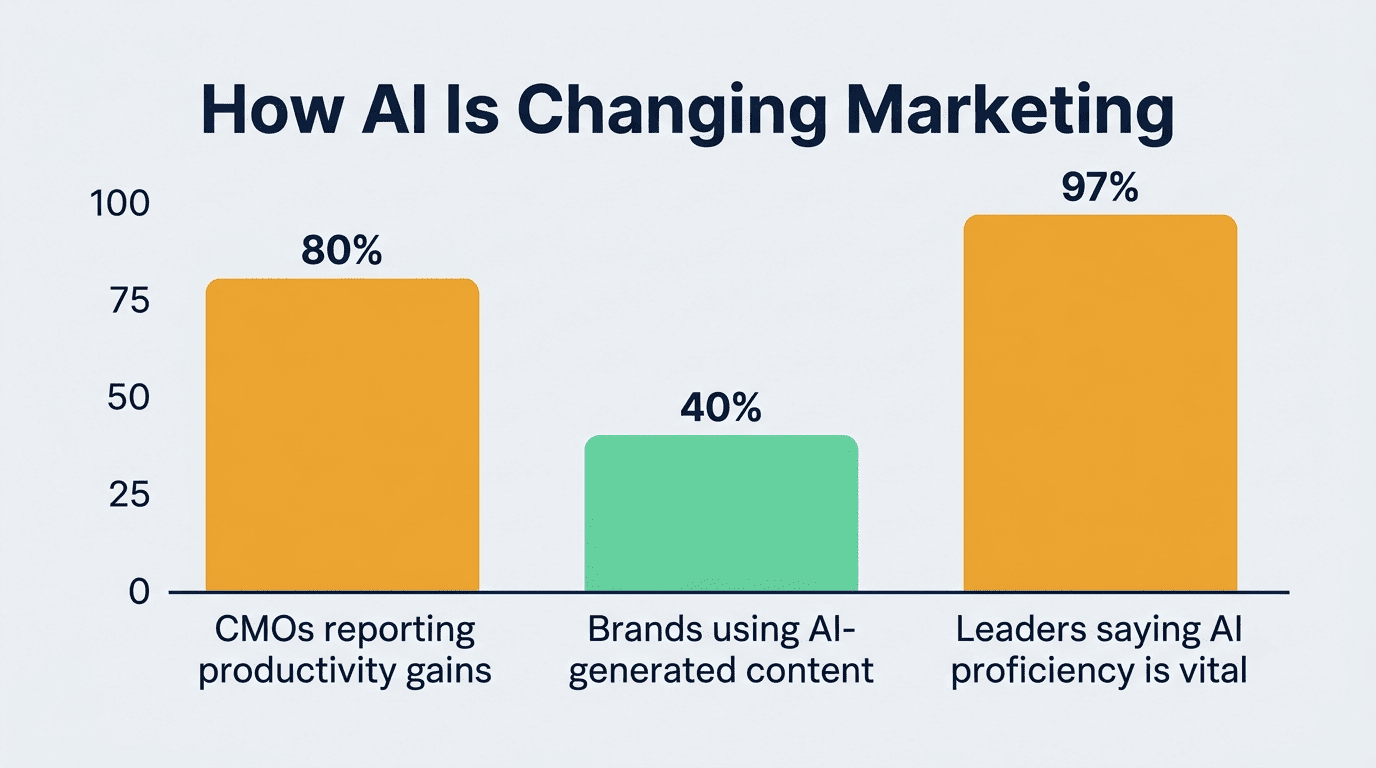
These platforms fall into a handful of categories: creative and copy generation, bid and budget automation, and targeting and analytics. About 80% of CMOs already say AI has improved their marketing productivity, and the rest of this guide breaks down which tool fits which job, budget, and business size.

How AI Is Used in Advertising Today
Generative AI has moved from a side experiment to a standing line item in most paid-media budgets. Programmatic advertising already automated the buying side years ago; what changed is that AI now touches the creative and strategic layers CMOs used to guard closely.
From manual optimization to AI co-pilots
In a Boston Consulting Group survey of over 200 CMOs, about 80% said AI has already improved productivity across their marketing teams, especially in content creation, social media engagement, and ad copywriting. The tool moved from a “nice extra” bolted onto a media plan to a default part of the campaign workflow — media buyers now expect a first draft of copy or a budget recommendation to come from a model before a human touches it.
The five jobs AI does in a paid campaign
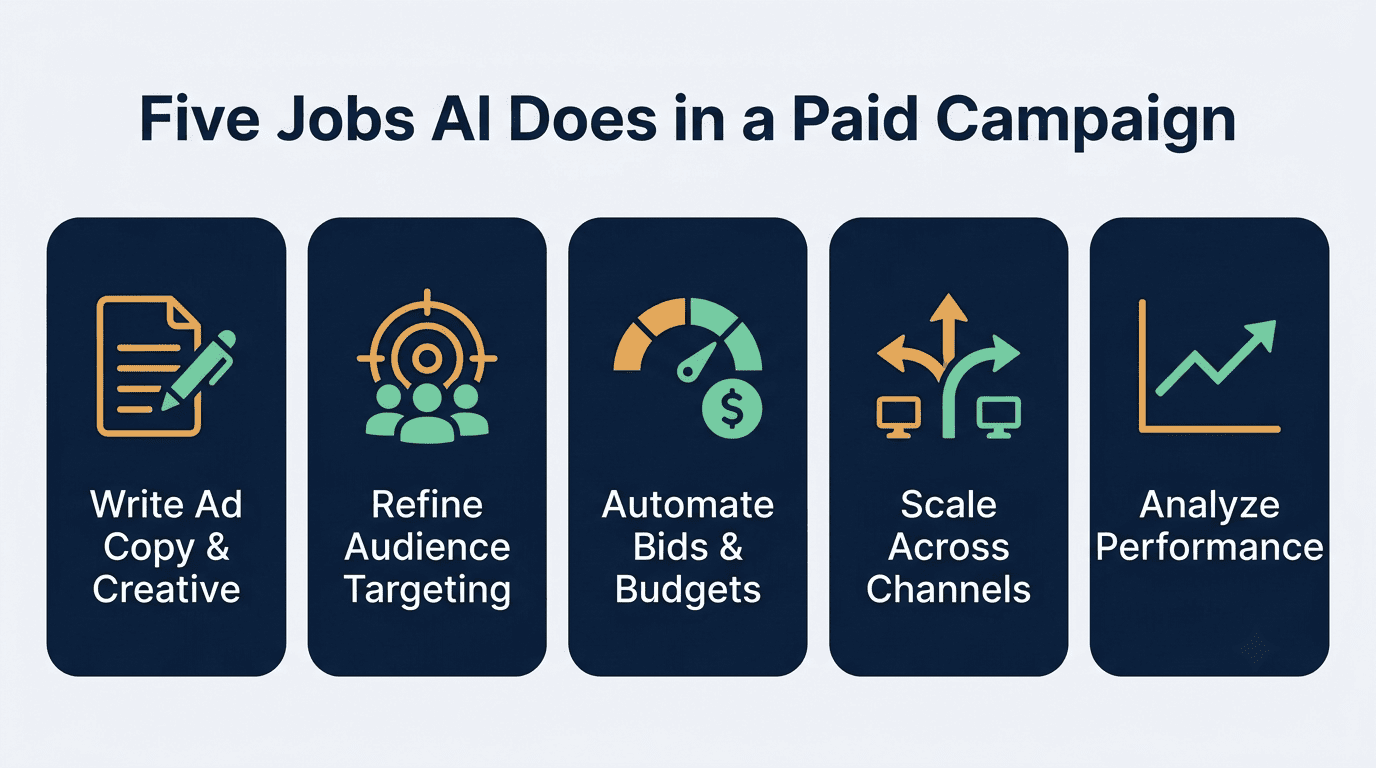
AI advertising tools handle five recurring jobs inside a paid campaign:
- Writing ad copy and generating creative
- Refining audience targeting
- Automating bid and budget decisions
- Scaling campaigns across channels
- Analyzing performance after launch
About 40% of brands already use AI-generated content in their marketing assets, per World Federation of Advertisers research. Per the 2025 Sprout Social Index, 97% of marketing leaders say AI proficiency is vital for proper job performance — a signal that fluency with these tools is no longer optional for anyone running paid media.
Best AI Tools for Ad Creative and Copy
Creative and copy are usually the first bottleneck teams hand off to AI, since testing dozens of headline or image variations by hand simply does not scale. AI advertising tools generate ad creative and ad copy in volume, then let human editors pick winners rather than write from scratch.
Ad copy generators
Jasper turns a brand brief into dozens of headline and description variations in brand voice. Starting at $59/month (billed annually), it is built for teams that need to keep tone consistent across hundreds of ad variants without a copywriter rewriting each one by hand. ChatGPT and Claude cover the same ground more flexibly — short-form ad copy, tone variations, and longer email or narrative sequences that support a campaign — though neither is purpose-built for ad testing the way Jasper is. Anyword adds a layer the others don’t: predictive performance scoring that estimates how a line of copy will perform before it ever reaches a live audience.
Ad creative and visual generators
AdCreative.ai generates ad images with conversion scoring and brand kits built in, starting at $39/month, so a small team can produce on-brand visuals and get a data-backed guess at which one will convert before spending on media. Pencil focuses on AI video ads for social and ecommerce, an area where manual editing is the slowest part of the workflow. Adobe Firefly and Runway round out the category with visual scaling, background extension, and motion assets generated from still images — useful for stretching one creative into the aspect ratios every platform demands.
| Tool | Best for | Starting price |
|---|---|---|
| Jasper | Ad copy and headline variations | $59/mo |
| AdCreative.ai | Ad visuals with conversion scoring | $39/mo |
| Anyword | Predictive copy performance scoring | Custom |
| Pencil | AI video ads for social/ecommerce | Custom |
| Adobe Firefly | Visual scaling and background extension | Custom |
| Runway | Motion assets from stills | Custom |
Best AI Tools for Campaign Automation and Bid Optimization
AI advertising tools automate bid and budget optimization, freeing media buyers from the daily grind of manually shifting spend between ad sets. This category ranges from fully autonomous platforms to rule-based automation layered on top of Meta and Google.
Autonomous cross-channel management
Albert (Albert.ai) manages cross-channel campaigns autonomously — it personalizes and optimizes ad content at scale across Facebook, YouTube, Google Ads, and Bing, adjusting spend and creative without a human approving each change. It’s built for large budgets and complex, multi-market needs, and pricing is custom because implementations vary widely by account size.
Meta ad optimization
Madgicx (from $99/month) automates budget decisions and audience optimization specifically for Meta, making it a natural fit for teams whose spend is concentrated on Facebook and Instagram. Smartly.io (custom pricing) goes further with creative automation and scaling built for large-scale Meta budgets, where manual creative production simply can’t keep pace with the volume of variants needed.
Google Ads and rule-based automation
Optmyzr (from $249/month) gives Google Ads teams a rule engine, scripts, and reporting layer for granular control over bidding logic. Revealbot (from $49/month) works across both Meta and Google with automation rules that pause weak ads and shift budgets toward winners — a lighter-weight option than Albert or Smartly.io for teams that still want a human setting the rules.
Best AI Tools for Targeting, Testing, and Analytics
The tools in this category focus less on producing the ad and more on proving which version deserves the budget. Most are tested across a 30-to-90-day window on Google, Meta, TikTok, LinkedIn, and Shopify before a winner is declared.
Predictive testing and creative analytics
Predict which copy variations will perform before launch. That’s Phrasee’s core pitch — language testing at scale with custom pricing, aimed at brands running high volumes of email and ad copy tests. Omneky takes a similar approach for visuals, running creative testing at scale to identify which image or video styles are actually driving conversions rather than just impressions. Motion adds AI tagging of ad creative, breaking a video or image down into attributes (color, pacing, hook style) to quantify which specific elements drive performance.
Competitive and audience research
Semrush (from $139.95/month) rounds out the category with competitor ad analysis, keyword research, and traffic insights that sharpen targeting before a campaign even launches. It’s less about optimizing an ad in flight and more about making sure the targeting brief is right from day one.
AI Advertising Tools by Platform
Different platforms favor different tools, largely because each ad network exposes a different API and creative format. Here’s a rough map of what pairs well with each channel:
- Meta (Facebook & Instagram): Madgicx, Smartly.io, Revealbot, Pencil.
- Google Ads: Optmyzr, Albert, Revealbot, plus ChatGPT or Gemini for copy drafts.
- TikTok and short-form video: Pencil, Motion, Runway for creative production.
Meta (Facebook & Instagram)
Madgicx and Smartly.io both specialize in Meta budget and creative automation, while Revealbot layers rule-based automation on top for teams that want more manual control. Pencil covers the video-ad side, which matters heavily on a platform built around Reels.
Google Ads
Optmyzr and Albert both operate on Google Ads, though Optmyzr is the rule-based, human-directed option and Albert leans autonomous. Revealbot bridges Google and Meta in one dashboard, and ChatGPT or Gemini are commonly used just for the copy layer rather than bidding.
TikTok and short-form video
Pencil and Motion both address the creative side of TikTok, where video volume and iteration speed matter more than static ad copy. Runway adds motion-asset generation for teams that need to turn a still image into short-form video without a full production shoot.
How to Choose the Right AI Advertising Tool
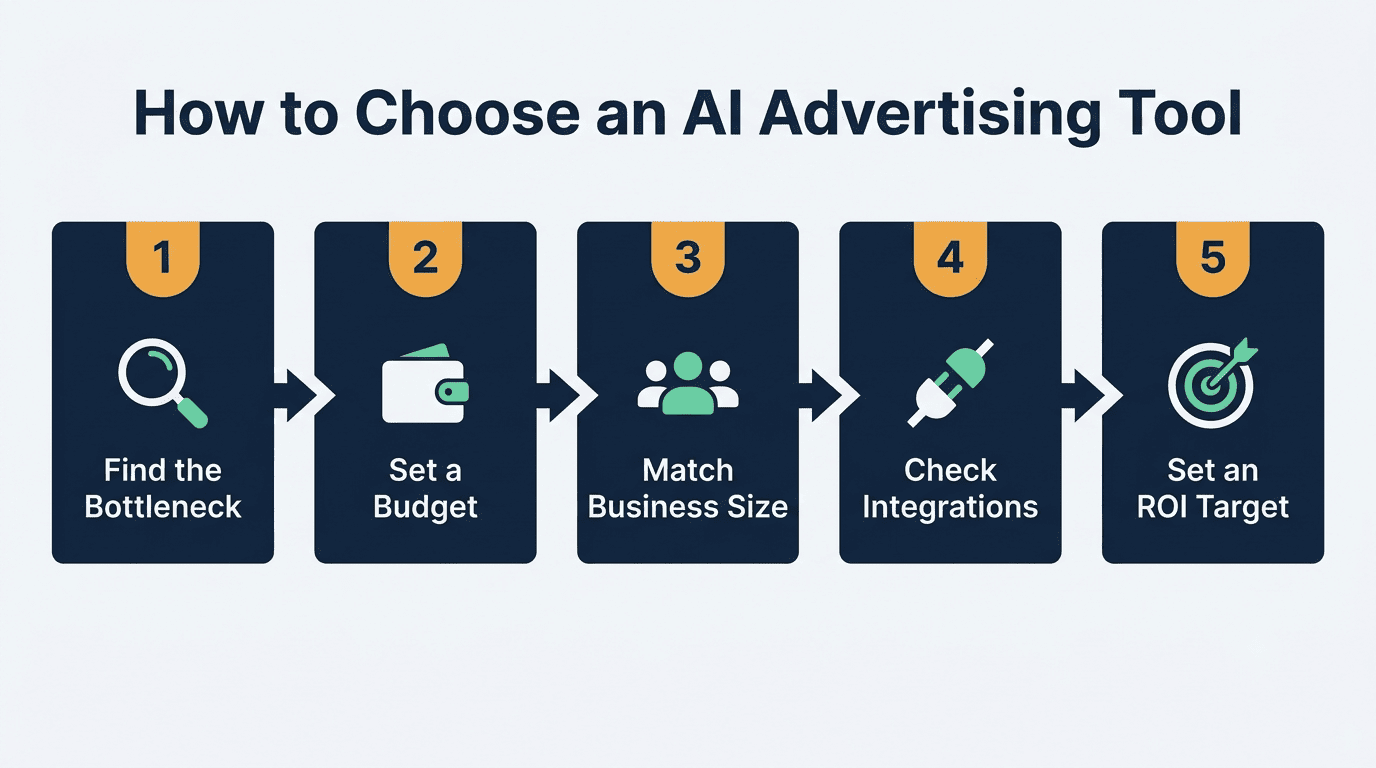
- Identify the bottleneck. Decide whether copy, creative, bidding, or reporting is slowing your team down most — that’s the category to solve first.
- Set a budget ceiling. Entry tools start around $39–$59/month; automation platforms run $49–$249/month; enterprise tools like Albert use custom pricing.
- Match the tool to business size. Small teams tend to fit AdCreative.ai, Jasper, or Madgicx; agencies lean toward Optmyzr and Revealbot; enterprises need Albert or Smartly.io.
- Check platform integrations. Confirm the tool connects natively to the ad platforms (Meta, Google Ads, TikTok) you already run spend on.
- Define a measurable ROI target. Set a CPA or ROAS benchmark before rollout so you can tell within 30–90 days whether the tool earned its subscription.
Frame selection around the bottleneck first — copy, creative, bidding, or reporting — then layer in budget, business size, and whether the tool plugs into your existing platforms. A navigator like our AI marketing software directory helps match the right tool to the task and budget rather than guessing from a vendor’s homepage.
| Business size | Recommended tools | Typical budget |
|---|---|---|
| Small team | AdCreative.ai, Jasper, Madgicx | $39–$99/mo |
| Agency | Optmyzr, Revealbot | $99–$249/mo |
| Enterprise | Albert, Smartly.io | Custom pricing |
What Advertisers Should Not Automate
AI excels at execution, not vision, and the gap between the two shows up fastest when a brand automates something that needed a human judgment call. Coca-Cola’s AI-generated holiday video ad drew public backlash, with viewers online calling it “soulless” and describing it as the opposite of the warmth in the brand’s earlier, human-made holiday spots — a reminder that audiences notice when a brand’s emotional core gets outsourced to a model.
AI proficiency is vital for proper job performance.2025 Sprout Social Index
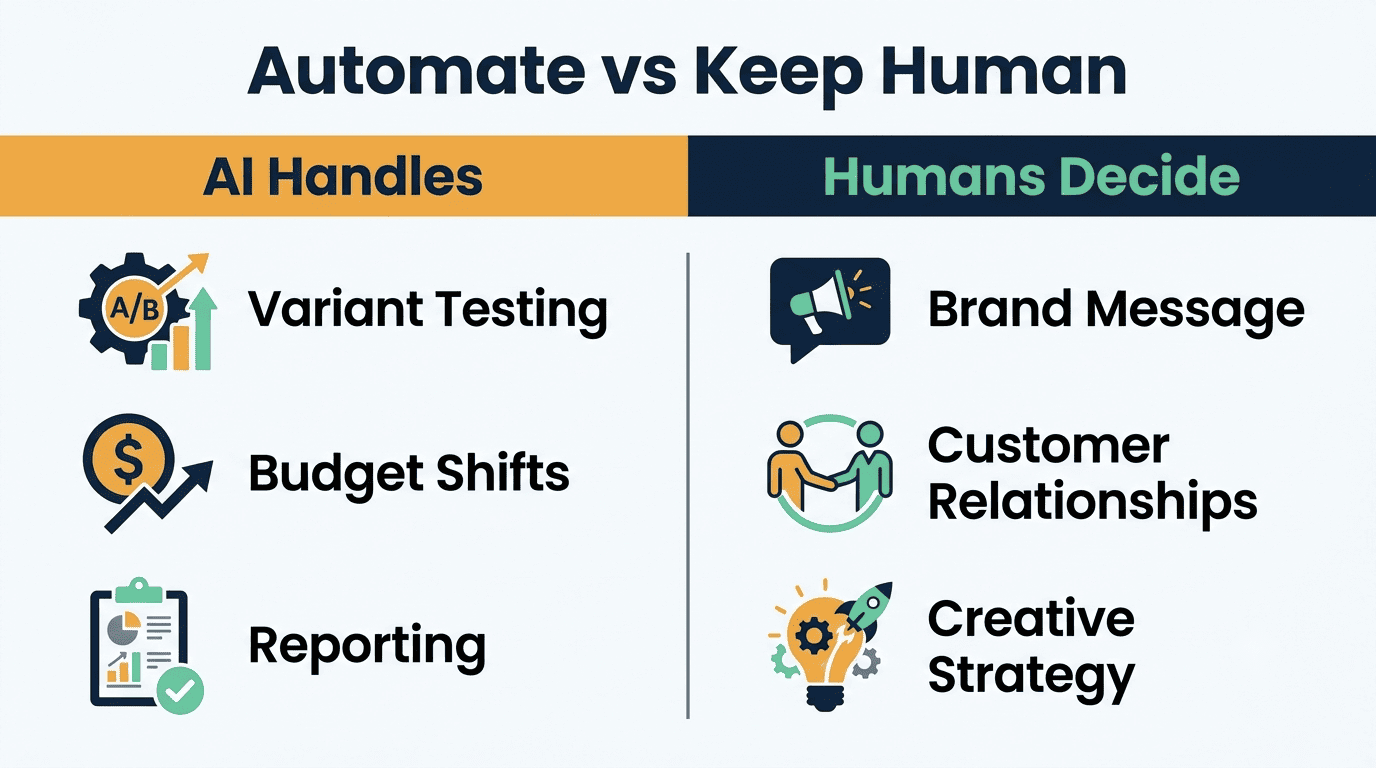
Keep relationship building, original thinking, and creative strategy human. These AI advertising tools are a co-pilot for execution, not a substitute for the brand judgment that decides what a campaign should say and why. The strongest teams use automation to clear the busywork so people can focus on what a model still can’t do well:
- Setting the campaign’s core message and brand voice
- Building genuine relationships with customers and partners
- Original creative strategy and big-swing ideas
- Judgment calls on tone during sensitive moments or backlash
Automation handles variant testing, budget shifts, and reporting; the humans on the team decide what the brand actually stands for in a given campaign. Treat AI advertising tools as the execution layer of the team, not the source of the ideas.
Related AI marketing guides
Building a full stack? Explore AI marketing analytics tools and AI social media marketing tools to round out your marketing workflow.
Frequently Asked Questions
What is the best AI tool for advertising?
There is no single winner — it depends on the job. For creative, AdCreative.ai; for copy, Jasper; for Meta automation, Madgicx; for enterprise cross-channel management, Albert.
How is AI used in advertising?
AI advertising tools handle ad copy and creative generation, audience targeting, bid and budget optimization, multi-channel scaling, and post-campaign performance analysis.
Can AI create ad campaigns?
AI can generate creative, write copy, and manage bidding and budgets autonomously (as Albert does), but strategy and brand positioning still need human direction.
What AI tools do marketers use for ads?
Commonly Albert, AdCreative.ai, Jasper, Madgicx, Smartly.io, Optmyzr, and Revealbot, plus ChatGPT and Claude for copy drafting.
Is AI advertising worth it for small businesses?
Yes — affordable tools like AdCreative.ai (from $39/month) and Revealbot (from $49/month) let small teams generate creative and optimize spend without a large in-house staff.
How much do AI advertising tools cost?
Entry tools like AdCreative.ai start around $39/month, Revealbot starts around $49/month, and Jasper starts around $59/month. Automation platforms such as Madgicx and Optmyzr run $99–$249/month. Enterprise tools like Albert and Smartly.io use custom pricing.