
AI Tools for Marketing Automation: The 2026 Guide to Working Smarter, Not Harder
If your team still copies data between apps and hand-writes every email, you are leaving hours and revenue on the table. This guide to AI tools for marketing automation shows exactly which platforms automate content, email, ads, and analytics — and how to pick the right ones for your stack.

AI marketing automation uses machine learning and predictive analytics to run repetitive marketing work — segmenting audiences, scoring leads, personalizing messages, and optimizing campaigns — with minimal manual input. Salesforce’s State of Marketing research found that high-performing marketers using AI agents reclaim roughly eight hours a week, freeing up time for strategy instead of spreadsheet work.
What Is AI Marketing Automation?
Marketing automation itself isn’t new — email drip sequences and rule-based triggers have existed for two decades. What’s changed is the intelligence layer sitting on top of those workflows, and that layer is what separates a merely automated stack from one that actually adapts to each customer.
Marketing automation vs. AI marketing automation
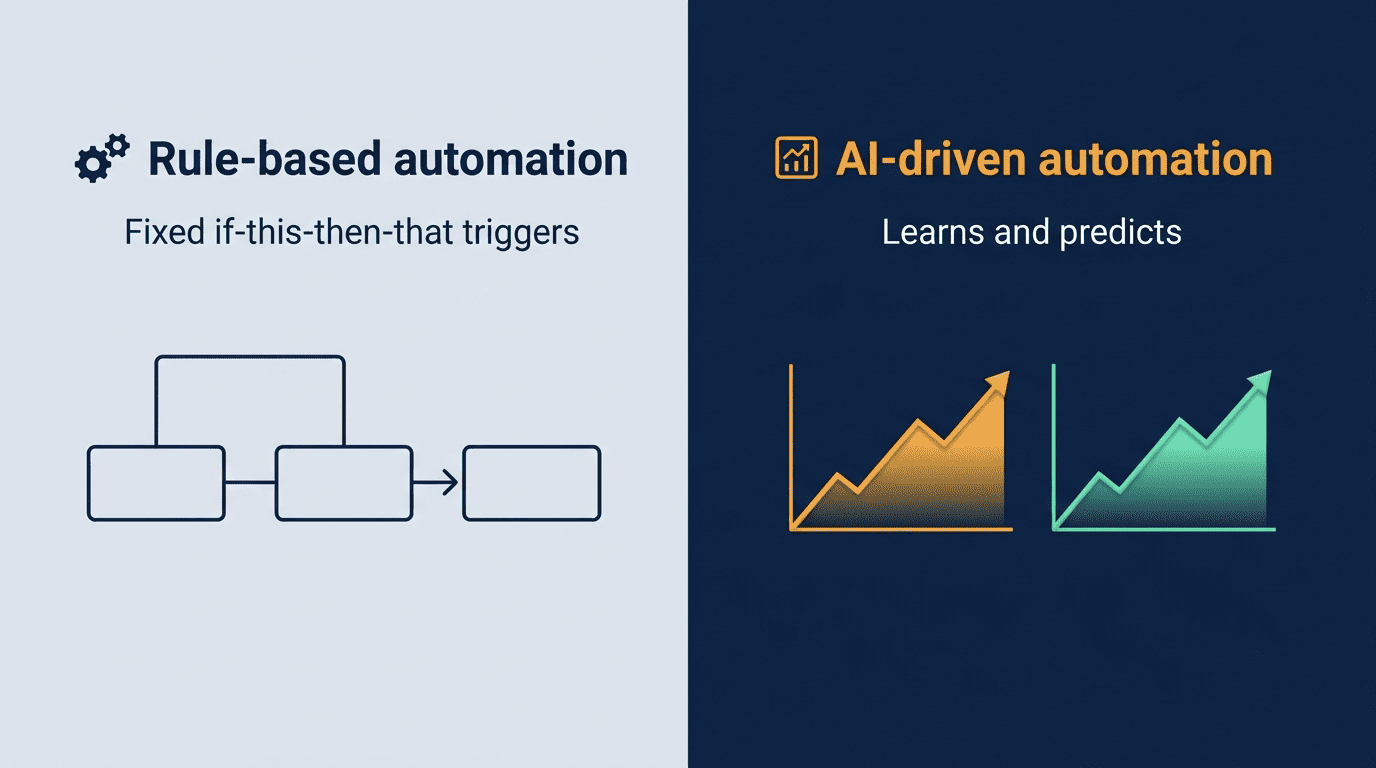
Traditional automation follows fixed if-this-then-that rules: a form fill triggers email three, a cart abandonment triggers a discount code. AI marketing automation adds machine learning and predictive analytics on top of those rules. It analyzes behavioral data across every interaction, spots patterns a human would miss, predicts what a customer will do next, and picks the best next action instead of the pre-scripted one. Teams running these systems report example KPIs like +15% conversion rates and −30% campaign creation time compared with rule-only automation.
Why it matters now
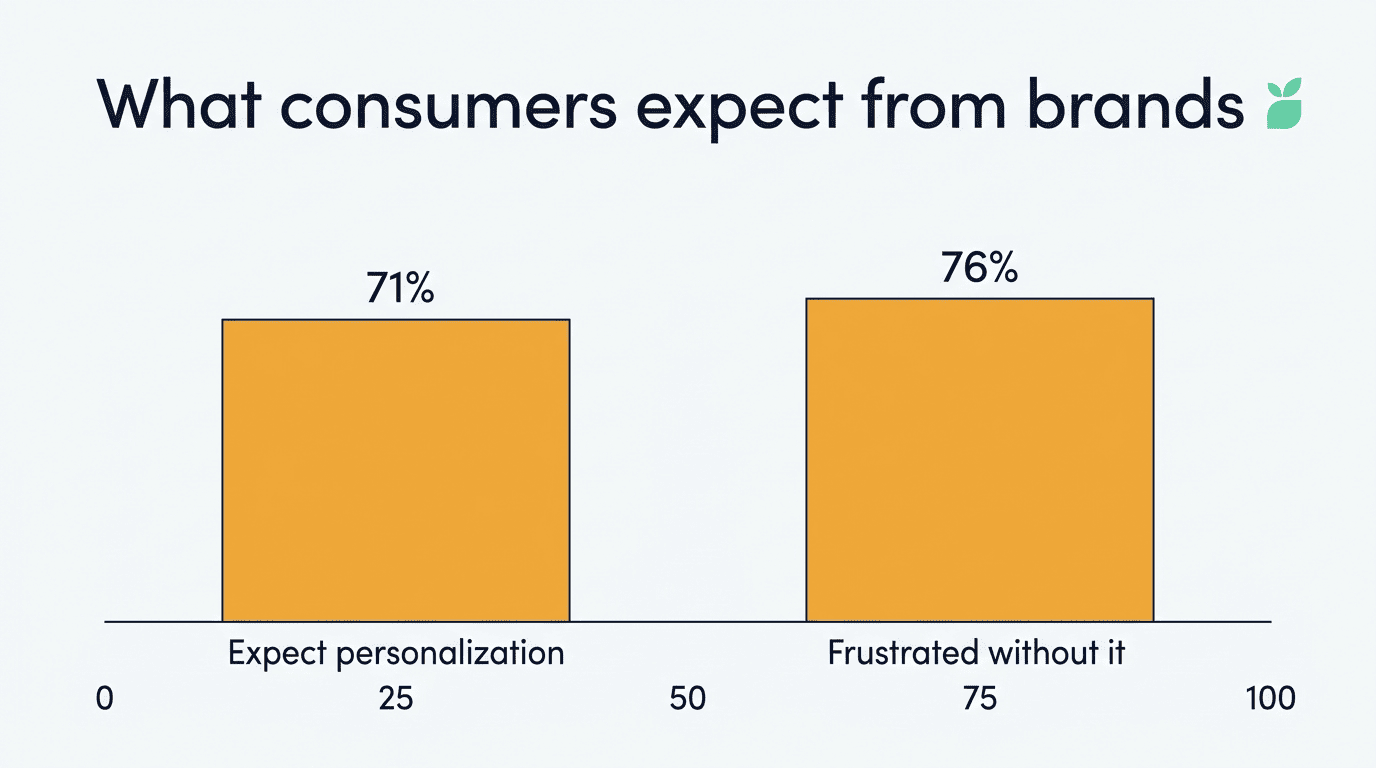
Consumer expectations have caught up with the technology, and the gap between personalized and generic experiences is now a business risk, not a nice-to-have:
- 71% of consumers expect personalized interactions from the brands they buy from.
- 76% get frustrated when that personalization doesn’t happen.
- Marketing leaders increasingly say AI gives them a clearer read on customer preferences than manual analysis alone.
McKinsey’s research on generative AI in marketing finds that AI-driven approaches can cut marketing cost-to-serve by up to 30% and lift team productivity two to three times, which is why budget for AI marketing tools keeps growing even as overall martech spend flattens.
Generative AI could add the equivalent of $2.6 trillion to $4.4 trillion annually across the use cases we analyzed… about 75 percent of this value falls into four areas: customer operations, marketing and sales, software engineering, and R&D.McKinsey & Company
How AI Marketing Automation Works
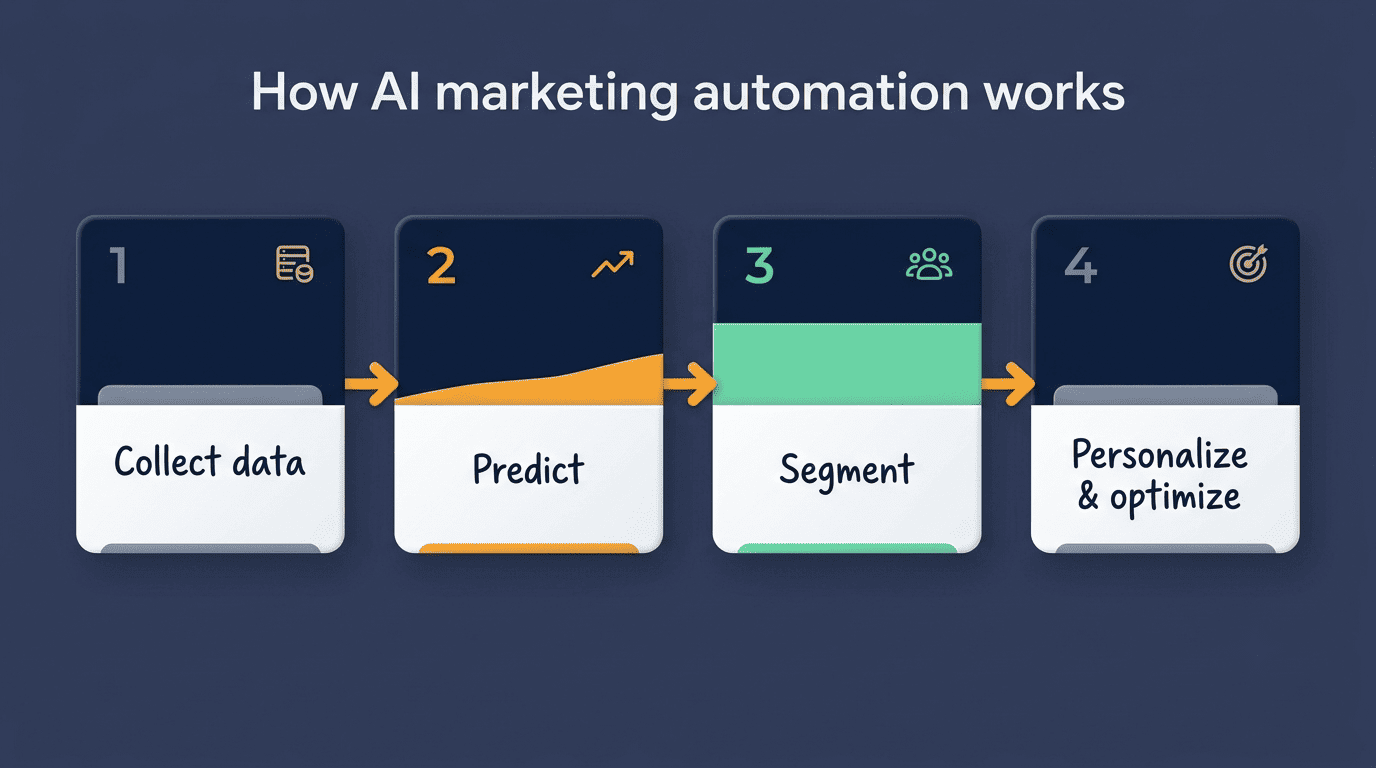
Underneath the dashboards, every AI marketing platform is doing some combination of three things: predicting, segmenting, and executing. Understanding which one a tool focuses on makes it much easier to evaluate vendor claims.
Predictive analytics and lead scoring
Machine-learning models score which contacts are most likely to convert or churn, so sales and marketing teams focus effort where it actually pays off instead of chasing every lead equally. These models look at engagement patterns, purchase history, and firmographic data to assign a probability score in real time. Predictions become reliable once a business has roughly 500 or more contacts and about three months of interaction history — below that threshold, the model simply doesn’t have enough signal to beat a coin flip.
Segmentation, personalization, and AI agents
Where a marketer might manually build five or six audience segments, AI analyzes hundreds of variables at once to build dozens of micro-segments based on behavior and predicted need, then personalizes content per segment automatically. Newer platforms go a step further with AI agents that execute multi-step workflows — draft, schedule, send, report — with minimal human input at each stage. Even agentic workflows still need clean first-party data and a human reviewing outputs before anything ships to a live audience.
| Automation type | Decision logic | Example action |
|---|---|---|
| Traditional (rule-based) | Fixed if-this-then-that triggers | Send email 3 days after signup |
| AI-driven | Machine learning on behavioral data | Send the offer predicted to convert this specific contact today |
The Best AI Tools for Marketing Automation by Function
No single platform covers every marketing job well, so most teams stack two to four tools around a core CRM. The main jobs to cover are:
- Content and copy generation
- Email and lifecycle automation
- All-in-one CRM and campaign management
- Ads, social, and SEO optimization
- Workflow automation connecting the rest of the stack
Here’s how the leading options break down by the function they’re built for.
Content and copy generation
Jasper generates on-brand blog posts, ad copy, emails, and social content for marketing teams, with its entry Pro plan starting around $59/seat per month (billed annually; $69/month billed monthly). ChatGPT (Plus tier at $20/month) covers ideation, outlines, and first drafts, while Grammarly handles tone and editing on top of whatever draft a team produces.
Email and lifecycle automation
Klaviyo powers e-commerce email and SMS with predictive send-time and product-recommendation models; it’s free for up to 250 contacts, then starts around $20/month. ActiveCampaign (from $15/month) and Braze handle multi-channel lifecycle journeys and message-timing optimization for larger, more complex customer bases.
All-in-one platforms and CRM
HubSpot Marketing Hub bundles a content assistant, predictive lead scoring, and campaign tools into one platform, with Starter plans running around $20/seat per month for 1,000 contacts. Salesforce Marketing Cloud and Mailchimp serve similar all-in-one needs for teams that want fewer vendors to manage rather than a best-of-breed stack.
Ads, social, and SEO
Albert.ai autonomously optimizes paid media spend across channels — a Harley-Davidson dealership in New York running the platform reported a 2,930% increase in sales leads within three months. Sprout Social (from $79/seat for the entry Essentials plan) manages AI-assisted social publishing and listening, while Surfer SEO and Semrush handle AI-driven content and search optimization.
Workflow glue
Zapier connects thousands of apps into automated cross-tool workflows, letting non-technical marketers wire AI steps into existing tools without writing code and without waiting on engineering resources.
| Tool | Primary function | Starting price |
|---|---|---|
| Jasper | Content and copy generation | ~$59/seat/mo (annual) |
| ChatGPT Plus | Ideation and drafting | $20/mo |
| Klaviyo | Email/SMS lifecycle automation | Free ≤250 contacts, then ~$20/mo |
| ActiveCampaign | Multi-channel lifecycle journeys | ~$15/mo (annual billing) |
| HubSpot Marketing Hub | All-in-one CRM + campaigns | ~$20/seat/mo |
| Sprout Social | AI-assisted social management | ~$79/seat/mo (annual) |
How to Choose and Implement AI Marketing Tools
Buying the tool is the easy part. Getting a team to actually change how it works — and trusting the model’s recommendations enough to act on them — is where most AI marketing rollouts stall.
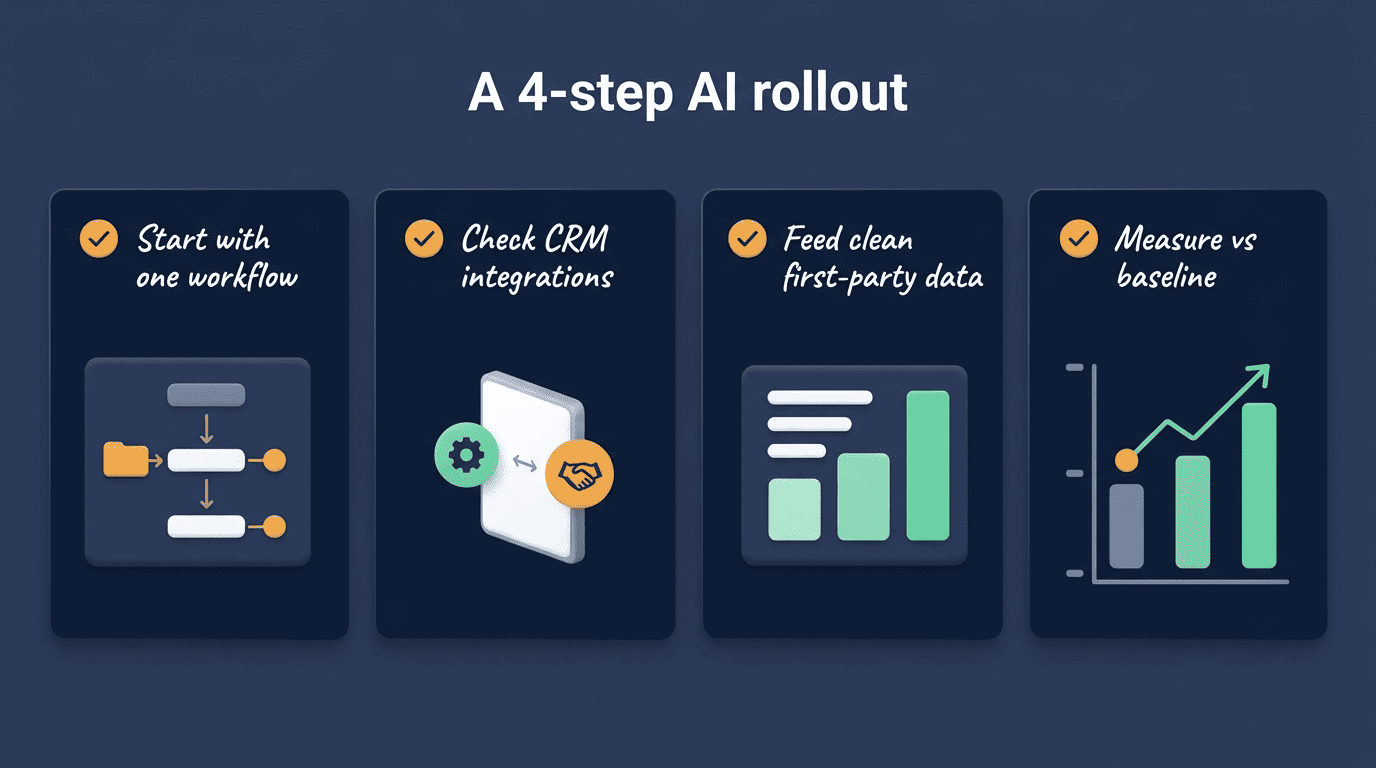
A short, disciplined rollout beats a big-bang platform switch almost every time:
- Start with one high-friction workflow. Pick something painful and measurable, like email nurture sequencing or lead scoring, rather than trying to automate everything at once.
- Check integrations with your CRM and data sources. A predictive model is only as good as the data it can actually see; confirm the tool connects natively to where your customer data already lives.
- Feed it clean first-party data. Duplicate records, stale fields, and missing consent data will quietly wreck prediction accuracy before you notice.
- Measure against a baseline, then expand. Compare AI-driven results to your pre-AI conversion and cost numbers for at least one full cycle before rolling the tool out to a second workflow.
Businesses that deploy AI-led processes across their go-to-market motion have shown meaningfully higher revenue growth than peers still running manual processes — Accenture research puts AI-led companies at roughly 2.5x the revenue growth of the rest — and most leading businesses now say they’re increasing AI investment specifically to drive that growth.
Before signing a contract, confirm the tool clears these basics:
- Native integration with your existing CRM and email platform
- A free trial or free tier long enough to test against real data
- Clear data-privacy and consent handling for the customer records it touches
- A reporting layer that ties AI-driven actions back to revenue, not just activity
Free vs. paid
Most categories now have a usable free tier, which makes piloting cheap before anyone signs a contract:
- ChatGPT’s free tier for drafting and ideation.
- HubSpot’s free CRM for contact and pipeline management.
- Klaviyo’s free plan for up to 250 email/SMS contacts.
Start free, prove the workflow saves time, and only upgrade to paid tiers once volume or advanced predictive features justify the cost.
As the U.S. Federal Trade Commission notes in its guidance for businesses using AI, statements about what an algorithm can do must be truthful, non-deceptive, and backed by evidence — a useful reminder that “the AI decided” isn’t a compliance strategy for lead scoring or ad targeting.
Limits and the Human in the Loop
AI can’t fully automate marketing on its own, and every serious deployment ends up needing a human somewhere in the loop.
Generative models can hallucinate facts and drift off-brand. A content tool asked to write about a product spec it hasn’t seen will sometimes invent a plausible-sounding but wrong detail, which is why every AI draft needs a human fact-check before it publishes.
Predictive models need enough data to be trustworthy. Below the roughly 500-contact, three-month-history threshold mentioned earlier, lead-scoring output is closer to a guess than a prediction, no matter how confident the dashboard looks.
Strategy, positioning, and brand voice still need human judgment. AI can execute a campaign faster than a person can, but deciding what the campaign should say and who it should say it to is still a marketing leadership call, not a model output.
Related AI marketing guides
Building a full stack? Explore AI marketing analytics tools and AI email marketing tools to round out your marketing workflow.
Frequently Asked Questions
What is AI marketing automation?
Software that uses machine learning and predictive analytics to run repetitive marketing tasks — segmentation, lead scoring, personalization, and campaign optimization — with minimal manual input.
What are the best AI tools for marketing automation?
By function: Jasper and ChatGPT for content, Klaviyo and ActiveCampaign for email, HubSpot for all-in-one CRM and campaigns, Albert.ai and Sprout Social for ads and social, and Zapier for connecting the rest of the stack.
How is AI used in marketing automation?
To analyze behavioral data, predict customer actions, segment audiences into micro-groups, personalize messages, score leads, and auto-optimize campaigns in real time.
Can AI fully automate marketing?
No. AI automates and accelerates execution, but strategy, brand voice, and human oversight of outputs are still required.
What is the difference between marketing automation and AI marketing?
Traditional automation runs fixed, rule-based workflows. AI marketing adds machine learning that predicts and adapts, personalizing and optimizing beyond preset rules.
Are there free AI marketing tools?
Yes. ChatGPT’s free tier, HubSpot’s free CRM, and Klaviyo’s free plan for up to 250 contacts all let you start without cost before upgrading.