
AI Tools for Email Marketing: The 2026 Stack for Higher Opens and Sales
The average marketing email now competes for attention in an inbox flooded with hundreds of others. The best AI marketing tools for email fix the three things that decide whether yours gets opened: the subject line, the send time, and the relevance of the copy.
Marketers have already voted with their budgets — most now use AI somewhere in their email workflow, subject lines being one of the most common starting points. The payoff shows up in the numbers: email marketers commonly report returns in the $36–$42 range for every $1 spent, per Litmus’s email ROI research, and this guide groups the AI email marketing tools that protect that return into four types so you can match one to your actual bottleneck.
What AI Actually Does in Email Marketing
AI-powered email tools don’t replace the campaign — they replace the guesswork inside it. Instead of writing one subject line and hoping, or blasting a list at 9 a.m. because that’s when it’s always been sent, the software tests, predicts, and adjusts per contact. That shift is why AI email marketing software has moved from novelty to default in most ESPs (email service providers) over the past two years.
Five jobs AI does inside an email campaign
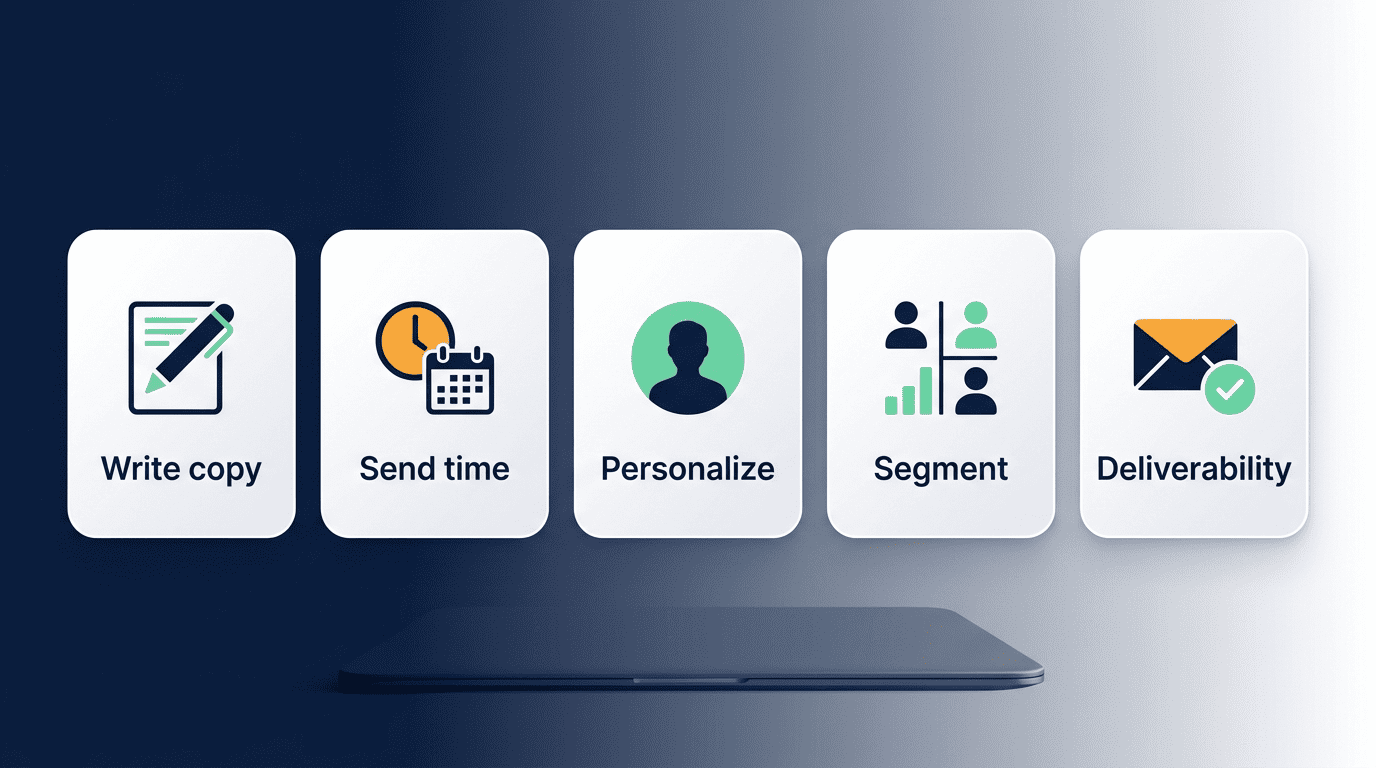
An AI email automation tool typically handles a specific mix of these five jobs, and most platforms only do two or three of them well:
- Generates subject lines and body copy — drafts variants for A/B testing or a full first pass of the email.
- Predicts send time per contact — instead of one blast time for the whole list, each recipient gets their own optimal window.
- Personalizes content by segment or behavior — swaps product blocks, offers, or tone based on past clicks and purchases.
- Scores leads and segments lists — ranks contacts by likelihood to convert so sales and marketing prioritize the same names.
- Predicts churn and protects deliverability — flags inactive subscribers and inbox-placement risk before it tanks sender reputation.
Subject-line generation and content generation are consistently among the most common AI use cases marketers report for email. Segmentation has a well-documented payoff too — industry research has long linked targeted, segmented sends to sharply higher revenue per email than one-size-fits-all blasts — which is why AI content personalization and segmentation now sit at the center of most stacks rather than at the edge.
Why it moves the numbers
The reason teams keep adding AI subject line generation and predictive send-time optimization to their stack is simple: email is still the highest-ROI channel marketers have, and AI compounds that return rather than replacing it. McKinsey research on AI in marketing and sales has found double-digit revenue uplift in functions where it’s applied, and among marketers who already use generative AI, HubSpot’s research puts the share who say it has enhanced how they do their job at around 8 in 10 — email included.
Consumer expectations are pushing in the same direction — most subscribers now expect a personalized inbox, not a mass blast, which is what makes AI content personalization less of a feature and more of a baseline requirement. Teams that skip it aren’t just leaving open-rate points on the table; they’re falling short of what their own list already expects by default.
Best AI Platform Tools (All-in-One ESPs)
For most teams running regular newsletters, promotions, or lifecycle flows, the AI lives inside the ESP itself rather than a separate app. These platform tools bundle AI email marketing tools — subject-line generation, send-time prediction, personalization — with the sending infrastructure, list management, and reporting.
| Tool | Best for | AI email marketing features | Starting price |
|---|---|---|---|
| ActiveCampaign | B2B automation | AI Campaign Builder, extensive automation triggers, predictive sending | $15/month |
| HubSpot | Full-funnel marketing | Breeze AI inside Marketing Hub | $15/seat |
| Klaviyo | Ecommerce | Smart Send Time, Segments AI, predictive CLV | $20/month |
| Mailchimp | Small business | Generative AI content tools, campaign optimization | $13/month |
| Brevo | Budget / free tier | Aura AI, free plan for 300 emails/day | Free |
| Omnisend | Ecommerce cart recovery | AI-assisted abandoned-cart flows | $16/month |
ActiveCampaign & HubSpot — automation that learns
ActiveCampaign’s AI Campaign Builder can turn a single prompt into a working campaign, and it sits on top of a large library of automation triggers that fire based on what a contact actually does — not just what list they’re on. Independent deliverability testing has put its inbox placement well above the industry average, with plans starting at $15/month.
HubSpot takes a broader approach: Breeze AI is built into Marketing Hub, which starts at $15/seat/month on annual billing, and runs on a shared AI-credit allowance rather than a flat per-seat AI fee, with outcome-based pricing available for AI agents that handle more of the campaign end to end. Both learn from the sending history in your own account rather than a generic model, which is why performance tends to improve the longer you use them.
Klaviyo, Mailchimp, Brevo & Omnisend — ecommerce-first AI
Klaviyo, built for online stores, pairs Smart Send Time with Segments AI and predictive customer lifetime value, starting at $20/month with over 350 apps in its integration marketplace covering ecommerce platforms. Mailchimp’s generative AI features aim at smaller teams that need a fast first draft, from around $13/month on discounted entry tiers.
Brevo (formerly Sendinblue) runs its Aura AI features on a genuinely usable free plan — 300 emails a day at no cost — which makes it the default starting point for anyone testing AI email marketing software before committing budget. Omnisend focuses its AI on the moment that matters most for retail: recovering abandoned carts, from $16/month.

Which of the four fits depends mostly on what you’re selling and how big the list already is:
- Small store just adding AI to existing sends → Omnisend or Mailchimp.
- Established ecommerce brand with a large list and complex flows → Klaviyo.
- Budget-constrained team that needs volume before it needs polish → Brevo’s free tier.
- Multi-channel brand that wants email AI tied to a broader CRM → Klaviyo or ActiveCampaign from the section above.
Best AI Copywriting Tools for Email
Some teams don’t have a sending or automation problem — they have a writing problem. For those, a dedicated AI email generator plugged into an existing ESP closes the gap faster than switching platforms, and it’s often the fastest-ROI addition to a stack of AI tools for marketers that’s already handling sends and automation.
Jasper writes to your brand voice, not a generic one. It’s built to hold a consistent tone across subject lines, body copy, and CTAs, which matters more in email than almost any other channel because subscribers read your brand daily. Teams that already have a working ESP but a thin content pipeline tend to add Jasper as a layer rather than migrate. See Jasper’s official site for current plans.
Copy.ai drafts a full email in about 30 seconds, with plans starting at $24/month on an annual plan. It’s built for speed over depth — useful for teams running high email volume who need a fast first pass to edit rather than a finished, on-brand draft.
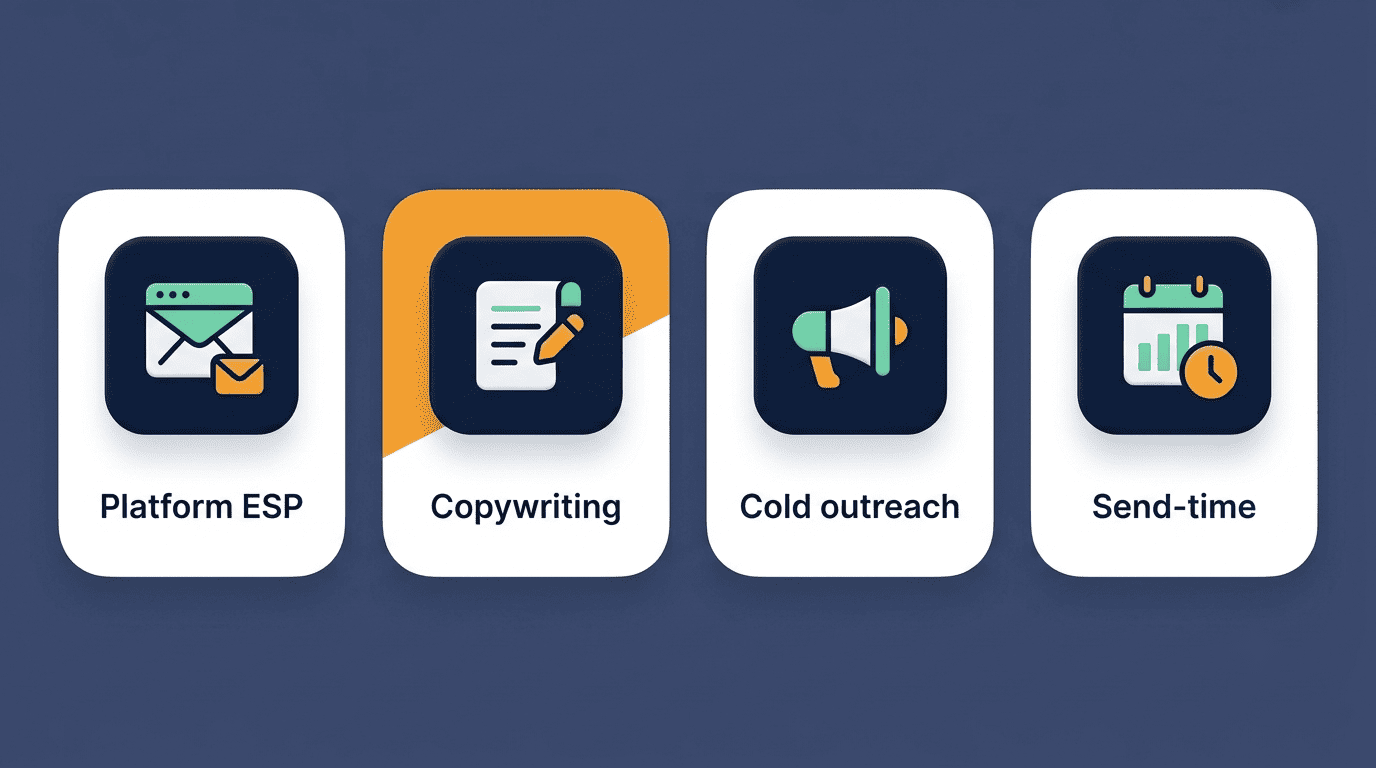
Both tools work best as an addition to an ESP’s own AI, not a replacement for the sending and automation layer — they solve the blank-page problem, not the deliverability or timing problem. Before adding one, check whether it actually covers your gap:
- Need faster drafts without losing brand voice? Jasper.
- Need a full email drafted in seconds to edit down? Copy.ai.
- Need subject lines optimized by language-performance data at scale? Phrasee/Jacquard.
- Need emotional-language optimization backed by enterprise data science? Persado.
Phrasee & Persado — enterprise language AI
Phrasee — now operating under the Jacquard brand — uses natural language generation purpose-built for subject lines and marketing copy, sold on enterprise-only custom contracts that are commonly reported starting around $24,000/year. Persado goes further into the psychology of language, optimizing word choice and emotional tone against performance data, on sales-led pricing that typically lands in six-figure annual contracts for large customers.
Both are built for large lists where a fractional lift in open rate translates into meaningful revenue, which is why they show up almost exclusively at enterprise scale rather than in small-business stacks. Neither publishes self-serve pricing — both route prospects through a sales conversation before quoting a number.
Best AI Tools for Cold Outreach and Deliverability
Marketing email and cold outreach are different problems. Outreach lives or dies on inbox placement and sender reputation, not on newsletter design, and a separate category of AI email automation tools has formed around exactly that.
Bulk senders should keep their spam rate below 0.1% and should never let it reach 0.3% or higher — rates at or above that threshold have a serious negative impact on inbox delivery.Gmail Email Sender Guidelines, Google
Instantly & Snov.io — high-volume cold email
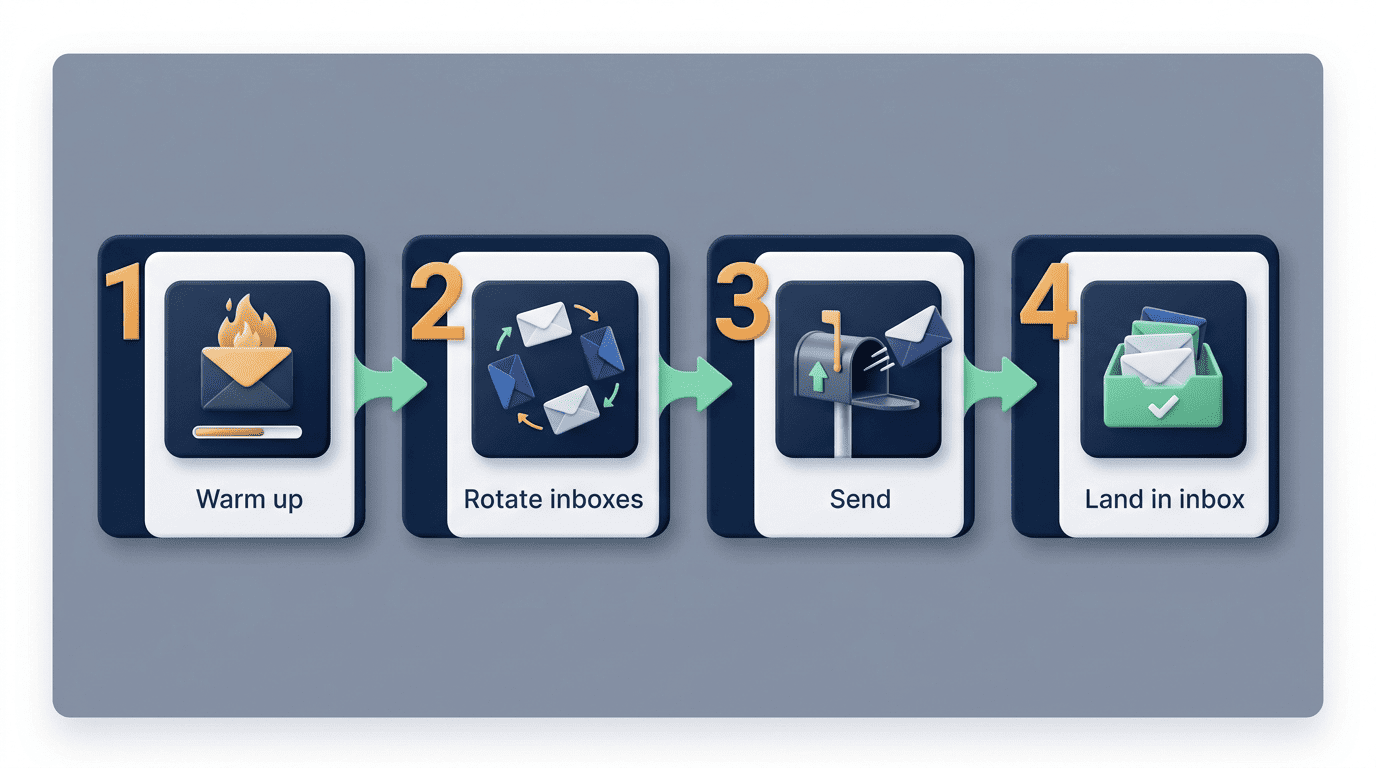
Instantly AI runs inbox rotation and warm-up infrastructure across multiple sending accounts, plus automatic follow-ups, backed by a lead database in the hundreds of millions of contacts. It’s rated 4.8/5 on G2 and starts at $37/month on annual billing ($47/month billed monthly).
Snov.io pairs an AI Email Builder with lead-finding tools and is used by an estimated 300,000 companies across more than 180 countries. Both are built for B2B teams sending high volumes where deliverability — not design — decides whether the campaign works at all.
Seventh Sense — send-time as a specialty
Seventh Sense does one thing: individual-level send-time optimization layered on top of HubSpot or Marketo, starting around $80/month for HubSpot (Marketo integration runs considerably higher). Rather than sending to a whole list at once, it delays delivery to each contact until the moment they historically tend to open email — a narrower promise than a full platform, but a sharper one.
The three tools solve different-sized slices of the same problem:
| Tool | Specialty | Scale | Starting price |
|---|---|---|---|
| Instantly | Inbox rotation + warm-up | Hundreds of millions of contacts in database | $37/month |
| Snov.io | AI email builder + lead finding | 300,000+ companies, 180+ countries | Free tier available |
| Seventh Sense | Individual send-time optimization | Layers on HubSpot or Marketo | $80/month (HubSpot) |
How to Choose the Right AI Email Tool
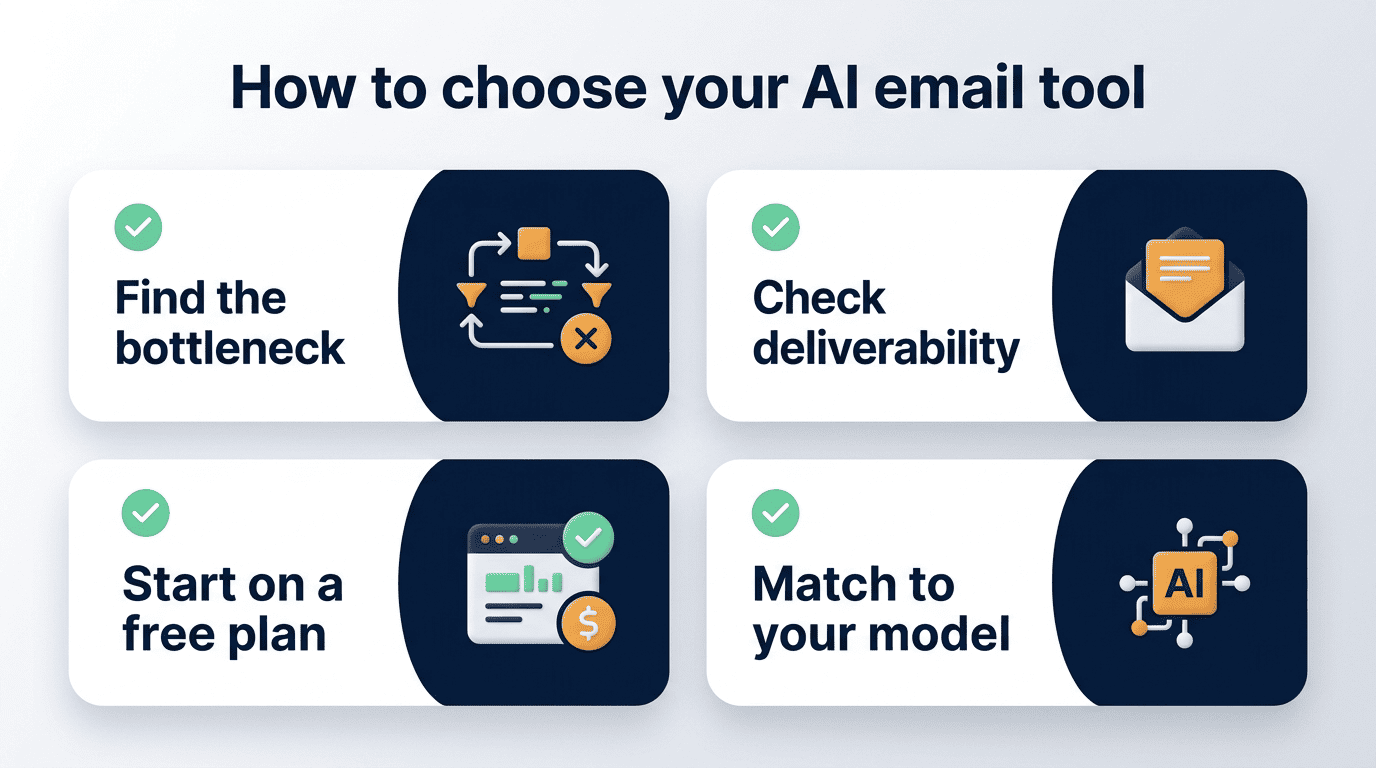
Most buying mistakes in this category come from picking a platform before identifying the actual bottleneck. Working through it in order avoids paying for automation you don’t need or missing the deliverability layer you do.
Match the tool type to your bottleneck
- Identify what’s actually broken: sending and automation (ESP), writing quality (copywriting tool), inbox placement at volume (cold outreach tool), or just timing (a specialist like Seventh Sense).
- If it’s an ESP, check inbox placement and automation depth before price — a cheap plan with poor deliverability costs more in lost sends than it saves.
- Start on a free plan where one exists — Brevo, HubSpot, and Mailchimp all offer one — before committing to an annual contract.
- Confirm the AI learns from your own account’s sending history rather than applying a generic model to every customer.
- Match the platform to the business model: ecommerce points toward Klaviyo or Omnisend; B2B nurture points toward ActiveCampaign or HubSpot; high-volume cold outreach points toward Instantly or Snov.io.
- Layer a copywriting tool like Jasper or Copy.ai on top only if writing — not sending — is the actual constraint.
This is also where AI-powered marketing tools tend to earn their budget fastest: email is measurable in a way few other channels are, so a wrong pick shows up in the open-rate report within a week, not a quarter.
Related AI marketing guides
Building a full stack? Explore AI content marketing tools and AI marketing analytics tools to round out your marketing workflow.
Frequently Asked Questions
What is the best AI tool for email marketing?
There isn’t one universal answer — it depends on the job. For sending and automation, ActiveCampaign or HubSpot lead; for ecommerce, Klaviyo; for copywriting, Jasper or Copy.ai; for cold outreach, Instantly.
Can AI write marketing emails?
Yes. Tools like Jasper and Copy.ai generate subject lines, body copy, and CTAs — Copy.ai can draft a full email in about 30 seconds — and adapt the copy to a subscriber segment. Subject-line generation is one of the most common AI use cases marketers report for email.
Is there a free AI email marketing tool?
Yes. Brevo offers a free plan covering 300 emails a day, and Mailchimp and HubSpot both have free tiers with limited AI features. Most cold-outreach tools offer a free trial instead of a permanent free plan.
How is AI used in email marketing?
Five main jobs: generating subject lines and copy, predicting the best send time per contact, personalizing content by segment or behavior, scoring leads and segmenting lists, and predicting churn or deliverability risk.
Are AI email marketing tools worth it?
For teams sending regularly, yes — email marketers commonly report returns in the $36–$42 range per $1 spent, and McKinsey research points to double-digit revenue uplift where AI is applied in marketing and sales. Start with one tool aimed at your biggest bottleneck rather than a full stack.