
How to Choose AI Marketing Tools: A Practical 7-Step Framework
The hard part of AI marketing isn’t finding options — it’s picking the right ones. There are thousands of AI marketing tools on the market now, and the difference between a purchase that pays for itself and one you quietly abandon in six months comes down entirely to how you choose.

This guide walks through a repeatable framework — define the problem, match a category, test integration, pilot, and measure ROI — so you buy for outcomes, not hype. One stat worth anchoring the urgency: 97% of marketing leaders now say AI proficiency is vital to their job.
Why Choosing the Right AI Marketing Tool Matters
Organizations that select AI tools strategically report roughly 50% time savings and a 25% lift in operational efficiency. That gap between winners and everyone else isn’t about which vendor they picked — it’s about whether they had criteria before they picked anything. Tools adopted without a clear definition of the problem they’re meant to solve get abandoned within six months, regardless of how capable the underlying model is.
The demand for that discipline is only growing. 97% of marketing leaders say AI proficiency is now vital to job performance, according to the 2025 Sprout Social Index. Of those leaders, roughly half plan to maximize the AI tools they already own, while the other half plan to invest in new ones. That near-even split is exactly why a selection framework matters more than a shopping list — half the market is trying to avoid buying anything new at all.
Step 1 — Start With the Problem, Not the Tool
Every AI marketing tool purchase should start as a response to a problem, not a reaction to a demo. Skipping this step is the single most common reason evaluations drag on for months and still end with the wrong shortlist.
Define a specific outcome
Write the problem as a measurable outcome, not a vague aspiration. “Improve marketing” isn’t a brief a vendor can build against. “Cut first-draft writing time in half” or “score inbound leads by likelihood to convert” is.
A concrete problem statement instantly narrows the field of relevant AI-powered marketing tools and gives you a success metric you can reuse later during the pilot stage. It also gives everyone on the buying committee the same yardstick, which cuts down on debates driven by which vendor gave the flashiest demo.
Audit what you already have
Before you shop, check whether your current CRM, email platform, or analytics suite already ships the AI feature you’re about to pay for separately. Maximizing the AI already built into your existing tech stack is the first and cheapest defense against tool sprawl — the slow accumulation of overlapping subscriptions that nobody fully uses.
Run this audit before you open a single vendor website. Most established marketing platforms have shipped generative or predictive features in the last two years, and a feature you assumed you’d need to buy separately is often already sitting unused inside a tool you’re already paying for.
Step 2 — Match Your Need to a Tool Category
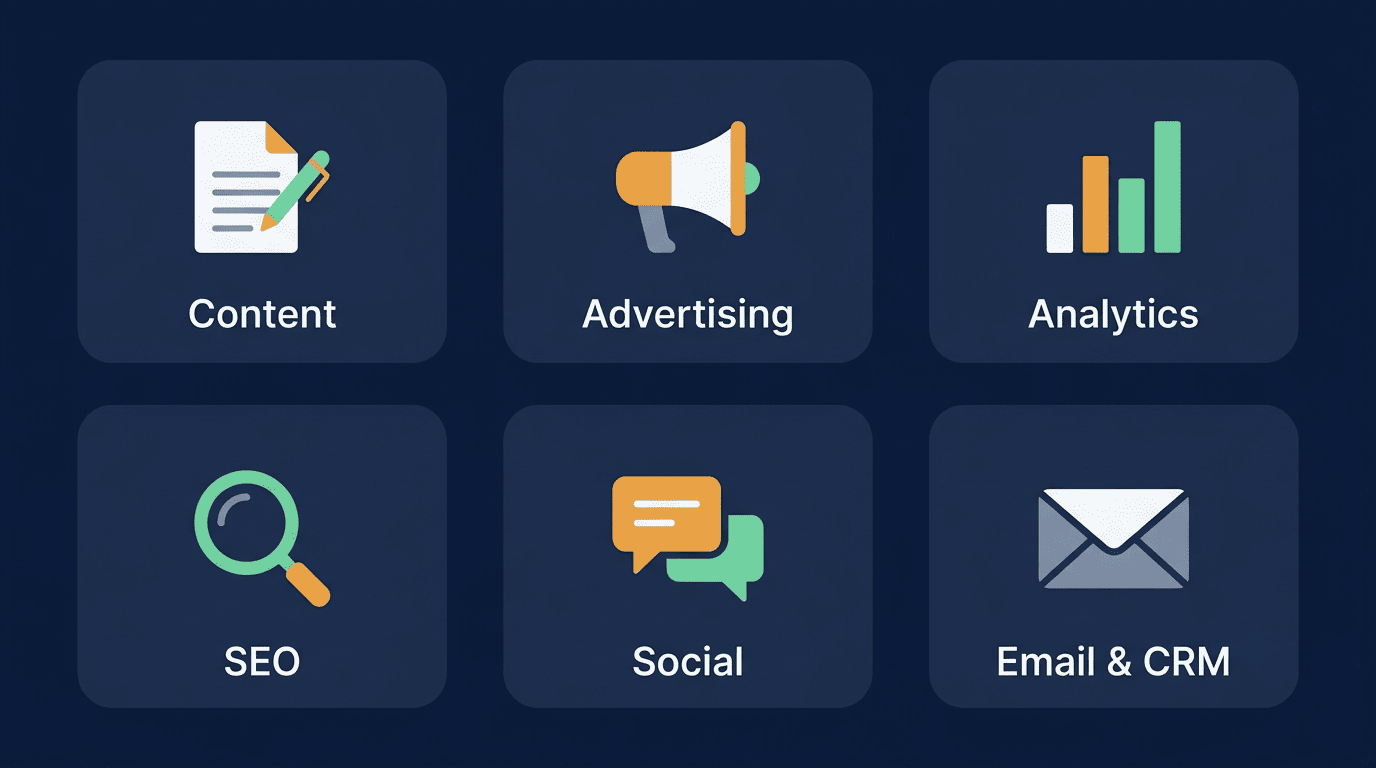
AI marketing tools cluster into a small number of recognizable categories, and it pays to know them before you start comparing vendors:
- Content generation — drafting, editing, and repurposing copy, from blog posts to ad variants
- Advertising and bid optimization — automated bidding, budget allocation, and creative testing
- Analytics and predictive insights — forecasting, attribution, and customer scoring
- SEO and AI visibility — keyword research, content gap analysis, and now visibility inside AI answer engines
- Social media management — scheduling, listening, and generative captions
- Email and CRM automation — segmentation, send-time optimization, and lifecycle triggers
Different tools are built for different jobs — a content generation engine and a bid optimization engine solve nothing alike, even when both get marketed as “AI marketing tools.” If content is your specific gap, our deeper breakdown of AI tools for content marketing covers that category on its own.
Map the category to your funnel stage
Top-of-funnel content, mid-funnel nurture, and bottom-funnel attribution each favor a different category of tool. A generative writing assistant does little for a business whose real bottleneck is lead scoring at the bottom of the funnel. Pick the category that matches the stage where your biggest bottleneck actually lives, not the category that’s easiest to demo.
If you’re not sure where the bottleneck sits, pull the last quarter’s funnel numbers before you shortlist anything. The stage with the steepest drop-off is almost always where an AI tool will show the fastest, most measurable return.
| Funnel stage | Primary bottleneck | Matching tool category |
|---|---|---|
| Top of funnel | Content volume and speed | Content generation, SEO/AI visibility |
| Mid funnel | Lead qualification and nurture | Email/CRM automation, predictive analytics |
| Bottom of funnel | Conversion and attribution | Analytics and predictive insights, advertising/bid optimization |
Step 3 — Check Data Quality and Integration
An AI marketing tool is only as good as the data it reads. Without clean, relevant, first-party data, the model is just guessing — a well-tuned algorithm fed messy or incomplete data will still produce unreliable recommendations. Before signing anything, confirm the tool can actually access your first-party data, not just public information scraped from the web.
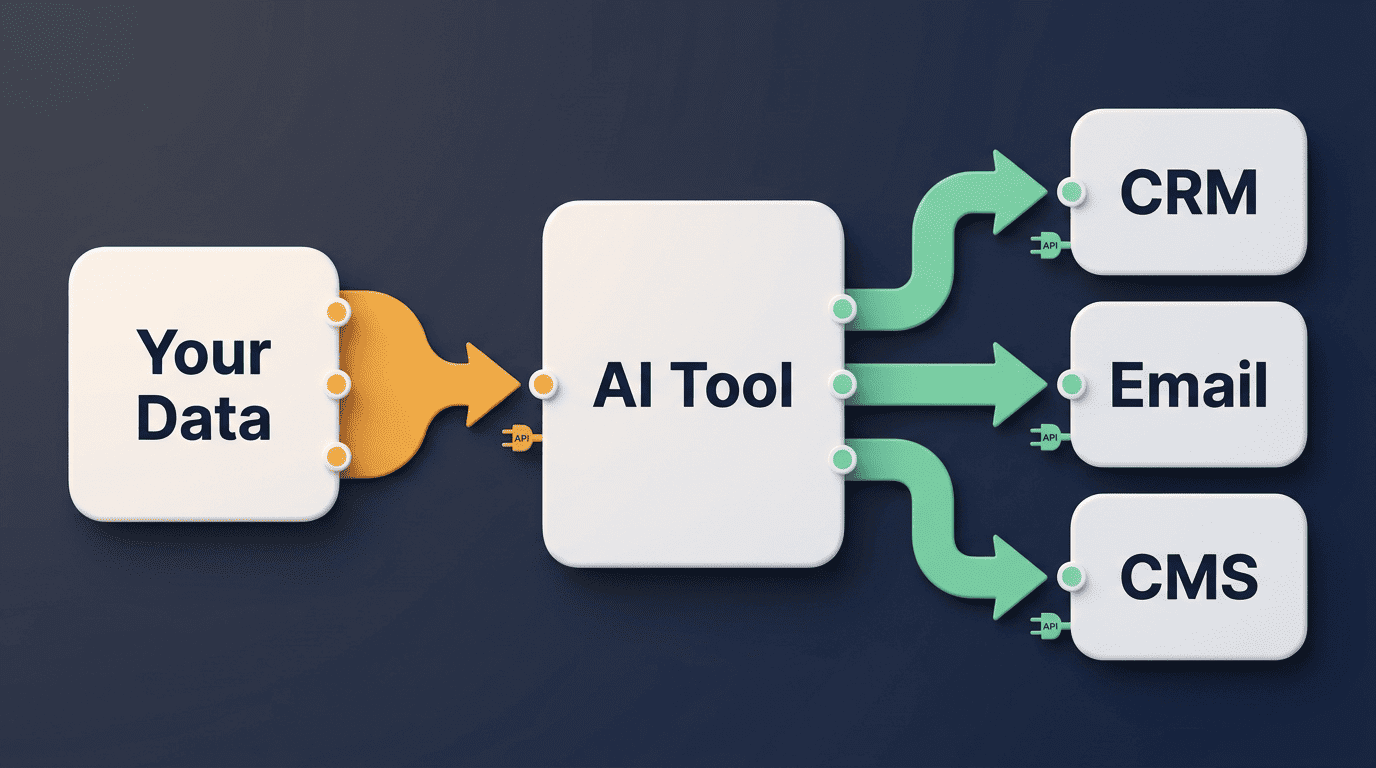
Native integrations matter as much as raw model quality. Prioritize tools with direct connections to your CRM, email platform, and CMS, since every manual export-import step is a place data quality degrades. Where native links are missing, connector ecosystems become the fallback — some automation platforms link thousands of apps, and CRM vendors like ActiveCampaign report 900+ native integrations. Check API support and how smoothly a candidate tool actually fits your current stack before you check its feature list.
Here’s a quick checklist for the data-quality conversation with any vendor:
- Does it connect natively to your CRM, ESP, and analytics stack, or require manual CSV exports?
- Can it read first-party behavioral data, not just aggregated or public data?
- Does it document its API and rate limits publicly?
- Who owns the data once it’s inside the tool, and can you export it back out?
Step 4 — Evaluate Ease of Use, Team Fit, and Scalability
Match tool complexity to your team’s actual skill level. The best AI marketing tools for a lean team are rarely the most powerful ones — some AI marketing platforms assume machine-learning fluency, while others are built as no-code interfaces that, as one vendor puts it, “don’t need a tech wizard” to operate. Involve the people who will use the tool daily in the evaluation — not just the buyer signing the contract — because adoption fails at the desk, not the boardroom.
Confirm the tool scales with your growth and offers real support and structured training, not just a knowledge-base link. Thin onboarding is one of the most common reasons adoption stalls after the initial excitement of a new purchase wears off. A few questions worth asking any shortlisted vendor directly:
- What does onboarding actually include — live training, documentation, or both?
- Is pricing per seat, per usage, or flat — and how does it change as your team grows?
- What happens to your workflows if you need to switch tools later?
Step 5 — Compare Pricing and Total Cost of Ownership
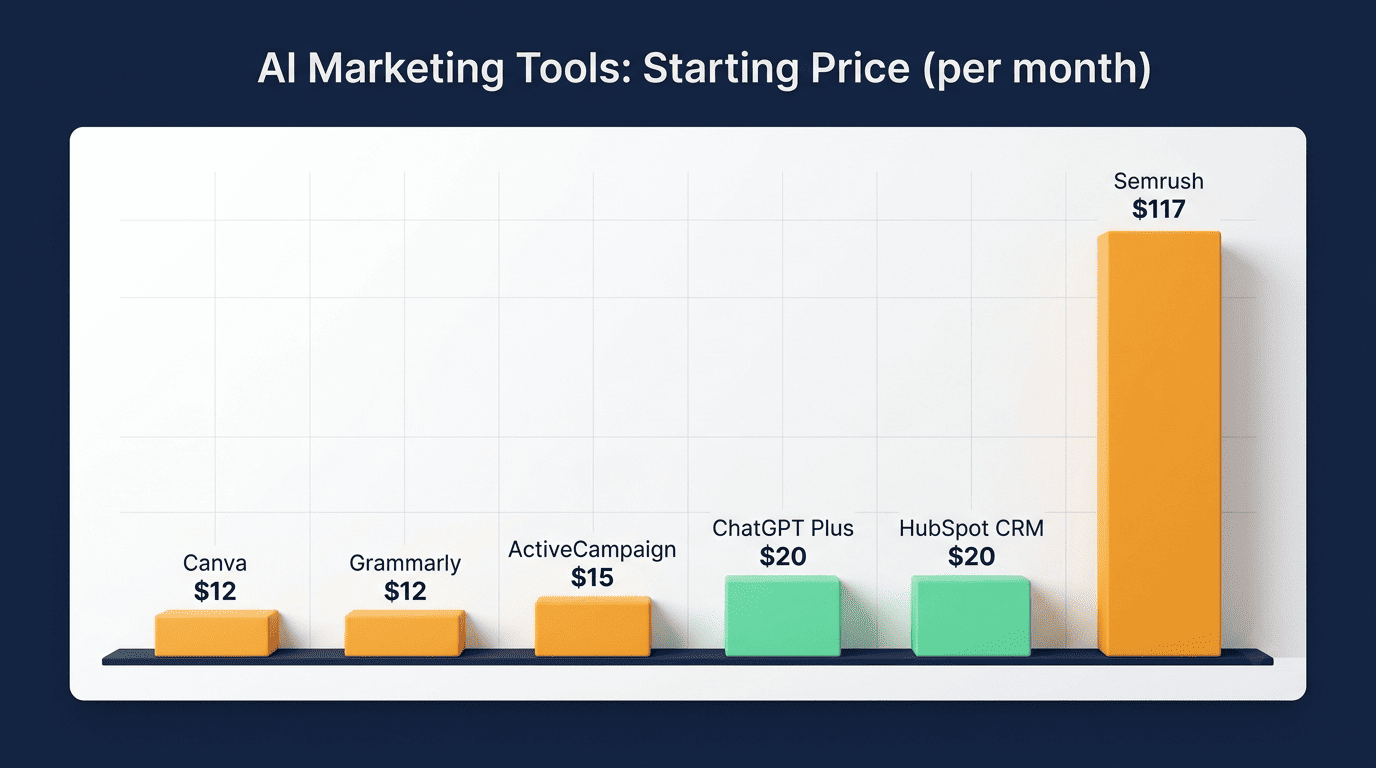
Subscription price is only part of the cost. Implementation time, staff training, ongoing maintenance, and switching costs if the tool doesn’t work out all belong in a real total cost of ownership calculation — not just the number on the pricing page.
| Tool | Starting price | Category |
|---|---|---|
| ChatGPT Plus | ~$20/mo | Content generation |
| Canva | from ~$12/mo | Content/creative |
| Grammarly | from ~$12/mo | Content editing |
| Notion AI | ~$20/user/mo (bundled into the Business plan) | Content/workflow |
| Semrush | from ~$117/mo | SEO/AI visibility |
| HubSpot CRM | from ~$20/user/mo | CRM/email automation |
| ActiveCampaign | from ~$15/mo | Email/CRM automation |
Pricing shifts often, so treat these as anchors for budgeting conversations rather than final quotes — always confirm current tiers directly with the vendor, for example on OpenAI’s ChatGPT pricing page or HubSpot’s pricing page.
Many strong AI marketing tools also offer free tiers worth piloting before you commit budget to anything. If your budget is tight this quarter, our roundup of free AI tools for marketing is a reasonable place to start, upgrading only where the paid tier proves out real ROI.
Step 6 — Run a 30–60 Day Pilot and Measure ROI
A pilot only tells you something useful if it’s structured before it starts, not evaluated after the fact. Run it against your messiest real workflow — never the polished vendor demo — because that’s where integration gaps and adoption friction actually surface.
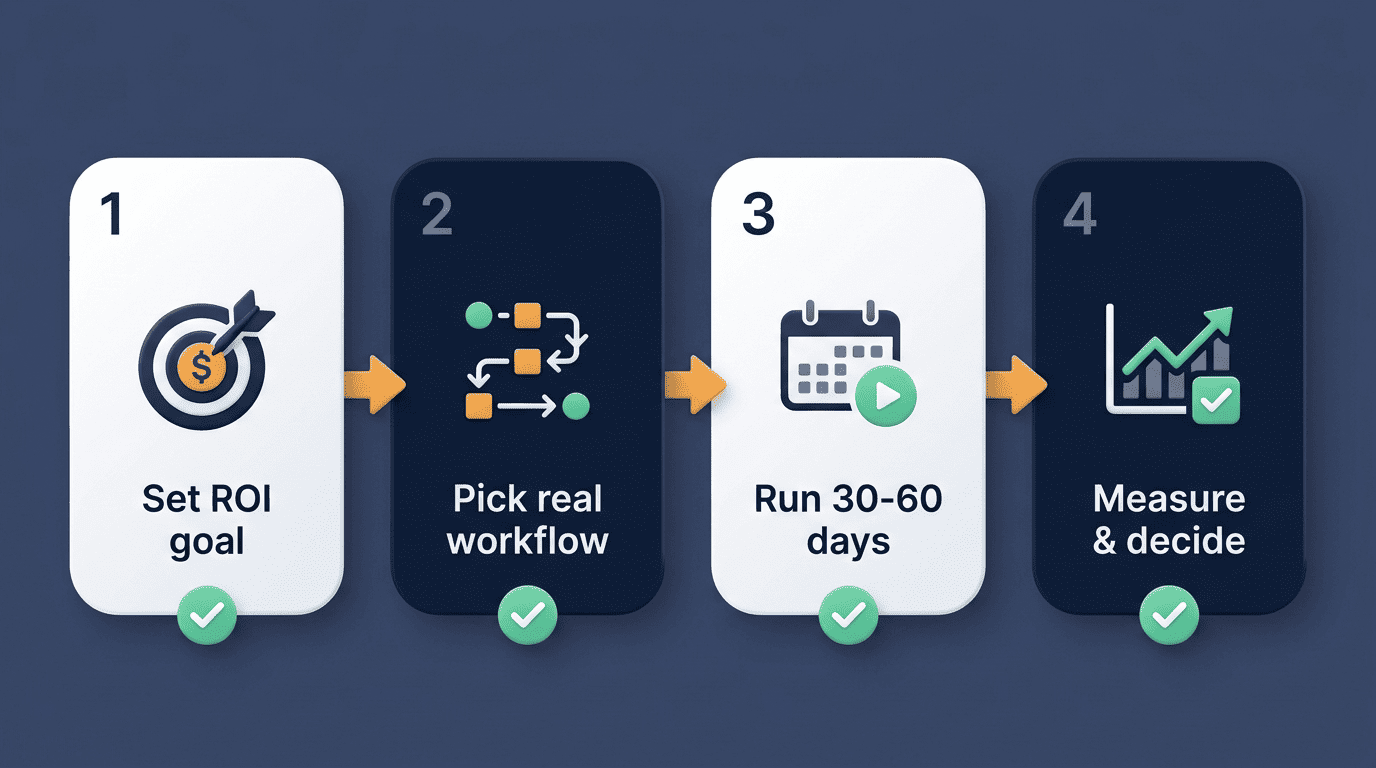
- Define what “worked” means in one measurable number before day one — time saved, leads scored, or cost per asset.
- Choose one real, imperfect workflow to run the pilot on, not a clean sandbox.
- Involve the actual end users, not just the buyer, from day one of the trial.
- Track the metric weekly for 30–60 days rather than waiting until the end to check in.
- Compare the result against your pre-set number, not against how impressive the tool felt to use.
- Decide to scale, renegotiate, or walk away based on that comparison — not on sunk cost.
Strategic pilots are also where outsized results tend to show up: one widely cited Albert.ai deployment for a Harley-Davidson dealership reportedly drove a 2,930% jump in leads over three months. Results at that scale are the exception, not the baseline expectation — but they illustrate why measuring within a defined window, rather than eyeballing results, is what turns a pilot into a real go/no-go decision.
The NIST AI Risk Management Framework (AI RMF) is intended for voluntary use and to improve the ability to incorporate trustworthiness considerations into the design, development, use, and evaluation of AI products, services, and systems.NIST AI Risk Management Framework (AI RMF 1.0)
Step 7 — Watch for Red Flags: Black Boxes, Data Risk, and Tool Sprawl
Avoid black-box tools. You should be able to understand, at least at a working level, how a model reaches its outputs, and the vendor should be transparent about the data it trains and runs on, what it integrates with, and its intended use. If a sales team can’t explain how a recommendation was generated, that opacity becomes your problem the first time a campaign underperforms and you can’t diagnose why.
Confirm privacy and security compliance for customer data. Any tool touching customer records should meet your organization’s existing data-security bar, not a lower one negotiated in the sales process. Ask specifically how customer data is stored, whether it’s used to train the vendor’s models, and how deletion requests are handled.
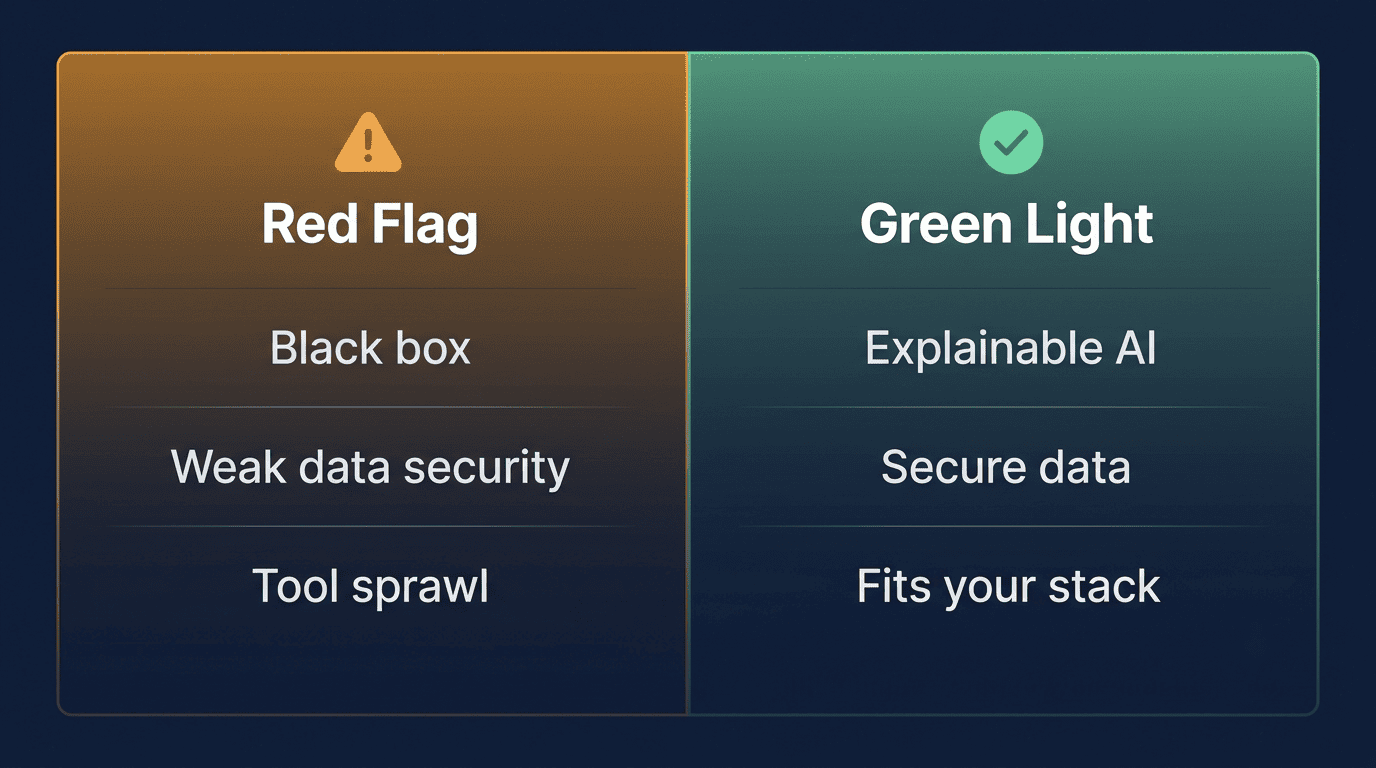
Don’t let tools multiply. Overlapping, half-used subscriptions quietly drain both budget and attention, and nobody notices until the renewal invoices pile up. A short audit checklist for spotting sprawl before it compounds:
- Two or more tools doing substantially the same job on different teams
- Subscriptions with active users below a handful per month
- Tools bought for a pilot that never got a formal renew/cancel decision
- Features you’re paying for separately that your CRM or CMS already includes natively
Consolidate before you add: maximize the AI already built into your existing platforms before signing anything new. Worked through deliberately, these seven steps turn a crowded market of AI tools for marketing into a short, defensible shortlist — chosen for the outcomes they deliver rather than the features they demo.
Frequently Asked Questions
How do I choose the right AI marketing tool?
Start from a specific problem, match it to a tool category, verify integration and data quality, run a 30–60 day pilot, and keep only what proves measurable ROI.
What should I look for in an AI marketing tool?
Problem-solution fit, native integration with your stack, data quality and security, ease of use for your team, transparent (explainable) AI, scalability, and a clear ROI path.
Are AI marketing tools worth it?
Yes when chosen deliberately — organizations report roughly 50% time savings and 25% efficiency gains — but tools bought without criteria are commonly abandoned within six months.
How much do AI marketing tools cost?
From free tiers to enterprise. Common entry points: ChatGPT Plus around $20/mo, Canva and Grammarly from around $12/mo, HubSpot CRM from around $20/user/mo, and Semrush from around $117/mo — plus implementation and training in the true total cost.
How do I evaluate an AI tool before buying?
Run a structured 30–60 day pilot on a real workflow with pre-set success metrics, involve the end users, and compare total cost of ownership — not just the subscription price.
How many AI marketing tools should I use?
As few as solve your defined problems. Avoid tool sprawl by exhausting the AI already built into your CRM, email, and analytics platforms before adding new subscriptions.