
Free AI Tools for Marketing: 12 That Are Actually Worth Using in 2026
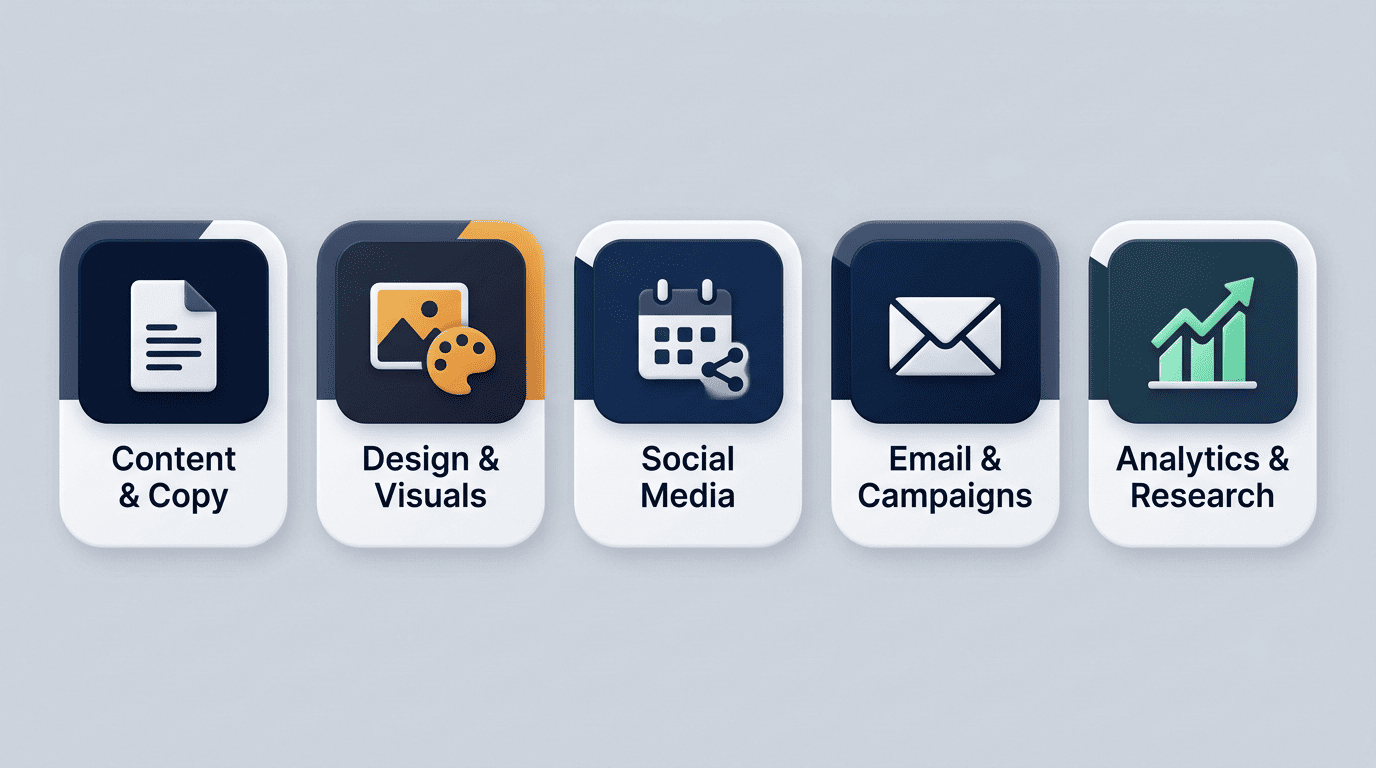
You do not need a big budget to put AI to work in your marketing. A short list of free AI marketing tools now covers content, design, social, email, and analytics on free tiers generous enough to run a real workflow, not just a demo. This guide sorts through the noise and organizes the tools by category, with the free-tier limits spelled out so you know exactly what you are getting.

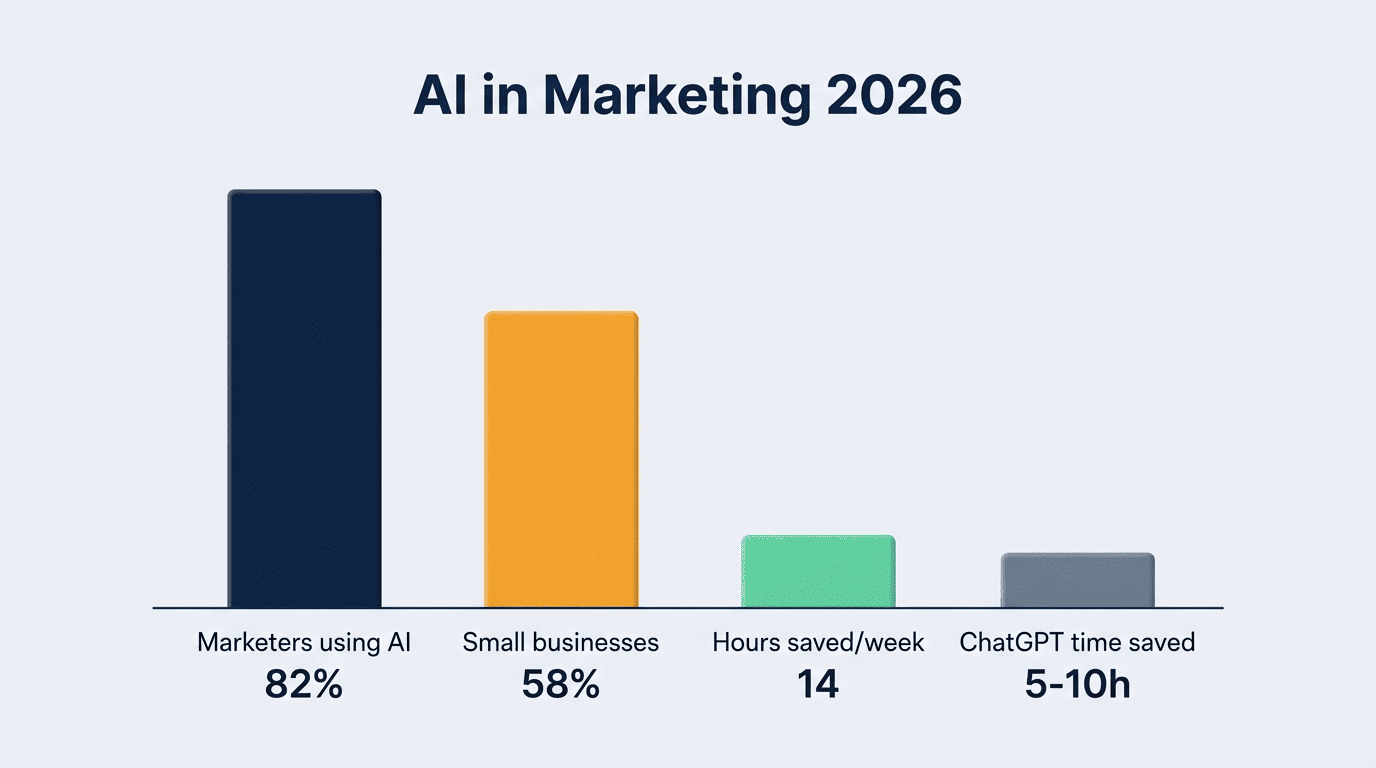
Adoption is already mainstream: 82% of marketers say they now use AI for marketing, and daily AI users report saving roughly 14 hours a week. The trick is knowing which free plans are generous enough to build on and where the limits actually kick in.
Why Free AI Marketing Tools Are Worth It in 2026
Marketing teams of every size are folding AI tools into daily work, and the free tiers are doing most of the heavy lifting. The pattern is consistent across surveys: people are not experimenting anymore, they are relying on these tools to get work out the door faster.
The adoption is real, and so are the time savings
Most of the gains show up as hours returned to the week, not abstract efficiency claims. Small businesses in particular have moved fast, and the tools they picked first tend to be the ones with the strongest free tiers.
- 82% of marketers say they now use AI for marketing tasks
- Daily AI users (“power users”) save roughly 14 hours a week on average
- 58% of small businesses now use AI tools in some part of their operations, per the U.S. Chamber of Commerce
- Marketers commonly report saving 5-10 hours a week on drafting and editing with tools like ChatGPT
- Canva AI reportedly cuts design production time by up to 80% on comparable creative work
- In a 2025 field experiment on an ad-creation task, human-AI teams produced 73% more output than human-only teams
In that same field experiment, human-AI teams produced roughly 73% more output than human-only teams on the ad-creation task tested, which is a useful data point for adding a free AI tool to an existing workflow rather than replacing it.
What “free” really means (freemium and free-tier limits)
Nearly every tool on this list runs a freemium model: a free-forever tier with real functionality, plus paid upgrades once you outgrow it. That is different from a time-limited trial — you keep access, but with caps.
| Tool | Free-tier limit |
|---|---|
| Buffer | 3 channels, 10 scheduled posts per channel |
| Brevo | 300 emails per day |
| AnswerThePublic | Up to 3 searches per day with a free account |
| Vizard | 60 minutes of video upload credit (free plan) |
| Canva | Free-forever core plan, ~50 Magic Studio AI credits/month |
The free tier exists so you can validate whether a tool earns a place in your stack before you pay for it. Treat the cap, not the price tag, as the real test.
Free AI Tools for Content & Copywriting
Copywriting is where most marketers start, because a first draft from AI is almost always faster than a blank page. Four tools cover most of the ground here, each with a different strength.
ChatGPT — the all-purpose marketing writer
ChatGPT’s free tier writes emails, blog drafts, social posts, ad copy, and customer-facing replies, and it is the closest thing to a general-purpose marketing writer among free AI tools for digital marketing. It works well as a first-draft engine you then edit for brand voice. The paid ChatGPT Plus plan runs $20/month and adds newer models plus higher usage limits, which matters once you are generating content daily.

Copy.ai, Notion AI & Grammarly
Copy.ai’s free plan handles short-form marketing copy — headlines, product descriptions, and ad variations — without a learning curve. Notion AI, now bundled into Notion’s Business plan at $20 per member/month after its free trial credits run out, is strongest for ideation and content that lives inside a shared doc or wiki. Grammarly’s free tier polishes tone, clarity, and grammar across everything you publish, from emails to landing pages, and it is the one tool on this list most people already have running in the background. Google Gemini is worth adding to the rotation too — its free tier is a solid second opinion for research and long-form drafts, and it is already built into Gmail and Google Docs for marketers who live in that ecosystem.
Free AI Tools for Design & Visuals
Design used to be the bottleneck that forced marketers to wait on a designer or a paid stock photo subscription. AI-assisted design tools have mostly closed that gap.
Canva AI (Magic Studio) — design without a designer
Canva’s free-forever plan includes Magic Media (text-to-image generation) with roughly 50 AI credits a month, enough for a solo marketer to produce social creatives, ad variants, and blog visuals without hiring outside help — reportedly cutting design time by up to 80% on comparable work. Some advanced Magic Studio tools, like Magic Eraser and Magic Edit, are gated behind Canva Pro. One client, Conversational, credited Canva-made visuals for a reported 1,100% jump in social engagement after adopting the workflow. Canva Pro, if you need brand kits, more storage, and the full Magic Studio toolkit, runs around $120/year.
Adobe Firefly & Leonardo.ai for AI image generation
When templates are not enough, Adobe Firefly and Leonardo.ai both offer free image-generation credits — Firefly resets 25 generative credits monthly, Leonardo resets 150 Fast Tokens daily — and Firefly is built to be commercially safer for brand use since Adobe trains it on licensed and public-domain content.
Free AI Tools for Social Media
Scheduling and repurposing content eats hours every week, and this is one of the categories where free tools genuinely replace a paid subscription for a small team.
Buffer’s free plan covers 3 channels, 10 posts per channel, and 100 AI-generated content ideas, plus an AI Assistant that drafts captions — enough to run a small brand’s organic posting cadence without paying anything. Hootsuite offers a 30-day free trial rather than a permanent free tier, so it is better suited to a short evaluation than an ongoing free workflow. Vizard’s free plan includes 60 minutes of video upload credit, turning long-form footage into short, captioned social clips automatically — useful if you already have webinar or podcast footage sitting unused.
- Connect your top 2-3 social channels to Buffer’s free plan.
- Use the AI Assistant to draft a week of captions from your existing content.
- Schedule 10 posts per channel to fill the free-tier allowance.
- Pull any long-form video you have into Vizard to generate short clips.
- Review AI drafts for brand voice before anything goes live.
- Track which posts get the most engagement and repeat that format.
- Upgrade only the channel that hits its free-tier cap first.
Free AI Tools for Email & Campaigns
Email remains one of the highest-ROI marketing channels, and the free AI tools here focus on cutting the time between “we need a campaign” and assets that are ready to send.
HubSpot Campaign Assistant + Free CRM
A free AI campaign generator can turn three inputs — a topic, target audience, and goal — into landing page copy, marketing emails, and ad copy for Google, Facebook, and LinkedIn in about 60 seconds, compared with the weeks a traditional campaign build can take. Pairing a free campaign generator with a free CRM tier gives a small team a place to store and segment the contacts those campaigns generate, without paying for either tool separately.
Free AI email tools (Brevo, Mailchimp, MailerLite)
Brevo’s free plan allows up to 300 emails per day, which is enough for most small-list senders. AI-assisted subject lines and send-time optimization across these platforms are worth using — vendors like Mailchimp offer built-in subject-line testing and an AI subject-line helper, and A/B testing subject lines against your own baseline is worth the extra few minutes even on a free plan.
Free AI Tools for Analytics & Research
Content and design get the attention, but research and measurement tools are what tell you whether any of it is working.
Google Trends & Google Analytics
Both are free forever and remain the foundation of demand and performance research for most marketing teams. Google Trends surfaces rising queries and seasonal demand shifts before they show up in your own traffic data. Google Analytics (GA4) applies machine-learning models to generate insights and predictive metrics — Google is careful to note this is closer to applied machine learning than general-purpose AI, but the practical effect for marketers is the same: forecasts and anomaly detection without manual analysis.
AnswerThePublic for content ideas
The free tier — up to 3 searches a day with a free account — maps the actual questions your audience is typing into search engines. For a small content or SEO team, that is often more useful than a paid keyword tool, because it surfaces phrasing you would not have guessed.
The Catch: Limits, Privacy & When to Upgrade
Free AI tools are not a permanent substitute for judgment, and treating them that way is the most common mistake marketers make with this stack.
Where free tiers stop
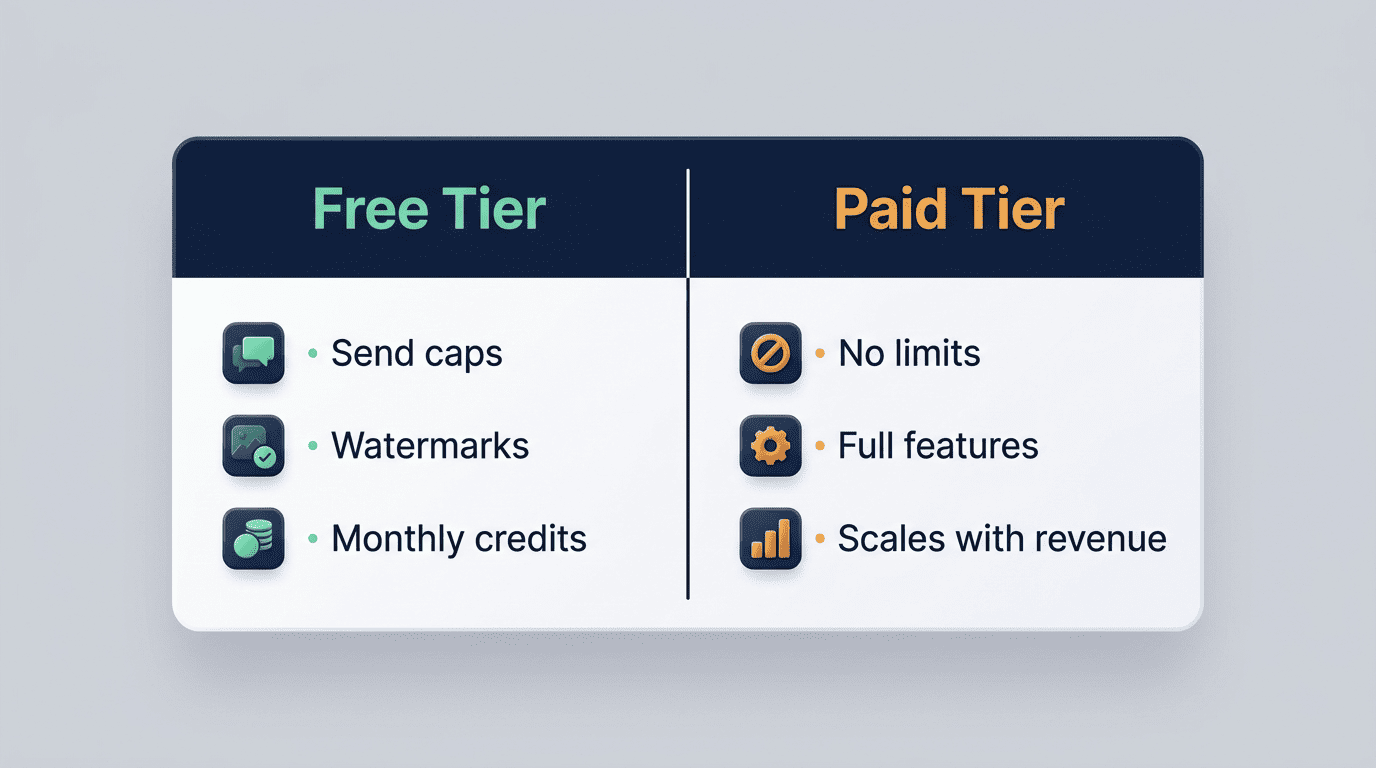
Four places free plans quietly stop scaling:
- Send caps — daily or monthly email and message limits
- Watermarks — on exported images, videos, or design assets
- Channel and post limits — how many accounts and scheduled posts you can run at once
- Monthly generation credits — capped AI image, video, or content generations
When a tool becomes core to how you generate revenue, the paid tier usually pays for itself within a month or two.
Privacy and human oversight
Do not paste sensitive customer data — names, purchase history, support tickets — into public AI tools without checking how that tool handles data retention, and confirm your obligations under GDPR or CCPA if you serve those regions. A few habits keep a free AI marketing stack safe to run:
- Strip names, emails, and order details before pasting customer data into a chat tool
- Check each tool’s data-retention and training-use settings before adopting it
- Keep a human editor reviewing every AI draft before it reaches a customer
- Re-check GDPR/CCPA obligations whenever a new tool touches EU or California contacts
Most agentic AI projects right now are early stage experiments or proof of concepts that are mostly driven by hype and are often misapplied.Anushree Verma, Gartner
Gartner has predicted that over 40% of agentic AI projects will be canceled by the end of 2027 due to escalating costs and unclear business value, which is a useful reminder that adopting AI tools deliberately — one workflow at a time — beats bolting on every new tool that launches.
How to Build a Free AI Marketing Stack
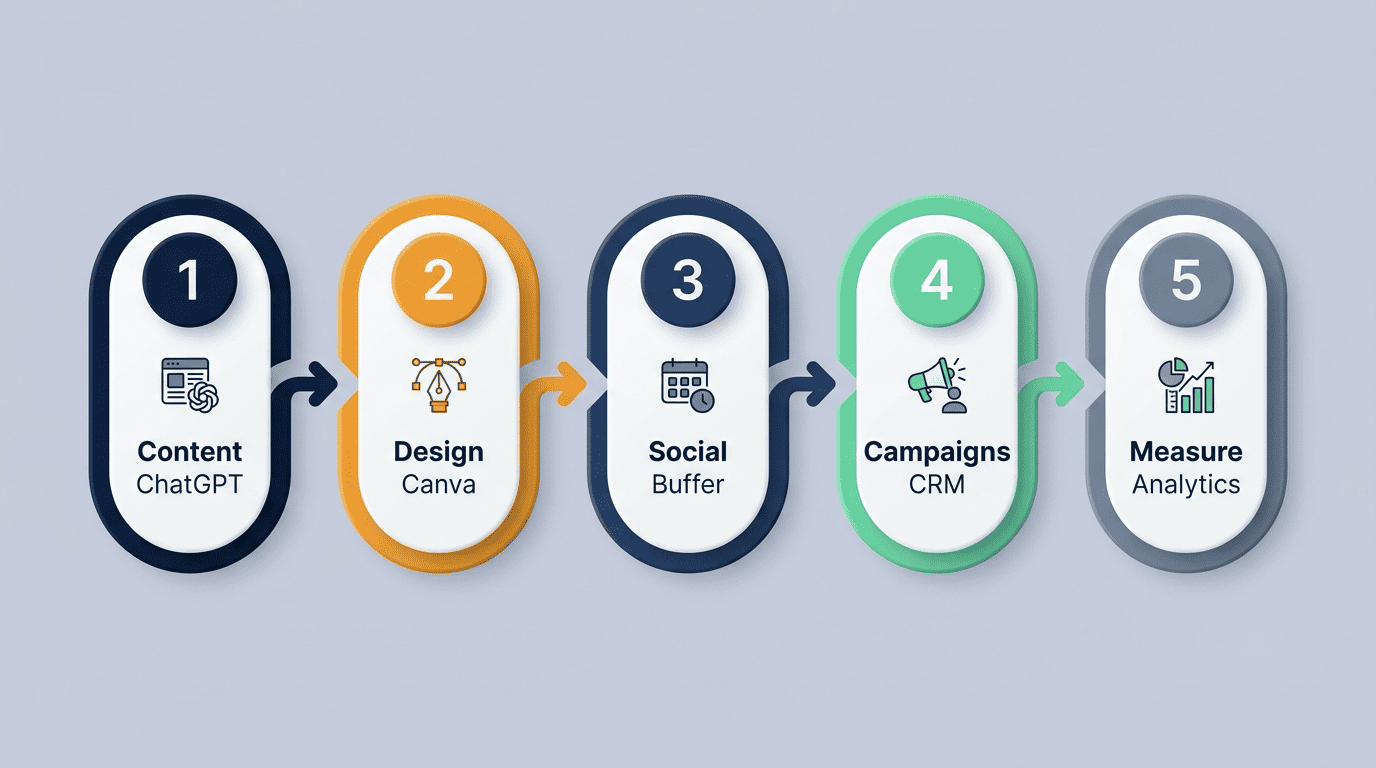
A practical free stack covers five jobs, one tool each:
- Copy and drafts — ChatGPT
- Design and creative — Canva AI
- Social scheduling — Buffer
- Campaigns and contacts — a free campaign generator plus a free CRM tier
- Research and measurement — Google Trends and Google Analytics
Each piece is free on its own, and together they cover the full loop from idea to published content to measured result.
| Function | Free tool | Monthly cost |
|---|---|---|
| Copywriting | ChatGPT | $0 |
| Design | Canva AI | $0 |
| Social scheduling | Buffer | $0 |
| Campaigns + CRM | HubSpot free tier | $0 |
| Research + measurement | Google Trends / Analytics | $0 |
Start with one workflow — usually content or social, since those show results fastest — measure what actually improves, and only upgrade the specific tool that hits its free ceiling. Adding five new AI tools at once is how most marketing teams end up not using any of them well.
Related AI marketing guides
Building a full stack? Explore AI content marketing tools and AI marketing tools for small business to round out your marketing workflow.
Frequently Asked Questions
What is the best free AI tool for marketing?
There is no single winner — it depends on the job. ChatGPT is the strongest all-around free writer, Canva leads for design, Buffer covers social scheduling, and a free campaign generator like HubSpot’s handles full campaign assets.
Is there a free AI marketing tool?
Yes, several. ChatGPT, Canva AI, Grammarly, Buffer, Google Trends, and Google Analytics all offer permanent free tiers with real functionality, not just time-limited trials.
Can I use ChatGPT for marketing for free?
Yes. ChatGPT’s free tier handles emails, blog drafts, social posts, and ad copy. The $20/month Plus plan adds newer models and higher usage limits if you scale up.
What AI tools do marketers use?
Common picks include ChatGPT, Canva AI, Grammarly, Notion AI, Copy.ai, Google Gemini, Buffer or Hootsuite for social, and Google Analytics or Google Trends for research.
Are free AI marketing tools worth it?
For most small teams, yes. 82% of marketers now use AI for marketing, and daily power users save roughly 14 hours a week. Free tiers are generous enough to validate value before you pay for anything.
When should I upgrade from a free plan?
Upgrade when free-tier limits — send caps, channels, credits, or watermarks — start blocking growth, or when a tool becomes central to how you generate revenue.