
AI Tools for Social Media Marketing: The 2026 Stack That Actually Saves You Hours
Social teams now spend more time approving AI drafts than writing from scratch. The best AI marketing tools for social media handle the grind — captions, resizing, scheduling, listening — so you focus on strategy, not on staring at a blank compose box.
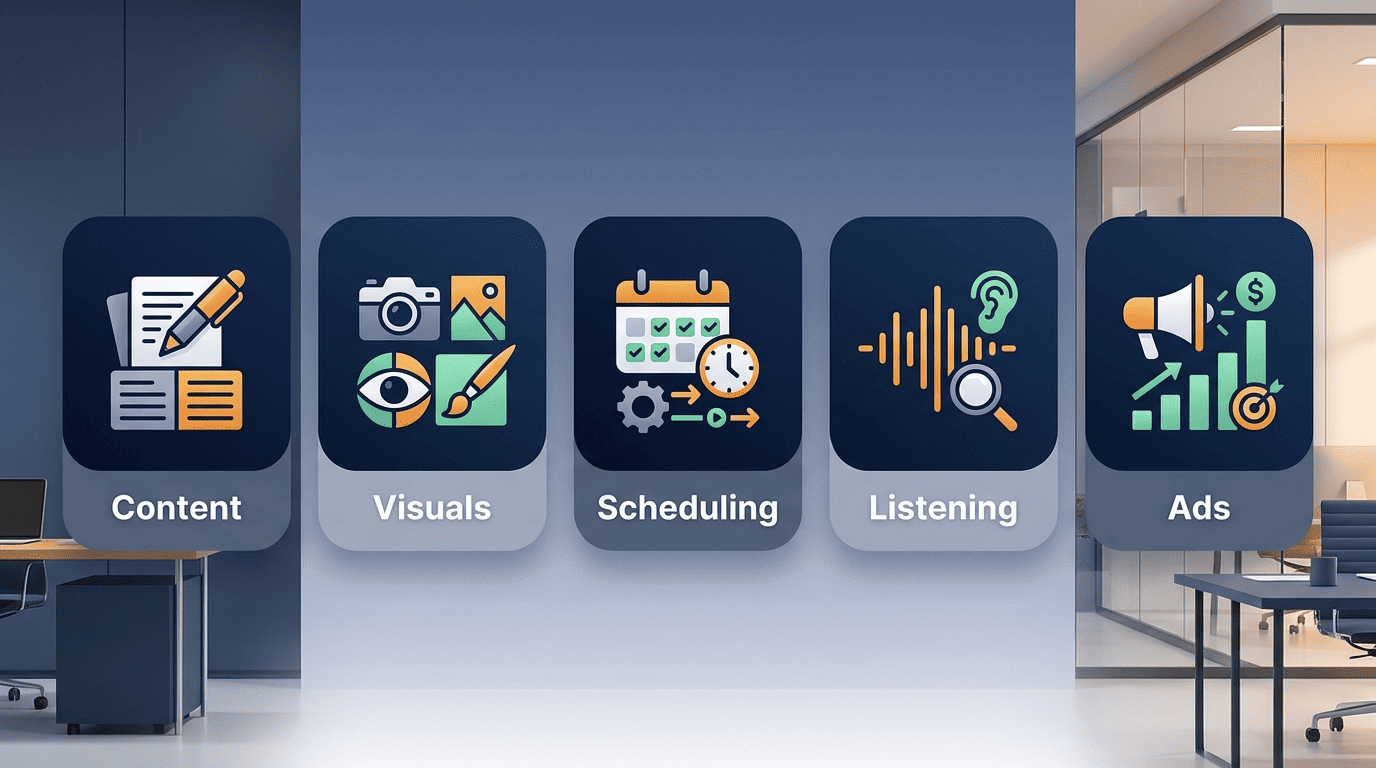
That shift is already the norm, not the exception. Sprout Social’s 2026 Index research puts AI adoption for content production well above 90% among marketing teams, and separate surveys show roughly 70% of marketers now use AI to speed up content creation. This guide breaks AI social media tools down by the five jobs they actually do, not by brand-name popularity, so you can match a tool to your bottleneck instead of buying another dashboard you’ll open twice.
What AI Social Media Tools Actually Do (5 Jobs, Not 50 Brands)
Every “best AI tools” roundup lists 20+ logos and calls it a day. That’s not useful when you’re trying to fix one specific problem — say, a content backlog or a listening blind spot. AI social media management software earns its subscription fee by automating one or more of five concrete jobs, and the AI-in-marketing market, valued near $47.32 billion in 2025, is built almost entirely around those five jobs.
The five categories that matter
AI-powered social media tools split into five jobs. The “best” tool in any of these categories is the one that removes your specific bottleneck, not the one topping a listicle. A solo creator drowning in captions needs a different stack than an agency juggling client sentiment reports.
- Content creation and copywriting
- Visuals — images and video
- Scheduling and publishing
- Social listening and analytics
- Paid social advertising
From assistant to agent
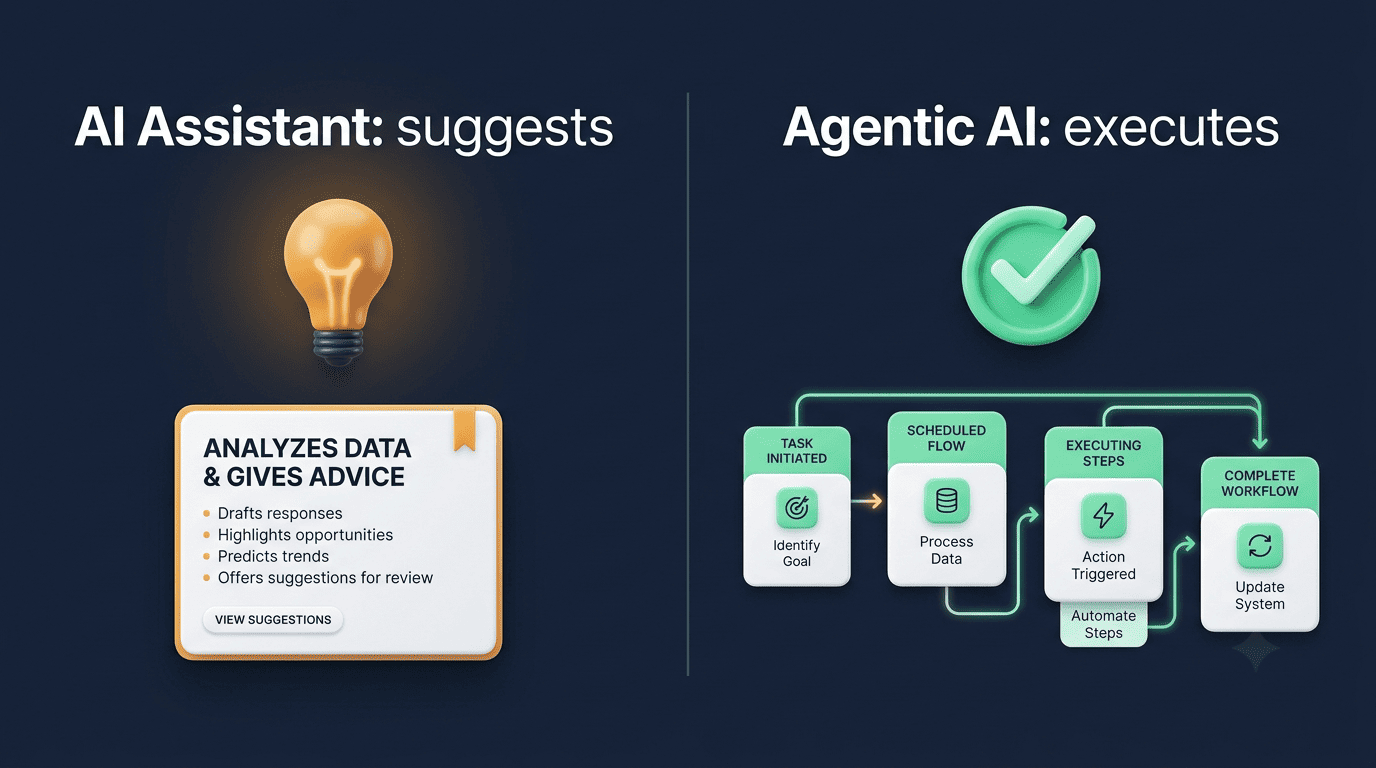
The bigger shift going into 2026 is from AI assistants that suggest — “here’s a caption idea” — to agentic AI that executes without a human clicking approve on every step. Sprout Social’s Trellis and monday.com’s AI agents both queue and act on tasks autonomously, from flagging a spike in negative mentions to drafting a response. Underneath most listening features sits the same core tech: natural language processing (NLP) and sentiment analysis, which is what lets a tool tell the difference between a sarcastic complaint and genuine praise in a comment thread.
Best AI Tools for Content Creation and Copywriting
Content generation is the most crowded category, and pricing varies more than feature lists suggest. Jasper, ContentStudio, Predis.ai, and Buffer’s built-in AI Assistant approach the same problem — turning a brief into a publish-ready post — from different angles.
| Tool | Best for | Starting price |
|---|---|---|
| Jasper | Brand-voice consistency across teams | ~$59/month (billed annually) |
| ContentStudio | High-volume content plus AI word credits | $19/month billed annually (25,000 AI words) |
| Predis.ai | Turning existing assets into new posts | $19/month (1,300 credits) |
| Buffer AI Assistant | Rewriting one post per network | Included with Buffer plans |
Jasper — brand voice at scale
Jasper runs more than 90 marketing applications built around one core problem: keeping brand voice consistent when five people are writing captions for the same account. Its Brand Voice and Brand IQ features feed a company’s tone, terminology, and past campaigns into every generation, so output doesn’t drift the way generic AI writing does. Jasper’s Pro plan starts around $59/month billed annually ($69/month billed monthly), with a 7-day free trial listed on its official pricing page, and it’s the strongest pick for teams where a single off-brand post is a real cost — enterprise accounts, regulated industries, agencies managing multiple client voices.
Predis.ai & ContentStudio — posts from what you already have
Turn existing assets into new posts. Predis.ai generates captions, carousels, and short videos directly from a product URL or existing content, on a Core plan priced at $19/month for 1,300 credits — useful for teams that have raw material but not time to write around it.
Stretch a content calendar without a writer. ContentStudio’s Standard plan runs $19/month billed annually ($29/month billed monthly) and bundles 25,000 AI words a month with content discovery and multi-platform scheduling, so idea generation and publishing sit in one tool instead of two subscriptions.
Adapt one post for every network fast. Buffer’s AI Assistant rewrites and resizes a single draft for each platform’s tone and character limits, folded into Buffer’s existing scheduling plans rather than sold separately.

Best AI Tools for Visuals: Images and Video
Visual production used to require a designer and a video editor on staff. Canva Magic Studio, Synthesia, VEED, and Predis.ai now cover image generation and AI video inside tools most teams already touch daily.
Canva Magic Studio for on-brand graphics
Canva Magic Studio bundles Magic Write and Magic Resize, letting a team generate a graphic once and auto-adapt it to Instagram, LinkedIn, and Story dimensions without manually rebuilding the layout three times. Canva Pro runs about $15/month ($10/month billed annually), per Canva’s own pricing page, and is usually the fastest way to keep a consistent visual style across a whole social calendar, since brand kits and templates carry across every resize.
Synthesia & VEED for AI video
Synthesia generates video with AI avatars reading a script — useful for explainer content, product walkthroughs, and paid social ads without booking a camera crew. VEED handles AI-assisted video editing: subtitles, cuts, and format conversion from a single upload. Both matter because digital video ad spend is projected at $140.18 billion, and AI video tools let smaller teams compete in a format that used to require a production budget.
Best AI Tools for Scheduling and Publishing
Scheduling is the most mature category among AI tools for marketers — most tools do the basics well, so the real differentiator is price-per-channel and whether AI features are baked in or bolted on.
| Tool | Starting price | Notable AI feature |
|---|---|---|
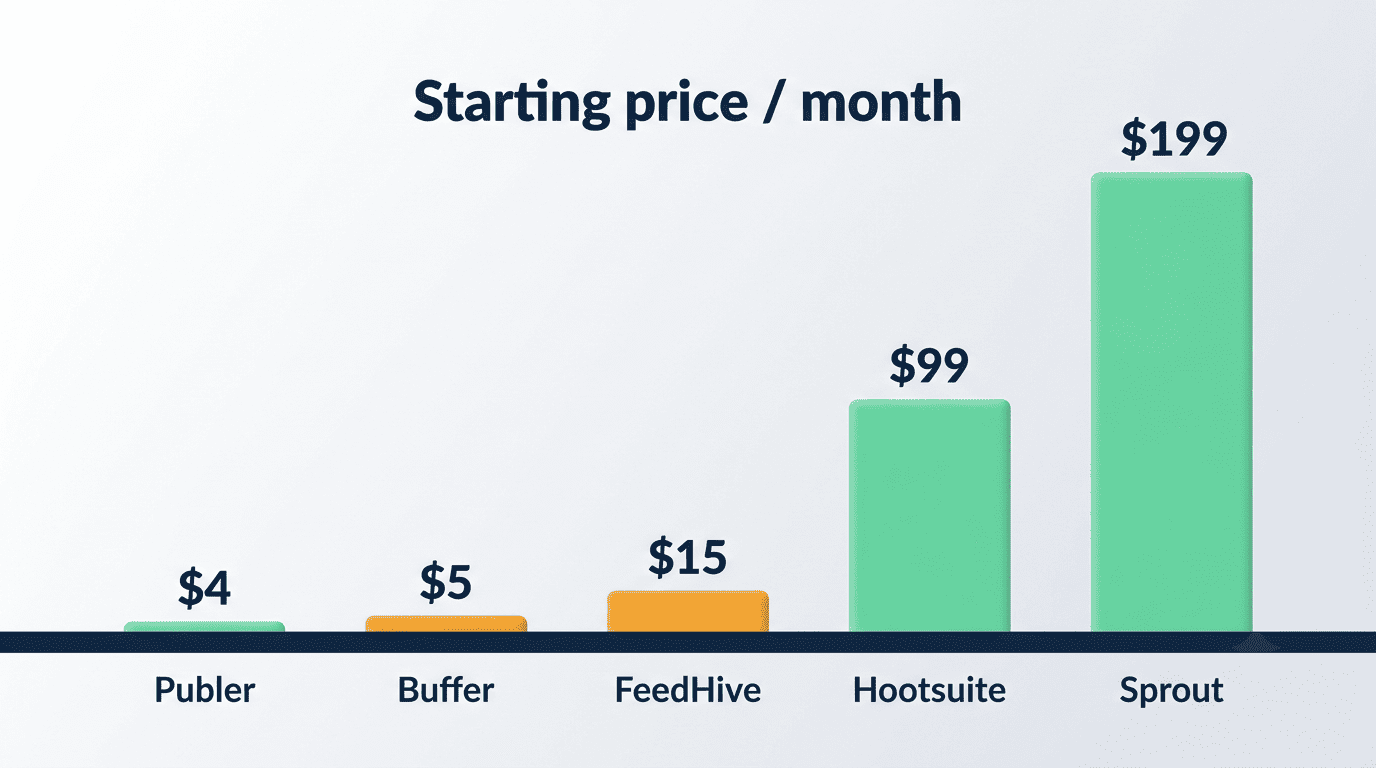
| Buffer | $5/month per channel (free up to 3 channels) | AI Assistant for rewrites |
| Publer | $4/month per channel billed annually ($5/month billed monthly) | Bulk AI content upload |
| FeedHive | $15/month (Creator plan) | Engagement Prediction score (0–100) |
| Hootsuite | $99/user/month (Standard) | OwlyWriter AI, Blue Silk AI |
Buffer & Publer — the affordable schedulers
Buffer’s Essentials plan starts at $5/month per channel, with a free tier covering up to three channels — Buffer reports over 230,000 monthly active users on its public metrics dashboard, and its AI Assistant rewrites drafts per platform inside the same scheduling workflow. Publer undercuts it slightly at $4/month per channel billed annually ($5/month billed monthly) and adds bulk content upload, making it a common pick for agencies scheduling dozens of client accounts at once. For small teams, this pair usually delivers the best AI-to-price ratio in the category.
FeedHive & Hootsuite — prediction and enterprise
FeedHive’s standout feature is Engagement Prediction, a 0–100 score trained on more than 1.5 million posts that flags a caption likely to underperform before it goes live; its Creator plan starts at $15/month. Hootsuite sits toward the enterprise end of the market — Standard plans start at $99 per user per month, with Professional running $199 per user per month — and pairs approval workflows with OwlyWriter AI for caption generation and Blue Silk AI for broader content assistance across large, multi-brand accounts.
Best AI Tools for Social Listening and Analytics
Social listening is where AI does work a human team physically can’t scale to: reading millions of mentions a day and scoring sentiment in real time. Sprout Social, Brand24, Brandwatch, Talkwalker, and Socialinsider each cover a different slice of that job.
“Companies that gain a real-time understanding of customer sentiment can act faster than competitors relying on quarterly surveys.”— Forrester Consulting, Total Economic Impact study commissioned by Sprout Social
Sprout Social & Brandwatch — enterprise listening
Sprout Social’s listening engine processes an average of 600 million messages a day (with the broader platform handling over a billion), and its AI Assist layers sentiment mining on top so teams can catch a PR problem in hours instead of days. A Forrester Total Economic Impact study commissioned by Sprout found a 268% ROI over three years for adopting the platform, whose Standard plan starts at $199 per seat. Brandwatch and Talkwalker cover a similar enterprise need — Talkwalker alone monitors more than 150 million sources across 30-plus channels, which matters for global brands tracking mentions outside their home market.
Brand24 & Socialinsider — affordable monitoring and benchmarking
Brand24 offers real-time mention monitoring with built-in sentiment analysis at a fraction of enterprise pricing, making it the default pick for smaller teams that need alerts on brand mentions without a $199-per-seat commitment. Socialinsider focuses on competitive analytics across six platforms (Facebook, Instagram, X, LinkedIn, YouTube, TikTok) with a 14-day trial, and recently launched an MCP (Model Context Protocol) integration that feeds live social data directly into AI assistants — a small but telling sign of where agentic AI for social media is heading next.
Best AI Tools for Paid Social Advertising
Paid social is where AI optimization has the clearest dollar payoff, because budget decisions that used to take a media buyer hours now run continuously in the background. Global social ad spend is projected at $276.7 billion in 2025, which is exactly why shaving even a few points off cost-per-acquisition matters at scale.
Madgicx & Meta Advantage+ for performance
Madgicx runs an AI Ad Generator alongside automated budget allocation aimed at ROAS and CPA targets; pricing scales with ad spend, and it offers a 7-day trial. It’s built for accounts spending well into six and seven figures a month on Meta ads — a scale where even small efficiency gains compound fast. Meta Advantage+ is the native alternative: Meta’s own AI layer for automated targeting and budget shifts inside Ads Manager, with no separate subscription. Between the two, most teams start with Advantage+ for simplicity and add a third-party tool like Madgicx once they need finer control over the metrics that actually decide ad budget:
- ROAS (return on ad spend) — revenue generated per dollar spent
- CPA (cost per acquisition) — cost to earn one conversion or sale
- CTR (click-through rate) — share of viewers who click the ad
- MER (marketing efficiency ratio) — total revenue divided by total ad spend across channels
How to Choose the Right AI Social Media Tool
Buying decisions here go wrong the same way almost every time: a team picks the tool with the longest feature list instead of the one that fixes their actual bottleneck. Socialinsider’s own comparison criteria are a reasonable checklist:
- Depth of AI (not just the presence of a chatbot)
- Cross-platform coverage
- Ease of use
- Reporting quality
- Price relative to team size
Match the tool to the job, not the hype
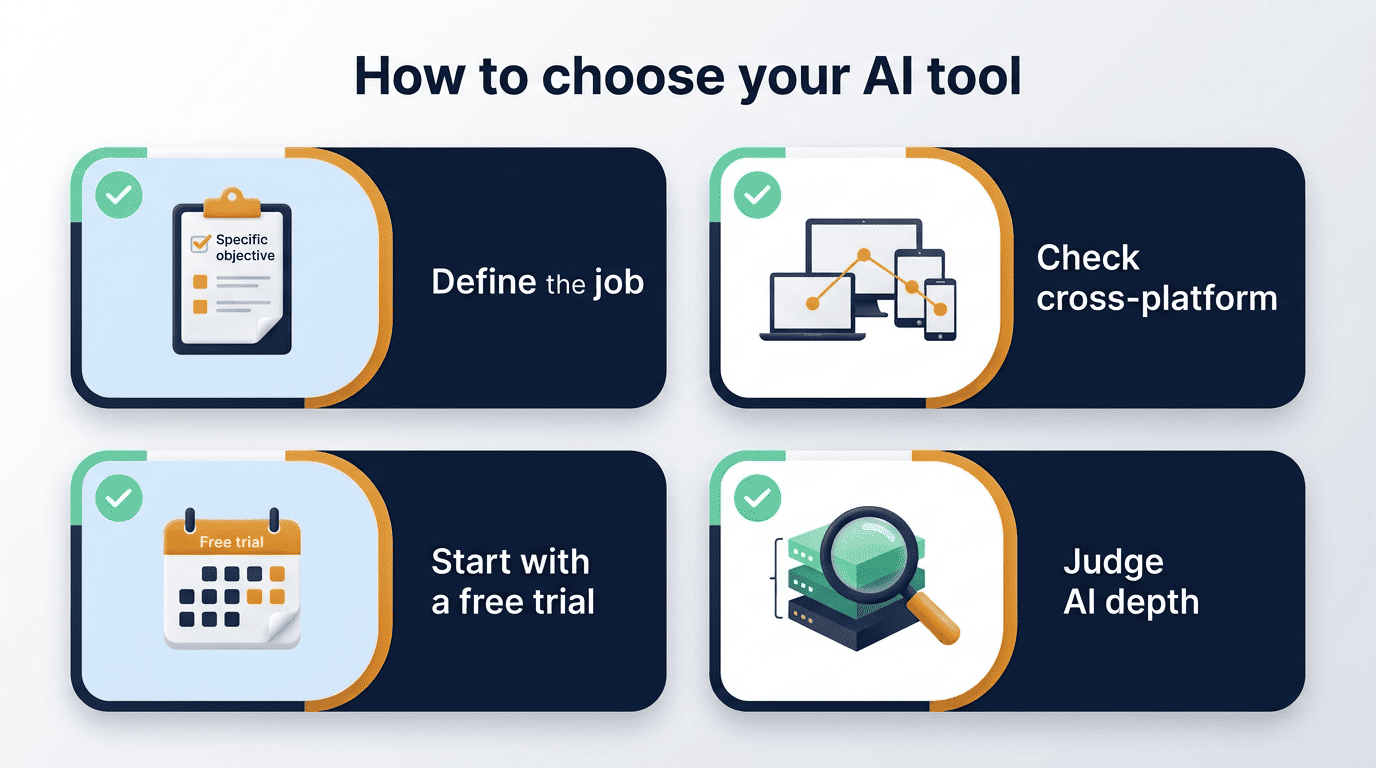
- Identify your real bottleneck — content volume, visuals, scheduling chaos, listening blind spots, or ad spend efficiency.
- Check cross-platform coverage before committing — a tool that only handles Instagram is a dead end for most teams.
- Start on a free tier or trial before paying annually; nearly every tool above offers one.
- Judge AI depth, not feature-list length — a tool with three sharp AI features beats one with fifteen shallow ones.
- Match budget to team size: small teams do well with Buffer, Canva Magic Studio, and Brand24 together; enterprise teams lean toward Sprout Social and Jasper for consistency and scale.
That last pairing — Buffer, Canva, Brand24 versus Sprout Social and Jasper — is really the fastest way to shortlist AI-powered marketing tools without testing all twelve products in this guide. Pick your bottleneck first, then pick the tool built for it.
Related AI marketing guides
Building a full stack? Explore AI content marketing tools and AI email marketing tools to round out your marketing workflow.
Frequently Asked Questions
What is the best AI tool for social media marketing?
There is no single best tool — it depends on the job. Jasper leads for copywriting and brand voice, Buffer leads for affordable scheduling, Sprout Social or Brand24 lead for social listening, and Canva Magic Studio leads for visuals.
Can AI create social media content?
Yes. AI tools write captions, generate images (Canva Magic Studio), produce avatar-led video (Synthesia), and adapt a single post for each network’s format. Surveys put AI content adoption among marketers between roughly 70% and over 90%.
Is there a free AI tool for social media?
Yes. Buffer is free for up to three channels, and Canva offers a free tier alongside its paid Pro plan. Most other tools on this list offer a 7 to 14-day trial before requiring payment.
How do marketers use AI for social media?
Across five jobs: generating content, producing visuals, scheduling and publishing, social listening and analytics, and optimizing paid ad spend. The 2026 shift is toward agentic AI that executes these tasks with less manual approval.
Are AI social media tools worth it?
For teams posting regularly, yes — they save measurable hours on repetitive work. A Forrester study on Sprout Social found a 268% ROI over three years. Start with one tool aimed at your biggest bottleneck rather than adopting a full stack at once.