
Ask an AI tool to “write a blog post about our new pricing” and you will get something competent, structureless and unusable. Ask a freelance copywriter the same thing and they will ask you six questions before opening a document. The difference is not intelligence. It is that one of them is allowed to ask and the other one isn’t, so it guesses — and the guess is always the statistical middle of everything ever written on the subject.
That is the whole mechanic behind most disappointment with AI writing. Not that the model is weak, but that it was handed a topic and asked for a task.
A topic is not a task
“Write me a post” specifies a format and a subject. It leaves unsaid the reader, the purpose, the length, the tone, the things you must mention, the things you must not, and what the post is supposed to make someone do. A human writer fills those gaps by asking. A model fills them by averaging.
The averaging is why AI output has a recognisable texture. Balanced structure, three points per section, a hedged conclusion, an opening line that restates the title. That is not the model’s personality; it is what you get when nobody specified anything, so it produced the least wrong version of everything at once.
The fix is not a longer prompt. It is a prompt that removes decisions rather than adding words. Every constraint you supply is a branch the model no longer has to guess its way down.
What a working brief contains
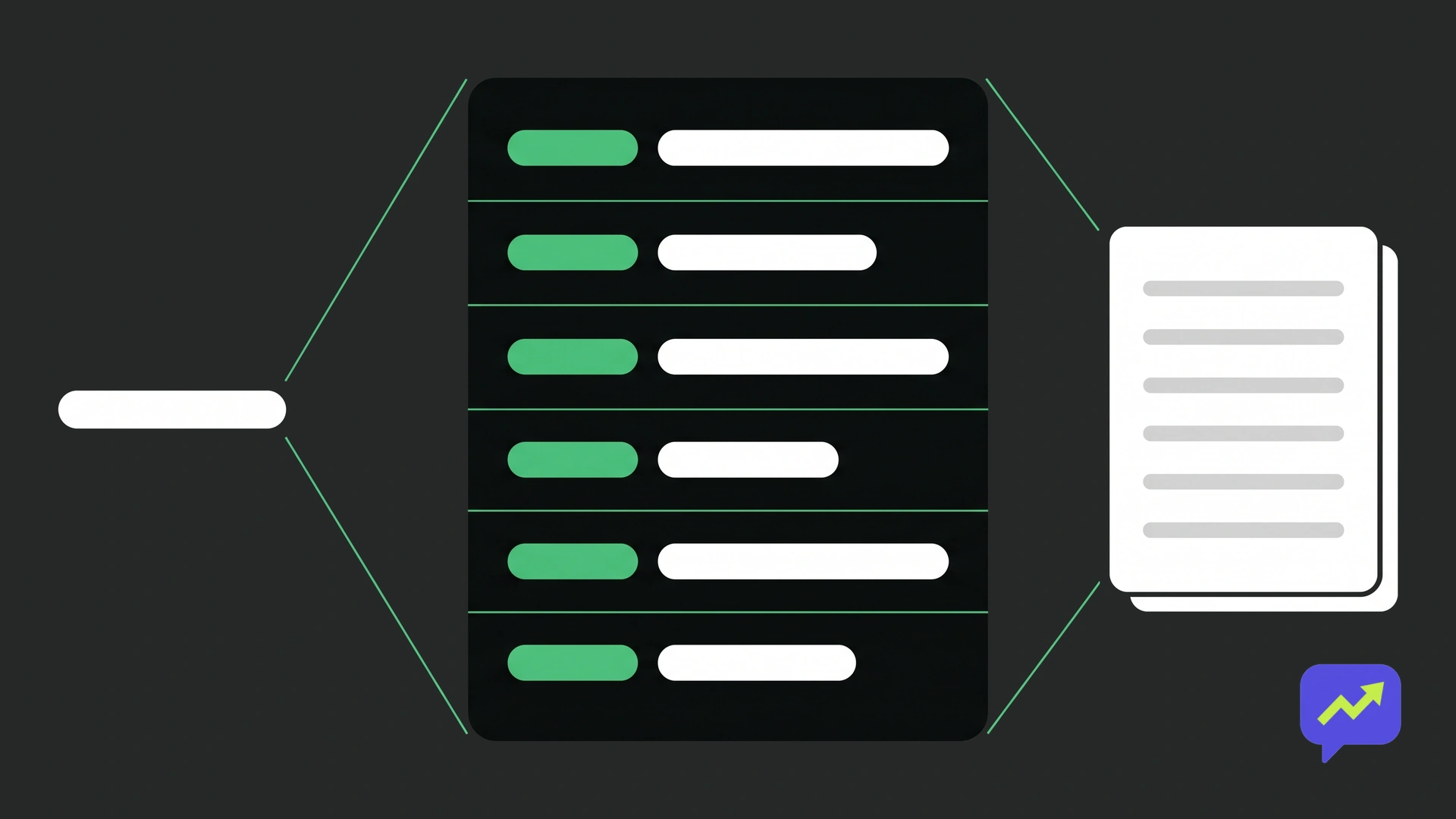
Five things, and they are the same five a decent agency brief has had for thirty years.
Who reads it and what they already know. “Small business owners who have never used an AI tool” and “marketing leads already running three of them” produce completely different drafts of the same article. This is the single highest-leverage line in any prompt, and it is the one most often missing.
What it is for. A piece that exists to rank is structured differently from one that exists to be forwarded internally, which is different again from one that exists to close a deal that has stalled. State the job. “Informative” is not a job.
The raw material. Facts, numbers, the actual feature names, what the customer said on the call, the objection you keep hearing. Without these the model has nothing but the topic, and it will write around the absence gracefully — which is exactly the failure mode, because a graceful absence reads like content.
Form and limits. Length, sections, whether it takes a position or presents options, whether first person is allowed, what must appear and what is off-limits. Claims you can’t make for legal reasons belong here, explicitly.
Voice, by example rather than adjective. “Professional but friendly” means nothing; every model already thinks it is writing professionally but friendly. Paste two paragraphs you liked and say “match this rhythm and vocabulary.” Examples carry information adjectives cannot.
Five lines, maybe eight. It takes ninety seconds and it is the difference between a draft you rewrite and a draft you edit.
Give it what you already have
The best input is usually something that already exists and that you were not thinking of as input.
The sales call transcript where the customer explained their problem in their own words. The support thread that keeps recurring. The one landing page that outperformed the others. Three competitor pages you want to be positioned against. Your last four newsletters, if the job is to sound like your last four newsletters.
Pasting real material does two things at once. It supplies specifics the model could not have invented, and it anchors the voice to yours instead of to the average. Teams that get consistently good output are rarely writing cleverer instructions — they are feeding better material in. The guides on AI tools for content marketing and AI tools for email marketing both assume this, because in practice it is what separates the teams for whom these tools work from the teams for whom they don’t.
Treat the good prompt as an asset
Most people write prompts the way they write search queries: fresh every time, thrown away after. That is the real waste. A prompt that produced a good product description is a template, and the second use costs nothing.
Keep them in a plain document with the variable parts marked, as in: audience, product, the three features, the objection to pre-empt, the call to action. When someone new does the task, they fill the slots rather than reinventing the brief, and the output stays consistent across people — which is usually the actual business problem, not raw quality.
Two habits make the library worth keeping. Note what you had to fix in the output, then put the fix into the prompt so you don’t fix it twice. And when something comes out well, save the prompt immediately, because you will not be able to reconstruct it in a week.
Iterating beats front-loading, too. A short brief, one generation, then “shorter, cut the intro, more concrete on the second point” gets you there faster than a thousand-word prompt written blind. You are steering, not programming.
What a brief cannot fix
Three honest limits, because prompt advice usually oversells.
A brief cannot supply judgement. Whether the claim is defensible, whether the angle is right for this market this quarter, whether the tone will land with people who already dislike you — the model has no way to know and will sound equally confident either way. That decision stays yours, which is roughly the argument in AI marketing tools vs marketers.
A brief cannot make a weak tool strong. If the underlying model is small or the tool wraps it in a rigid template, a better prompt raises the floor a little and leaves the ceiling where it was.
And a brief cannot verify anything. Specificity makes output more confident, not more true. Every number, name, date and claim still has to be checked by a person, and the better the prompt, the more plausible the wrong ones look.
A reasonable place to start
Take one task you do repeatedly. Write the five lines — reader, purpose, material, form, voice sample. Run it. Fix what is wrong in the prompt rather than in the output, run it again, and save the version that works.
One prompt, done properly, usually changes the opinion people have of the whole category. Not because the tool improved, but because it finally got told what the job was.
If you would rather skip the drafting, the assistant on the front page takes the same kind of brief conversationally — describe the audience, the purpose and the constraints in one message and it will ask for what’s missing rather than guess. Working with the assistant covers how to phrase it, and the short version is the same as everything above: tell it the job, not the topic.